Archive for 2007
By: The Scribe on November, 2007
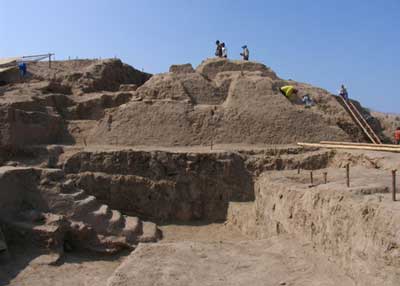
It was around 4,000 years ago that an advanced civilization lived in the northern coastal desert of Peru, pre-dating the Inca and building massive, complex structures to their deities. Who were the people of this advanced civilization? Currently, the question of who they were remains unanswered – however, they left behind a large, colorful temple for future historians to admire.
The temple is massive, and was constructed in an unusual way for the people of ancient Peru – whoever built the temple created their own mud bricks to use for building the structure, instead of using carved stones or rocks as most Peruvian civilizations did. The ability to create mud bricks from local sediment is considered an advanced function of society – so whoever constructed this temple knew exactly what they were doing.
What the temple was used for isn’t too difficult to surmise – on the front of the building there was a staircase leading up to an altar. The kind of altar here, and the location of the altar on the building, point directly to its use for making offerings to deities and engaging in fire worship.
The fire temple had several of its walls painted as well, which makes these murals possibly the oldest wall paintings known in the Western Hemisphere. One of the red and white murals shows a deer being hunted and trapped in a net, which makes this fire temple a place of very different iconographic and architectural tradition than what was previously known to be the case in the area.
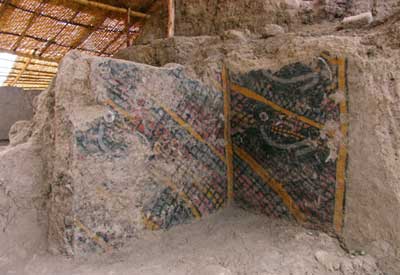
With a size of approximately 2,500 square meters – nearly half the size of a football field – the Peruvian fire temple is close to the modern city of Lima, about 755 kilometers away. Adding to the curiosity factor of the building is a skeleton of a monkey and a piece of turquoise, as well as the way which the dirt was burying the building – it appeared as though once the people finished using this building, they deliberately buried it! The monkey skeleton and turquoise, found near ritual areas of the temple, were probably ceremonial offerings to commemorate the building.
Want to read more?


Tomorrow: More Ancient Standard

By: The Scribe on November, 2007

In 2007, Archaeology magazine reported that a team digging at the ancient Egyptian city of Hierakonpolis – about 400 miles south of Cairo – had discovered something in the site’s ‘elite cemetery’ that validated the city’s role in the development of the Egyptian state around the time of the First Dynasty.
The name Hierakonpolis translates as “the city of the falcon”, and what was found there was the earliest depiction of a falcon ever discovered – something which meant a lot to the Egyptian people throughout the Dynastic period. However, before that in the Predynastic period, the falcon was one of the clearest surviving examples of a symbolic image or motif that would carry on from those early centuries into the Dynastic period.
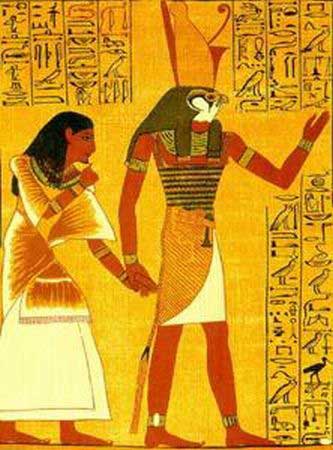
Once the Dynastic period arrived in Egypt, the image of a falcon symbolized the king or Pharaoh, who was supposed to represent the embodiment of the god Horus – the falcon-headed deity of Egyptian religion. Horus was the patron god of kingship, and therefore the discovery of this falcon-shaped figurine at Hierakonpolis actually pushes back the association of falcons with royalty to nearly half a millennium earlier than previously thought.
The team that found the figurine was headed by archaeologist Renee Friedman, and the piece was actually located inside of one of the city’s structures that surrounded the largest known early Predynastic tomb in Egypt. Unique finds weren’t unusual for this tomb – previously, the tomb yielded an ivory carving of several hippos as well as a buried African elephant – suggesting that whoever was buried in the tomb was extremely important, and likely a very powerful ruler. With the discovery of a falcon carving, due to its association with royalty, there can be little doubt that it was a very important king who owned this tomb.
The falcon figurine is about 2.4 inches large, measuring from the tip to its tail, and appears to have been the work of a very skilled craftsman – and while the profile and shape of the figurine are similar to later falcon representations, the major difference is that the wings for this piece were carved free from the body and left attached only by a small, singular point. The falcon was carved out of a piece of malachite-veined basalt, which is what gives it the multi-colored appearance.
The city of Hierakonpolis may be familiar to some as the home of the legendary king Narmer, who Egyptologists used to credit as the founding father of Egypt – he was cited as the man who single-handedly unified the entire country and established the First Dynasty around 3100 BC. However, the discovery of a falcon figurine here in association with a royal burial – and according to the excavators, a number of other ‘falcon wings’ were found in the same area, though they had originally been mistaken for ears from human sculptures – presents some fairly compelling evidence for the leading role of Hierakonpolis in the birth of the Egyptian state, which apparently took much longer to develop than anyone had previously suspected.
Want to read more?


Tomorrow: Wall Paintings at an Ancient Peruvian Fire Temple
By: The Scribe on November, 2007

According to the production notes at the end of the book, the Cairo Codex of the Prophets – also referred to as the Codex Cairensis or the Codex Prophetarum Cairensis – was composed by a man named Moses ben Asher from Tiberias, “at the end of the year 827, after the destruction of the second temple.” This would place the manuscript’s creation at 895 AD.
The Codex is important for one single reason: it is believed to be the oldest known surviving Hebrew manuscript which contains the entire text of the Nevi’im, or prophets, from the Old Testament. Notably, the Codex contains only those books which belong to the Old Testament prophets according to Jewish tradition and terminology – including Isaiah, Ezekiel, Jeremiah, and most minor prophets with the exception of Daniel; also Judges, Joshua, Kings and Samuel are included as they were considered to be the ‘earlier prophets’.
In addition, there are 13 ‘carpet pages’ – these were an early Medieval version of illuminated manuscript decoration which was often found at the beginning of New Testament collections.
According to tradition, Moses ben Asher put together the Codex Cairensis with punctuation included, though according to some studies done on the manuscript, it turns out that it may actually have been written by a completely different person – for that matter, arguments against its authorship have actually resulted in doubts from the scholarly community as to its authenticity in terms of when it was written!
As for finding the Codex, the pieces of text were located inside of an old synagogue’s Gezina room, which functioned as a kind of storage space where faulty or worn out manuscripts could be placed and later disposed of formally, in order to not profane any sacred documents. Fortunately, as time passed, the Geniza room was walled over and forgotten, sealing the manuscript fragments safely for over a thousand years.
Want to read more?


Tomorrow: Horus of Hierakonpolis
By: The Scribe on November, 2007

At an ancient settlement in Puerto Rico, archaeologists have unearthed bodies, rock art, and large structures that may have belonged the to the Taino people – a Pre-Columbian indigenous culture which is thought to have migrated to the Caribbean from either South America or Mexico many centuries ago.
The Taino people were among the first cultures to run into Europeans when they arrived in the Americas, and thus it appears that this settlement probably dates from between 600 and 1500 AD. In fact, the site may even be the largest Taino settlement in the entire Caribbean, making it the most significant settlement these people ever developed – for starters, the site appears to have evidence of not only Taino occupation during the height of the culture, but also an occupation dating far back to a pre-Taino period.
The site on Puerto Rico is extremely well preserved, and while archaeologists knew that the area contained indigenous artifacts, the scope and significance of the site only became clear once construction began on a modern dam nearby. It was during the monitoring process of this work that a fascinating discovery was made: nearby to the dam site, there was a large plaza that covered approximately 40 meters by 50 meters of ground.
The plaza appears to be what the Taino called a ‘batey’, which was a rectangular area that the people built their settlements around – then they would use the plaza for things like ball games and ceremonial rituals. A number of the stones in the plaza also have ancient petroglyphs etched into them, which at the very least indicates the important functionality of the space. All evidence currently points to this being the largest known ancient ‘batey’ in the entire Caribbean as well. A number of the petroglyphs on the plaza’s stones depict a male figure with attached frog legs, which may hold a key to determining the origins of the Taino.
In and around the settlement, there have also been several burials located where some of the bodies were interred in rather unique positions – their legs were bent at the knees, and the bodies placed face down in the grave. This burial position hasn’t been seen at any other indigenous sites in the Caribbean, and it may also give indications as to from where the Taino originated.
Want to read more?


Tomorrow: More Ancient Standard
Previous page | Next page
