By: The Scribe on April, 2007
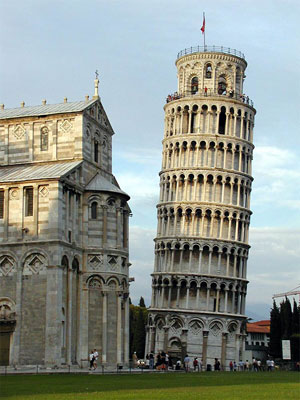 The Leaning Tower of Pisa, or Torre pendente di Pisa in Italian, is a freestanding bell tower (campanile) of the cathedral of the Italian city of Pisa. The tower stands behind the Cathedral as the third structure in Pisa’s Campo dei Miracoli (“Field of Miracles”).
The tower’s construction began in 1173, and it was intended to stand vertically as the Cathedral’s bell tower. However, before the structure was even finished, the poorly laid foundation causing the tower to begin leaning during construction. The tower itself was built in three successive stages, the entire process taking around 174 years. The bottom floor was built using white marble, and construction was led by Bonanno Pisano, a twelfth-century artist. The first floor is surrounded by pillars with classical-style capitals and arches.
Inside the tower, there is a winding staircase which leads to the top floor, a bell terrace. Before their removal due to weight concerns in 1990, the tower was home to seven bells dating from the 17th to 19th century. It was from this upper terrace that Italian scientist Galileo Galilei is said to have dropped two cannonballs of differing weights, in order to demonstrate that their descending speed was independent of their mass.
On the lowest side, the tower is 55.86m high, and 56.70m on this highest side. The spiral staircase inside has 294 steps.
Want to read more?

Tomorrow: Something that is hard to pronounce, but interesting anyway.

By: The Scribe on April, 2007

“I bind down Aristaichmos the smith before those below and Pyrrhias the smith and his work and their souls and Sosias of Lamia and his work and soul and what they say and what they do…”
– lead curse tablet from Athens, 4th C BC; found in the walls of a house
A curse tablet , or ‘binding spell’, was a certain kind of curse used to ask the gods to bring harm to someone; generally this would be a person against whom one was competing – in a law court, at an athletic event, or even a rival lover. For example, a curse tablet written by a court prosecutor might ask the gods to bind the wits and tongue of his opponent, to prevent him from mounting a strong defense. In athletic competitions, a curse might ask that a various parts of a rival’s body be ‘bound’ – his arms, shoulders, eyes, or whatever part that would be most important for the competition – so that the rival would not perform effectively.
In the classical world, curse tablets were usually very thin sheets of lead upon which the text of the curse could be inscribed. Then, the entire sheet was rolled up or folded, and pierced with an iron nail. These tablets were often buried in the ground, either inside of a grave or a well, or in a relevant area – if the curse was against a rival lover, the tablet could be buried next to his house, or in the arena for a curse against a fellow athlete. The simplest texts consisted of just the person’s name, though much longer and more elaborate curses were not uncommon.
The second type of binding spell was slightly more bizarre: lead ‘voodoo dolls’ were physically bound, stabbed with nails, and placed inside lead boxes. These types of curses are considered ‘sympathetic’, in the sense that the victim was persuaded by the curse to become like the lead material: “…as this lead is valueless and cold, so let him and his deeds be cold and valueless…”*.
It is likely that curse tablets were also written on perishable materials such as wood or papyrus, however these have long disappeared from the archaeological record. What is very interesting is that this seemed to be a common practice in Greek and Roman society – indeed, there was a very real fear of curses in the ancient world. In Selinous, a 5th C BC city in Sicily, the city government set up a column in the town square, explaining how a person could rid themselves of an avenging spirit brought on by a curse!
*Christopher A. Faraone, “Aeschylus’ umnos desmios (Eum. 306) and Attic Judicial Curse Tablets”,
The Journal of Hellenic Studies 105 (1985), pp. 150-154.
Want to read more?

Tomorrow: Who wants Pisa?
By: The Scribe on April, 2007
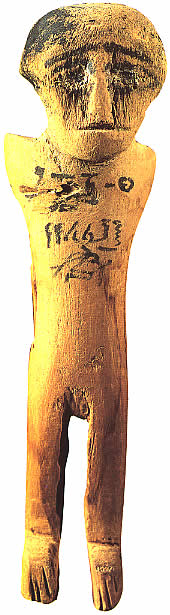 Execration texts were a type of Egyptian hieratic text, believed to possess magical qualities. Egyptian priests or state magicians would write the names of individuals or groups that were considered hostile or dangerous to Egypt on small statues or jars; these were then broken and buried, symbolizing the destruction of the enemy.
Pieces of these magical texts have been found near a number of tombs in Thebes, Saqqara, and the Nubian fortresses. One text near a fortress was written on a skull, which suggests that it may have belonged to an enemy – the capture, decapitation, and composition of the text on his skull was probably an attempt at magically transferring the fate of the one individual onto the entire enemy group.
Although execration texts were popular throughout Egyptian history, they were most frequently used during the New Kingdom. The example shown here is dated to the First Intermediate Period, and is currently on display at the Louvre. The statue’s missing arms were likely a deliberate attempt to magically ensure that the cursed enemy could not cause any harm.
Want to read more?

Tomorrow: Do do that Voodoo!
By: The Scribe on April, 2007
 Although the origins of werewolves are traditionally attributed to the Middle Ages, tales of humans transforming into wolves have been documented from as early as 440 BC.
Greek mythology contains the story of a king named Lycaon, who was transformed into a wolf after serving a bowl of human flesh to Zeus; another version of the story tells of Lycaon’s transformation into a wolf as punishment for sacrificing a child to Zeus. This tale resulted in the belief that from that point on, one man was turned into a wolf at the annual sacrifice to Zeus, but would be able to regain his human form after abstaining from human flesh for ten years.
In one of his writings, a Roman scholar named Pliny the Elder quoted the Greek author Euanthes, who told the story of a man who was selected by lot to swim across a lake, where he hung his clothing on a tree, and – upon swimming across the lake – was transformed into a wolf for nine years. The man was only able to swim back across the lake and regain human form if he did not attack any humans during those nine years.
The Greek historian Herodotus, in his work Histories, discussed a tribe to the north-east of Scythia called the Neuri, who were annually transformed into wolves for several days.
The Latin poet Virgil took a different approach, and in one of his writings described a sorcerer who was able to ingest a certain combination of lethal herbs that would turn himself into a werewolf; in the year 60 A.D., the Roman playwright Gaius Petronius composed his novel Satyricon, in which a character recites a story about a man who transforms into a wolf during a full moon.
Want to read more?

Tomorrow: Egyptian defense magic
