Archive for 2007
By: The Scribe on April, 2007
 In 2003, archaeologists working in the Pacific islands of Vanuatu located the region’s oldest cemetery, which contained a rather surprising sight: although the bodies had been carefully placed in their graves 3,000 years ago… the skulls of 70 people were missing!
The earliest known inhabitants of the Pacific islands were the Lapita people, and though the burials in this cemetery date to their occupation of the islands, many of the bodies and heads found here belonged to individuals from completely different corners of the Pacific. Although the Lapita people settled on Vanuatu and in Polynesia, the various groups of Lapita differed genetically. The reasons for this have yet to be explained by archaeologists, and it is hoped that the cemetery on Vanuatu may provide valuable genetic evidence for the settlement patterns of people in the ancient Pacific.
As for the missing skulls, it is thought that the bodies were originally buried with their skulls attached, but were retrieved after the flesh had decayed. Many ancient cultures are known to have kept ancestral skulls in shrines or high-traffic areas of the home, in order to pay honor to the dead.
Oddly enough, one burial of an elderly man had three skulls placed on his chest – it is possible that they were his descendants, though perhaps not surprisingly, the man himself was headless.
Want to read more?


Tomorrow: Early Werewolf mythology

By: The Scribe on April, 2007
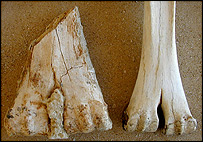 About twice the size of a modern camel, and standing about shoulder height of most African elephants, archaeologists unearthed the fossilized bones of a 100,000 year old camel from Syria. Standing about 12 feet high, human remains from the same period as the camel were also discovered nearby, suggesting that perhaps this camel was killed by a human.
 The camel remains were discovered by a joint Syrian-Swiss team at al-Hemel in the Palmyra region, about 250 km from the Syrian capital of Damascus.
It is unknown whether the human remains, which consist of a tooth and an arm fragment, may be attributed to a homo sapiens (a modern human) or a Neanderthal. The site of this discovery was next to a spring, where it is thought that the human may have stalked and killed the camel.
Archaeologists are still baffled as to where this species of camel originated, and why it disappeared, since this size of camel has not been attested to in any other country.
Want to read more?


Tomorrow: Get a-“head” in migration.
By: The Scribe on April, 2007
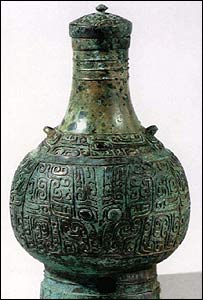 An ancient formula for brewing wine has been discovered by archaeologists on 9,000-year-old pottery fragments from Henan province, among the ruins of the ancient city Jiahu.
Tests by American scientists found traces of rice, honey, grapes, and other various herbs, a composition remarkably similar to modern rice and grape wines, confirming that the inhabitants of Jiahu had the technology and knowledge to brew wine 9,000 years ago.
Previously, the earliest known evidence for wine-making dated from around 7,400 years ago in Iran; this discovery now brings China to the forefront of early brewing traditions.
Archaeo-chemist Patrick McGovern led the team of researchers who discovered the wine formula; because he did not know exactly how the wine was made, aside from its ingredients, the formula was given to a brewery in Delaware that attempted to imitate the ancient wine – they now sell this product to the general public under the name “Chateau Jiahu”.
McGovern’s team also studied the residue of some 3,000-year-old wines, preserved inside sealed bronze vessels from the same region
Want to read more?


Tomorrow: Giant camels?
By: The Scribe on April, 2007
 Although it may look like just a piece of sculpture, this dog’s head is actually a drinking cup from 5th century Athens. It is thought to have been created by the Brygos Painter, who has over 200 pots and cups attributed to him in museums worldwide.
This drinking cup, or ‘rhyton’, was made with very close attention to detail: tiny whiskers are incised on the dog’s snout, and visible tendons bulge on the throat. The red band around the neck represents a collar, and on the rim of the cup is a painted scene from Greek mythology of pygmies battling cranes.
The rhyton probably belonged to a high-class Greek citizen, since dogs in ancient Greece were mostly kept as hunting companions. The cup itself would have likely been used to drink wine at men’s drinking parties, called ‘symposiums’. When the cup was empty, it would be turned upside-down to show the dog’s head, displaying the craftsmanship and allowing the vessel to have two functions: for practical use as a cup, and for aesthetic use as a piece of art.
Want to read more?


Tomorrow: 9000 year old wine, was that a good year?
Previous page | Next page
