By: The Scribe on April, 2007
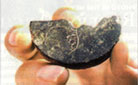 Among the ruins of an ancient city in the Chinese province of Henan, archaeologists have discovered 4,500 year old pottery fragments containing inscriptions. These fragments are believed to be pieces of a spinning wheel; the image shown here is a piece of a black ceramic spinning wheel about 4.7 cm wide.
The inscription here resembles the shape of a symbol from Taoist philosophy, suggesting that this city may have been one of the birthplaces of Chinese civilization. Previously, the earliest known Chinese writing came from the 3,000 year old royal tombs of the Shang Dynasty. These characters were inscribed on bones and tortoise shells, and were used by religious leaders for divination.
Want to read more?


Tomorrow: Drinking from a… dog?

By: The Scribe on April, 2007

Underwater archaeologists at Loch Tay in Perthshire, Scotland, have discovered a well-preserved, drowned forest, dating to the Neolithic period around 5000 years ago. Archaeologists have identified fallen elm and oak trees, as well as upright oak trunks surrounded by organic material, including moss and hazelnuts. Many of the trees have been preserved in odd shapes, creating a “spooky landscape protruding from the loch bed”.
The radiocarbon dates for these trees fall between 3200 and 2500 BC; scientists hope that samples of the preserved wood and pollen will be able to assist them in tree-ring dating and climate-change studies.
Want to read more?


Tomorrow: The beginnings of literacy in China
By: The Scribe on April, 2007
 Before the heyday of the compass, the Vikings of Scandinavia traversed the seas in their Norse ships, relying on sundials to help navigate the open waters… but what did they do on cloudy days?
Researchers in the past have suggested that Vikings may have used rock crystals known as ‘sunstones’ to assist in navigation during overcast conditions. Although there is no official archaeological evidence to support this theory, in early 2007 a team sailing the Arctic Ocean aboard the Swedish icebreaker Oden found that sunstones could indeed “light the way” in foggy or cloudy conditions.
Although the concept of a ‘sunstone’ is known only from an ancient Viking legend, the theory on its usefulness for navigation was first put forth by Danish archaeologist Thorkild Ramskou in 1966.
These rock crystals work as natural polarizing filters, changing brightness and color as they detect the angle of sunlight. Using these changes, Vikings could have determined which angle the light was coming from, and thus determined the sun’s orientation.
Since there is no concrete evidence of these sunstones, the matter is still under dispute. However, with recent studies confirming the reliability of sunstones for navigation in overcast conditions, it does not seem implausible that the Vikings could have made use of such technology for nautical purposes.
Want to read more?


Tomorrow: Swimming in…..the forest?
By: The Scribe on April, 2007
 If there is any doubt as to the accuracy of the old adage “man’s best friend”, one simply need consider the fact that ancient dog burials have been documented on every major landmass in the world, with the exception of Antarctica.
In fact, the earliest documented case of domestication occurs in a grave from Germany, dating to around 12,000 BC – and not only did the grave contain a dog, but also two human skeletons, suggesting that even at this early date, domesticated dogs had become an integral part of everyday human life and companionship.
The earliest evidence for domesticated dogs in North America dates to about 8,000 BC. In Illinois, four dog burials were excavated at the Koster site: each dog was lain on its side in a shallow grave, and the graves themselves were located in an area of the village where residents buried the remains of adults and children.
The >Bluegrass site in Warrick County, Indiana, contained quite a number of dog burials from the Middle Archaic period (ca. 6,000-3,500 BC). These dogs were small and light, similar in build to a mid-range terrier.
Although there are innumerable examples of dog burials from across the globe, it is interesting to note that most dogs are buried near or with human remains, and the majority of the time seem to have been buried with great care – placed carefully on their side or in a curling position, as if they were simply asleep, a testimony to the close companionship shared between man and dog during life.
Want to read more?


Tomorrow: The mysteries of Viking navigation
