By: The Scribe on April, 2007
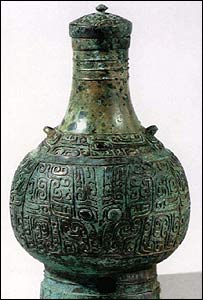 An ancient formula for brewing wine has been discovered by archaeologists on 9,000-year-old pottery fragments from Henan province, among the ruins of the ancient city Jiahu.
Tests by American scientists found traces of rice, honey, grapes, and other various herbs, a composition remarkably similar to modern rice and grape wines, confirming that the inhabitants of Jiahu had the technology and knowledge to brew wine 9,000 years ago.
Previously, the earliest known evidence for wine-making dated from around 7,400 years ago in Iran; this discovery now brings China to the forefront of early brewing traditions.
Archaeo-chemist Patrick McGovern led the team of researchers who discovered the wine formula; because he did not know exactly how the wine was made, aside from its ingredients, the formula was given to a brewery in Delaware that attempted to imitate the ancient wine – they now sell this product to the general public under the name “Chateau Jiahu”.
McGovern’s team also studied the residue of some 3,000-year-old wines, preserved inside sealed bronze vessels from the same region
Want to read more?

Tomorrow: Giant camels?

By: The Scribe on April, 2007
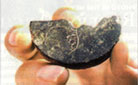 Among the ruins of an ancient city in the Chinese province of Henan, archaeologists have discovered 4,500 year old pottery fragments containing inscriptions. These fragments are believed to be pieces of a spinning wheel; the image shown here is a piece of a black ceramic spinning wheel about 4.7 cm wide.
The inscription here resembles the shape of a symbol from Taoist philosophy, suggesting that this city may have been one of the birthplaces of Chinese civilization. Previously, the earliest known Chinese writing came from the 3,000 year old royal tombs of the Shang Dynasty. These characters were inscribed on bones and tortoise shells, and were used by religious leaders for divination.
Want to read more?


Tomorrow: Drinking from a… dog?
By: The Scribe on March, 2007

Built in the 12th century for
King Suryavarman II of the
Khmer Empire, Angkor Wat was a Cambodian temple to the Hindu god Vishnu, and has been described as a rival to the splendor of the ancient temples in Greece and Rome. It was designed to reflect the home of the gods in Hindu mythology, containing a moat to represent the ‘cosmic ocean’, and an outer wall 3.6 km long that surrounds the temple complex.
In the middle of the temple, there is a ‘quincunx’ of towers – that is, five towers to represent the five mountains of the gods. There was extensive bas-relief decoration in three temple galleries and around the walls, though much of it has now been cut away and sold on the black antiquities market, making the interpretation of the scenes much more complex.The remaining panels we have depict various scenes from Hindu mythology, such as those from the Sanskrit epic poems Ramayana and the Mahabharata. Other panels show battle scenes, historical scenes of the king, as well as images of the 37 heavens and 32 hells of Hindu mythology. One of the most impressive features of the complex is also a causeway, leading to the enormous entrance, along which are balustrades in the shape of giant serpents. These were likely intended to be representations of the divine nature of fertility.
Want to read more?


Tomorrow: The Babylonian Goat King
