Archive for the ‘Ancient Asia’ Category
By: The Scribe on July, 2007
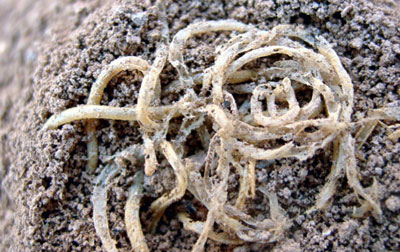
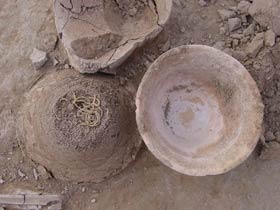
While it is often taken for granted that Italy holds the title of Pasta Inventor, a discovery of the world’s oldest noodles has turned this belief on its head. Underneath 10 feet of sediment, at a small archaeological site near the Yellow River in northwestern China, the dried remains of thin, yellow noodles about 50cm long were found inside of a clay pot.
It seems that the noodles were inside of someone’s bowl for dinner, when a sudden catastrophe caused the settlement’s inhabitants to try and flee the area. This theory comes from the discovery of a number of skeletons at the site that were strewn about in various positions as though the people were attempting to escape the area.
The most likely explanation is a catastrophic earthquake that caused severe flooding from the river – enveloping the settlement and in the process, inverting someone’s bowl of noodles. This unique and unlikely combination of factors caused a vacuum space between the ground soil and the bottom of the bowl, preserving the noodles from decomposition!
The noodles are very similar in appearance to La-Mian noodles, a traditional Chinese dish made by repeatedly pulling and stretching the noodle dough by hand. It is a very labor-intensive process, suggesting that the community that made these ancient noodles already had a well-established sense of cuisine and cooking practices. Scientific analysis of the noodles revealed that they were made from millet grains, unlike modern noodles that are made using wheat flour.
Prior to the discovery, the earliest known record of noodles comes from a book written during the East Han Dynasty in China, dating somewhere between 25 and 220 AD – however, there has always been some debate as to whether the Chinese, Arabs or Italians invented the food first. With the discovery of these noodles, all signs point to China as the first noodle production powerhouse.
Want to read more?


Tomorrow: Coatless Neanderthals

By: The Scribe on June, 2007

Archaeologists working in the Shimonogo ruins of Western Japan’s Moriyama, about 200 miles from Tokyo, uncovered what is believed to be a piece of the world’s oldest melon! Radiocarbon analysis dated the melon to around 2,100 years old, making it the oldest piece of melon found with fruit on the rind – a very rare find.
It is thought that the melon flesh was preserved due to where the fruit was located in the ruins, which was about one meter underground in a moisture-rich soil that seems to have acted like a vacuum-sealing. Since it was not exposed to the air, the fruit was kept in a soil layer unsupportive to the micro-organisms that typically break down organic remains.
The piece of ancient fruit is about 10.5 centimeters long, and the rind has been discolored to a deep brown. Chemical analysis has also identified the species of melon as native to Africa, suggesting that it probably made its way to Japan via India and Middle Eastern traders. Previous to this find, the oldest melon piece in the world was a found in China and dated to around the 4th century AD.
The Shimonogo settlement was surrounded by moats during Japan’s Yayoi period, which spanned around 300 BC – 300 AD. This could account for the kind of soil in the area and the prime conditions for preservation. While this find is rather limited in its practical use, it can certainly help to shed some light on the potential trade relationships between Japan and the Middle East during this period in history – as well as provide a bit of insight into the dining habits of the settlement’s people.
Want to read more?

Tomorrow: Sardinia’s Nuraghe (gehzunteit?)
By: The Scribe on June, 2007
 For several centuries in China, a minority group called the Bo people had a very peculiar burial practice: hanging the coffins of the dead on the side of a cliff. Some can be found in cliff caves, others sit on projections in the rock, while the most perplexing coffins are suspended on stakes or boards that protrude from the rock face. Their height along the cliff faces vary anywhere from 10 to 130 meters high, leaving experts baffled as to how some of the coffins were lifted and placed that high!
Although there are at least five sites in China where the hanging coffins have been found, as well as one site in the Philippines, the majority of the coffins were placed around Matangba and Sumawan, where there are over 100 visible coffins.
While not much is known about the Bo people, their hanging coffins have certainly shed some light on their rather different way of doing things: the coffins are unpainted and undecorated except for a few studs, and in many cases the coffins were hewn from one single piece of wood. Inside several of the coffins, archaeologists found blue and white porcelain bowls from the Ming Dynasty, a simple iron knife, and several iron spear points. Some coffins contained small remnants of linen and silk, but nothing that could help historians to determine status, rank, or social organization of these people.

There are rumors that several cliff paintings have been identified near the coffins, however due to concerns over their preservation, they have not yet been discussed or published in reports for the general public. Presumably, these will eventually reveal some small details about the Bo people, perhaps shedding some light on why they felt the need to hang their dead in coffins along the faces of cliffs.
The practice of ‘burying’ the dead along cliffs disappeared at the same time as the mysterious Bo people, leaving many questions behind about why they did this, and why they disappeared seemingly without warning. Their entire culture seems to have disappeared, leaving only a slew of hanging coffins along the Chinese landscape
Want to read more?

Tomorrow: Roman goddess of…sewers?
By: The Scribe on June, 2007

As famous as the Mongol Empire was during the height of its power, if there was one thing the Mongol military knew how to do, it was killing. Everyone, that is. Founded in 1206 AD by Genghis Khan, the Mongol Empire would eventually encompass over 12 million square miles of territory, with a population of over 100 million people, making it the second largest land empire in history.
The key to Mongolian success was easy enough: if a population refused to surrender, they would simply wipe out the entire population, raze their cities, and take over the land. Naturally, word gets around quickly when entire cities get destroyed, so for those cities who were wise enough to choose self-preservation over heroics and submit to Mongol rule, they were spared and treated rather leniently.
The Mongol military was divided into ten-men squads called arban, while a regiment was ten thousand men, called a tumen. Although they weren’t exactly subtle about their art of war, the Mongols knew what to do when it came to a siege, and did it without mercy. They were very skilled in the construction of trebuchets from trees in the surrounding vicinity, and could build great numbers of them very quickly.
What the Mongols tended to do was to destroy a city’s advancing land army with horse archers, lancers, and smoke engineers. The engineers would be responsible for constructing siege engines before and during a battle, using them during the battle to distract enemy forces and provide cover through elements such as smoke and fire, and then repair them in case of a siege against the city. After all, once a city’s entire land army was destroyed, there was no way to defend themselves other than holing up behind their walls.
Unfortunately, for populations that attempt to outlast a siege, food becomes scarce and the close quarters of vast numbers of people becomes a prime breeding ground for plague. And once a plague begins, it generally isn’t wise to keep the bodies of deceased plague victims inside the city walls to rot and spread more disease. Typically, the corpses would either be burnt or thrown over the walls – so the Mongols, seeing this as an opportunity to make the most of their surroundings, had a great fondness for collecting the corpses of these plague victims, setting them inside their trebuchets, and hurling the bodies back into the city.
In some cases, if the siege had just begun but the Mongols had access to plagued corpses from a previous town or the surrounding area, they would launch the diseased bodies into the city to try and start a plague on their own. The city would become infested, and thus easily captured once the disease had spread. Macabre, yes, but highly effective!
Want to read more?


Tomorrow: Hanging coffins!
Previous page | Next page
