Archive for the ‘Ancient Asia’ Category
By: The Scribe on September, 2007

Although the majority of fossil finds that come down to modern day tend to suggest that everything from insects to trees to animals were larger in ancient times, a recent discovery from a cave in China has reversed the trend, finding that – two or three million years ago – panda bears were much, much smaller than their descendants now living in Chinese forests.
It was inside a limestone cave in the Guangxi Zhuang Autonomous Region that a team of scientists discovered a small bear skull, embedded right into the wall. Further examination of the skull revealed that it did, in fact, belong to an ancient panda bear that lived in the forests of southern China. Judging by the skull’s features, these ancestral pandas were almost exactly the same in appearance as the Giant pandas who live today – except that they were about half the size!
Essentially, these miniature giant pandas were pygmy versions of the bears living today, even to the point of having already adapted a diet of bamboo – this can be identified by looking at the jaws and teeth of the skull, which actually needed to be stronger and more durable than a typical bear’s jaw, in order to grind down such tough plant material.
In addition, modern Giant pandas have what is known as a “false thumb”, which actually helps them to strip the leaves off stalks of bamboo, and scientists are hopeful that more fossils of the pygmy pandas will turn up in the near future, in order to determine whether these ancient creatures also had this mutation.
Oddly enough, about a million years ago, Giant pandas actually became bigger than the enormous sizes of today’s pandas, which seems to suggest that panda evolution has shifted back and forth in response to the bears’ environment and food supply. However, it is still strange that such a tiny panda lived several million years ago, since he would have shared the forest with other such creatures as the 4-meter-tall Stegodon, an ancestor of mammoths and later on, elephants. Also living at the same time was an ape called the Gigantopithecus, who was actually two or three times bigger than today’s gorillas.
It certainly would have been an interesting sight to see these diminutive panda bears walking amidst the giants…!
Want to read more?


Tomorrow: Those Knotty Incans

By: The Scribe on August, 2007

In the late 1300s, the inhabitants of what is now South Korea developed a new burial process for their loved ones – a method that, instead of allowing the body to decay naturally, in many cases resulted in an excellent natural mummification! Unfortunately, preservation of the bodies was the one thing these people did not want.
The people of the area believed that the body should decompose naturally, without the interference of outside factors – this included things like worms or other animals and parasites. In an attempt to maintain this natural decomposition, the body of the deceased would be laid on ice for 3 to 30 days during the mourning period, and then placed inside a double pine coffin, surrounded by his or her clothes. The coffin would then be covered in a mixture of lime soil.
However, instead of decaying, the bodies ended up being preserved – and, since no one expected that there might be mummies in South Korea, the mummies were not discovered until the summer of 2007, when construction work in the country began to increase, forcing the relocation of many cemeteries. In some cases, the burial practice led to an even better preservation of DNA than ancient Egyptian artificial mummification processes, since the absence of chemicals in the preservation process took less of a toll on the body!
The 500-year-old body of a child actually still holds samples of the virus responsible for hepatitis B, which could help modern scientists to determine if the virus has changed or mutated over the past 500 years – perhaps leading toward clues for treating the modern-day strain.
The most intriguing burial was that of a nobleman who seemed to have fallen out of favor with the area’s rulers. Inside the grave was a poem written by his wife, dating to around the same time as Shakespeare would have been writing his famous play, Romeo and Juliet – and oddly enough, the poem bears a striking resemblance what is found within the bard’s famous tragedy:
You always said we would be living together, to die in the same day
However, why did you go to the heaven alone?
Why did you go alone leaving me and our child behind?
…
I cannot live without you anymore.
I hope I could be with you.
Please let me go with you.
My love to you, it is unforgettable in this world,
And my sorrow, it is without end.
…
According to local records, the man was 32-years-old, and was the second son of the clan’s senior member, who was actually involved in a revolt against the country’s emperor. Although the lines from this poem were only a part of the entire document, a total of 13 letters, as well as slippers that had been woven from his wife’s hair, were found inside the coffin with his mummified body. It is unknown what happened to his wife after her husband’s death, however it is likely that she would have fled the area to avoid retribution from the Emperor and for the sake of her child.
Want to read more?


Tomorrow: So much for diversity…
By: The Scribe on August, 2007
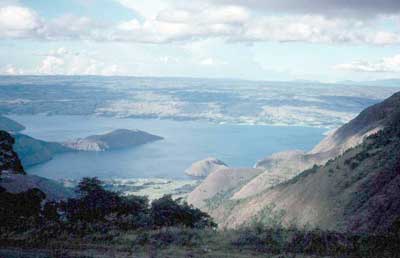
About 76,000 years ago, the volcano Toba – located in what is now Indonesia – erupted to create the largest and most devastating volcanic event of the past 2 million years. Almost 3,000 cubic kilometers of magma was spewed out, while sulfuric acid rained over the earth as far away as Greenland. The world became subject to a volcanic winter, and what followed was one of the most severe ice ages in documented history.
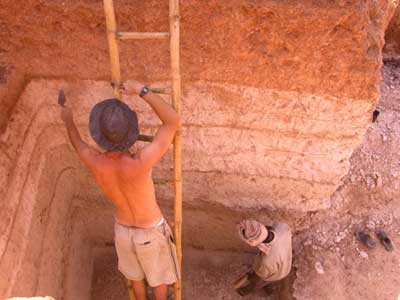
Over in India, the land was showered with 15 centimeters of volcanic ash, which can be seen today, working as a distinct age marker in the earth’s stratigraphy. And yet, contrary to all logic, archaeologists have unearthed assemblages of stone tools both above and below the ash deposit in India’s Jwalapuram Valley.
The tools look remarkably similar to those made by humans in Africa, which indicates that these tools were also human-formed – and yet, if humans were still in India after the depositing of ash (an incredible feat it itself), they would have had an extremely difficult time trying to survive. After all, the sheer magnitude of the eruption suspended both volcanic gas and sulfuric acid in the earth’s atmosphere for years, causing warm sunlight to be redirected away from Earth – and plunging the world into several centuries of temperatures that were at least 3-5 degrees C lower than normal after the event.
Along with the tools, a large piece of ochre was found – something that early humans used to create art, make symbols, cure animal hides, and sometimes help attach stone tool pieces to a wooden shaft. There are some archaeologists who are skeptical at the tool findings, believing that these did not come from what has been termed “modern” humans, but instead should possibly be attributed to an earlier hominid species – such as the European Neanderthals – which eventually died out.
While it is thought that humans had begun to develop the ability to make complex tools and form cohesive and sophisticated social behavior at this time, the notion that these early humans survived such a global catastrophe certainly paints a picture of the resilience and determined human instinct for survival that shows through human actions even today.
Want to read more?


Tomorrow: Sea Spider Fossil
By: The Scribe on July, 2007
 In July 2007, workers in central Vietnam found five jars filled with thousands of Chinese coins, dating back to China’s Tang Dynasty. The coins are extremely rare and highly valuable, since they were circulated primarily in Vietnam for trade during the peak of the Tang Dynasty.
Each of the coins has four Chinese characters on one side, with the opposing side left blank. Although there were a number of different kinds of coins minted during the Tang Dynasty, private casting of any coins was punishable by death, and the circulation of the various coin types was strictly monitored. Coinage alloy was highly regulated, and only certain towns were given the privilege of constructing their own minting forge.
In 718 AD, minting regulations were reaffirmed, as secret mints and forgeries began to pop up across the various townships. In 737 AD, the first official minister responsible for casting was appointed, and by the late 740s, the central government regulated that only skilled artisans could be employed to design new coinage, instead of the previously conscripted peasants.
In 808 and again in 817, a ban was applied to the hoarding of coinage, due to the sudden deterioration of value. No person, regardless of rank, was able to hold more than 5,000 strings of currency, and any balance that exceeded this amount had to be spent on the purchase of goods within two months – simply for the sake of getting more money back in circulation.
The Tang Dynasty, in general, was a period of progress and stability, so it is not unusual to see a series of coins minted specifically for trade in another location. It is likely that these were minted to ensure the value of the coinage was maintained while in another country, and it is hoped that further studies on these newfound coins will help determine exactly which part of the Tang Dynasty the coins were from – specifically before or after the ban on currency hoarding.
Want to read more?

Tomorrow: A story about Regicide
Previous page | Next page
