Archive for the ‘Ancient Central America’ Category
By: The Scribe on September, 2007

It appears that the ancient inhabitants of a cave in southern Mexico weren’t very good about cleaning up after themselves in the kitchen – in 1966, an archaeologist working around the Mexican town of Mitla stumbled across the remains of about 122 ancient chili peppers! The pepper pieces were distributed between two caves, and represent at least ten different varieties of chili peppers.
Analysis of the chili pepper remains showed that some of the ancient fruits had actually been kept fresh while others were dried and stored – much in the same way a person could purchase dried chili pepper flakes in a grocery store today. The likely explanation is that the inhabitants here would chop up the fresh peppers and use them for salsa or as a meal garnish, while the dried pieces were probably thrown into a sauce or stew.
If this sounds oddly familiar, it’s because it is – further investigation into the caves also revealed the ancient remains of beans, corns, and squash, all staples in the diet of modern Mexicans today! However, the evidence certainly seems to lean toward the idea that today’s Mexicans borrowed their culinary traditions from the ancient Zapotec Indians, who lived in the area between 600 and 1521 AD.
But why would anyone store their food supplies in a cave, and was anyone actually cooking there? Considering the known locations of Zapotec settlements in the area, the caves were probably used by Zapotec hunters as night shelters – if they’d gone too far from their village on a hunt to be able to return safely in the same day, they could stay in the cave, eat a meal, and rest before continuing their journey in the morning.

There also may have been crop fields nearby, which would have made the caves very handy for temporary crop storage, before transporting them to the village. Since the caves are about 1,900 meters above sea level, this would have made them ideal for crop storage – at this elevation, the harvested crops wouldn’t be threatened by flooding.
Although it remains to be seen whether the kinds of chili peppers found here are similar to modern species or if they are remnants of now-extinct varieties, the fact remains that the culinary heritage of southern Mexico has a much richer and distinct history than anyone had previously suspected.
Want to read more?


Tomorrow: Stinky global warming!

By: The Scribe on September, 2007

It has typically been thought that before Columbus discovered the “New World”, there were only a few, large civilizations on the mainland in Central America, with the Caribbean islands holding just a few, isolated villages on their own. The people who lived there were thought to have been fairly primitive, only holding basic interactions with other villages on neighboring islands, if they bothered to even talk to their neighbors at all.
And yet, it now appears that this view may be entirely unfounded. In the eastern Caribbean, 2900 kilometers away from Central America’s jade mines, several 1500-year-old jade axe blades have popped up on the island of Antigua. Needless to say, this is a highly unusual find, particularly if the theory of primitive societies on the Caribbean islands is true… after all, the jade from these Mayan mines in distant Guatemala couldn’t have just appeared on the island by chance! Someone had to bring it there – to that “isolated, primitive village” that typically eschewed outside contact.
It turns out that making assumptions about ancient history isn’t always the best course of action… since it now appears that there was an entirely different social atmosphere in the ancient Caribbean than previously assumed. Instead, it appears more likely that the Amazon and Orinoco Rivers in South America originally served as early trade highways up to the coast of Central American Guatemala. From there, a culture known as the Saladoid people created their own artifacts out of pottery and jade… and eventually moved to the Caribbean islands around 500 BC, becoming the “primitive people” of previous thought.
Since there are no jade deposits anywhere in the eastern Caribbean, it has always been a bit of a puzzle to figure out where jade artifacts from these islands could have come from – not to mention that most archaeologists believed that the Saladoid people only traveled to neighboring, small islands on short canoe trips here and there.

With the appearance of the jade axe blades on Antigua however, these formerly held beliefs are changing. For the first time, a source of jade and the jade from an artifact have been matched – which is how archaeologists have been able to determine that these blades came from a Mayan mine in Guatemala, and the blades themselves can be dated to around 250-500 AD.
What does that mean? Essentially, it means that these “primitive” Saladoid people who were living in the Caribbean were actually maintaining some long-distance trade with people on the mainland of Central America. Their civilization was complex enough to have trade relationships with mainland tribes – and, if they were trading with people from one area, why couldn’t they have traveled up to the Yucatan Peninsula, stopping at various points along the way?
If this theory is correct – and by all means, it should be, since the jade has been confirmed to have come from Central America – these Caribbean island-dwellers must have had some seriously refined seafaring capabilities, probably traveling in large, dugout canoes.
Scientists have also noted that some Saladoid artifacts contain some pieces of turquoise, namely of a type that doesn’t occur naturally in any known area of the Caribbean. So where is the closest known source? Turns out it may have come all the way from Chile… and that those “primitive, ancient Caribbean people” weren’t so primitive and isolated after all!
Want to read more?


Tomorrow: A brief history of polo
By: The Scribe on July, 2007
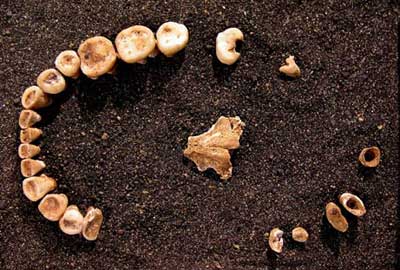
At the oldest known burial site in Mesoamerica, archaeologists discovered a set of skeletal remains that appear to be evidence of the earliest known dental work on this side of the world – which probably caused the patient excruciating pain, and in all likelihood leading to his death.
The teeth from the burial were filed down over an extended period of time, for the purpose of accommodating a second set of teeth – namely, a ceremonial set of ‘dentures’ that would have been inserted into the mouth along the upper jaw. According to forensic analysis done on the entire skeleton’s jaw, the bottom row of teeth was worn down normally, while the upper teeth were intentionally filed to make room for the denture – not to mention that the denture was most probably the palate of a jaguar or wolf.
Although the look of fangs while wearing this set of false teeth certainly would have intensified the man’s ceremonial appearance, in order to fit the animal denture inside his mouth, his own teeth were actually filed down to the nub – resulting in the exposure of his pulp cavities. Unless there was use of a local anesthetic – some herbal solution, perhaps? – this process would have been excruciatingly painful, and the exposed area would have allowed an infection to develop inside one of the exposed cavities, eventually leading toward his death.
The rest of the burial revealed the skull, leg, hand and foot bones of a healthy male who died somewhere between 28 and 32 years old. During his life, he was around five feet and one inch tall, and intriguingly enough, the stress and wear on the bones was surprisingly low. This indicates that the man led a highly sedentary life, regardless of the fact that the burial site was at a high altitude – 8,860 feet – that would have required a significant amount of physical exertion to carry out simple daily routines.
Thus, the denture man must have been a member of the community who was carefully cared for, probably to ensure he could fulfill a ceremonial role. To add fuel to the theory, it should be noted that the burial was actually located under a cliff wall filled with elaborate paintings of humans dancing and hunting. The iconography of the painting is also consistent with other known Mesoamerican artistic symbols.
While the thought of filing down one’s teeth for the purpose of wearing fang dentures is different enough in itself, the burial is important for another reason as well: before this find, there were no other burials or archaeological remains to suggest a social hierarchy in Mesoamerica during this period. Although one burial certainly isn’t enough evidence to draw full conclusions, it is an intriguing insight into a period of Central American history where very little is currently known.
Want to read more?

Tomorrow: A naked lady you’re supposed to look at.
By: The Scribe on July, 2007

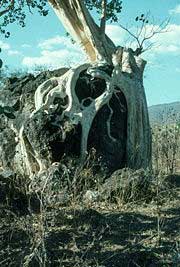
Although stories of paper production tend to center around its beginnings in China or Egypt, another culture developed their own system of paper production and use completely independent of these far-away societies. The Pre-Columbian Mayans made their own paper from the inner bark of fig trees – and in some cases, considered it so precious as to be sacred.
Mayan paper production started with a piece of a fig trees’ inner bark, which would be boiled and then pounded briskly with a stone, ensuring all the fibers were condensed and completely flattened. The resulting piece of bark paper was light brown with corrugated lines, and once it dried, the sheet would actually be somewhat stretchy. In addition, it was also quite delicate, and although this was bad for preservation, it meant that the paper itself was highly valued.
Amatl paper could be carefully folded or rolled up for storage, which resulted in its use as a base for many Mayan and Aztec codices, such as the Huexotinco Codex. It would be painted with a brush and then kept safe by priests or scribes working in a religious context.
 On occasion, amatl paper was used for important communications between various tribes, in particular those from whom a larger tribe was demanding tribute. The paper was also used for keeping track of tribute payments and keeping other trade records, for recording books of government, and for some elite members of society who could afford to use the paper in their everyday writings.
In fact, it is quite likely that the use of amatl paper evolved out of the earlier Mayan bark-clothing called huun, which was made by stripping bark off a tree and beating it into shape. The Mayans would later use the bark to create small, 6 inch by 8 inch pieces of ‘paper’ for books and documents, sometimes left in strips of up to 30 feet long and then folded accordion-style. These ‘screens’ were then bound with pieces of wood or leather, decorated with jewels, and then read either like a traditional book or unrolled to its full length.
Although huun paper continued to be used until around 1000 AD, it never achieved the same prominence and sacred use as amatl. While huun tended to be used for the mundane or for the average person’s daily writings, amatl paper was treasured – a gift from the gods, not to be used lightly.
Want to read more?

Tomorrow: Greek long jump with weights!
Previous page | Next page
