Archive for the ‘Ancient Europe’ Category
By: The Scribe on October, 2007
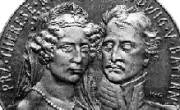 On October 12th, 1810, the Crown Prince Ludwig of Bavaria married Princess Therese of Saxony-Hildburghausen – and to commemorate the event, the citizens of Munich were invited to the front gates of the city to celebrate and join in the festivities. Food, drink, and horse races marked the day as one to be remembered… literally! The wedding celebration was such an enormous success – and the people enjoyed themselves so much – that the decision was made to repeat the festival every year, eventually giving rise to the Oktoberfest tradition.
The second year of Oktoberfest, in 1811, marked the addition of an Agricultural Show, which was created to boost awareness and publicity of Bavarian agriculture. There was little else to do at the early Oktoberfests – other than watch the horse races, look at agriculture, and drink – but in 1818, two swings and a carousel were added! Small beer stands were also becoming more prevalent, meaning that more people could afford to join in the festivities at a lower cost.
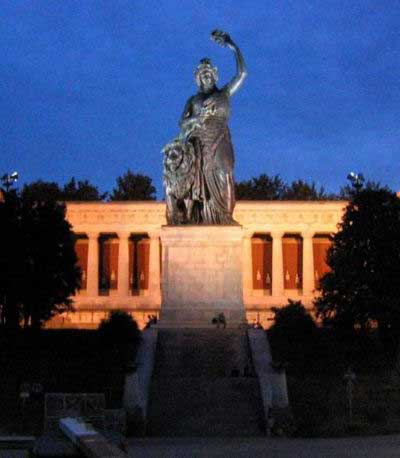
The first Oktoberfest parade took place in 1835, with the intention of honoring the original wedding that inspired the festival. It took awhile to catch on, however, as the concept of an annual parade didn’t really sink in until 1850. It was also in 1850 that the Statue of Bavaria was commissioned to watch over the festivities.
Over the next several decades, Oktoberfest would continue almost uninterrupted, but in 1854 and 1873, the festival was cancelled due to cholera outbreaks. There were also no festivities in 1866 while Bavaria fought in the Austro-Prussian War, and again in 1870 during the Franco-Prussian War. However, by 1880, there were over 400 tents and booths at the Munich festival – and in 1881, Oktoberfest attendees could purchase bratwursts at small food stands!
It was in 1892 that beer was first served in glass mugs, and by 1896, the small beer stands were so numerous that they had to be replaced by beer tents! Breweries began to sponsor the event, and large halls were set up and decorated by more affluent members of the local community. In 1910, Oktoberfest celebrated its 100th anniversary… and will mark its 200th anniversary in just a few years!
Want to read more?


Tomorrow: The Powerful Kugyo of Japan

By: The Scribe on October, 2007
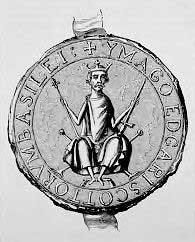 Edgar of Scotland – also known as Etgar mac Mail Choluim, or even Eadgar Margotsson – was the king of Scotland for 20 years, reigning between 1097 and 1107 AD. He originally claimed kingship in 1095, after his half-brother Donnchad mac Mail Choluim was conveniently murdered the year before by a supporter of Edgar’s uncle, Domnall Ban.
Donnchad had been reigning as the Scottish King, but he did not seem to gain much support from the people – and, when he didn’t choose his brother Domnall as heir (since the line of kingship at this time was appointed and not established by blood), family tensions rose to an extreme… namely, Domnall killed Donnchad because he thought it just wasn’t fair!
Unfortunately for Donnchad, Edgar had the presence of mind to seize the throne for himself, and was supported in his claims by two additional brothers – and although another brother named Edmund showed up on scene to support Domnall, the result was three against two, as it were. Edgar also had some limited support from the King of England, William Rufus, and it was in 1097 that Rufus sent Edgar enough military support to defeat Domnall once and for all.
With Domnall and Edmund out of the way, Edgar was able to continue his reign uncontested as the King of Scots. Nothing major happened during this time, and when compared to the rather severe domestic squabbles that occurred to get him in power in the first place, his actual reign was rather quiet and obscure. Actually, that’s not quite true… at one point, he gave a camel (or maybe it was an elephant? …these medieval folk had trouble keeping their exotic animals straight…) to the High King of Ireland. But that’s about it.

At the very least, Edgar contributed to the incredible architecture of Scotland, building a priory in Coldingham around 1098, as well as making contributions to Dunfermline Abbey, where he was buried after his death. He died unmarried and childless, appointing one of his supportive brothers – Alexander – as successor. Fortunately, since the troublemaking brothers were out of the way, the transition was relatively smooth. His will also left an appanage for parts of Lothian and Cumbria – the last good deed of a king whose greatest struggle was a family feud.
If only all Medieval kings had been so lucky!
Want to read more?


Tomorrow: Chachapoyas Cloud Warriors
By: The Scribe on September, 2007
 In a quarry near Peterborough, England, archaeologists uncovered the skeleton of a tiny baby that was born around 3,500 years ago. The discovery came about 2 months after the same team found the remains of a Bronze Age man about 50 meters away, which leads workers to believe that they have located an ancient cemetery in this area.
The baby’s body was found near the center of Bronze Age burial mound at a place called Pode Hole. The discovery came as quite a surprise, because although work has been ongoing at this site for almost 8 years, very little has been revealed about the ancient people who lived in the area. Now, with two bodies found in two months, archaeologists can say that the people who lived here seemed to have created a vibrant agricultural landscape, complete with a communal burial ground.
The skeleton of the baby was found lying inside a small grave that had been lined with birch bark, and several small items had been placed alongside the body – namely, a fully intact pottery vessel with an offering inside of wheat or grain. The bones of the child were very soft and extremely fragile, leading excavators to believe that the baby may have been stillborn, or at the very least, less than a year old at the time of death.
The baby’s body and the artifacts are scheduled to undergo testing, in order to better determine things like the age, diet, and lifestyle of the people who lived in this area during the Bronze Age in England. Since two bodies in total have been uncovered in such a short period of time, it is likely that further excavation will be conducted here with the hope of finding additional burials that may yield more information about the area’s ancient community.
Want to read more?


Tomorrow: More Ancient Standard
By: The Scribe on September, 2007
Warning: Please be advised that the following post contains descriptions of graphic, historical violence, and may not be suitable for some readers.
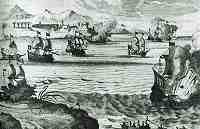 With his newly renewed hatred for the Spanish people, L’Ollonais began to increase the severity of his raids against both Spanish ships and towns along the coast. He forged a partnership with another Caribbean seaman named Michel de Basco, with whom he was able to amass a large army of pirates: a total of 600 men and 8 ships were under the control of these two buccaneers.
In 1667, L’Ollonais and Basco sailed for the Gulf of Venezuela, where they organized a land attack against a town at Lake Maracaibo. Although the town was defended by an “impregnable” fort with sixteen guns, L’Ollonais was able to approach the town from its undefended landward angle, pillaging the city and devastating its resources… however, L’Ollonais realized that many of the townspeople had somehow escaped, taking their most valuable items with them! Enraged, L’Ollonais and his men tracked down the townsfolk, torturing anyone they found until the person would reveal where he or she had hidden their possessions.
Unfortunately for the people, L’Ollonais was an expert at torture, and was able to find out all the information he wanted – he often sliced off portions of a person’s flesh with his sword, burned others alive, or in other cases, simply tied knotted rope around a person’s head until their eyes literally popped out.
 For the next several months, L’Ollonais and his crew continued to rape, pillage, and burn the area around Maracaibo, before eventually moving onto Gibraltar, a city along the southern shore of the lake. Although they were clearly outnumbered, the pirates were able to slaughter all 500 of Gibraltar’s soldiers, holding the city for random. Without mercy, he tortured, raped, and murdered many of the inhabitants – however, when the ransom was finally paid, L’Ollonais refused to leave. Instead, he plundered all of the city’s valuables, enslaved whoever was left, and burned the rest of the place to the ground.
Later that same year, L’Ollonais mounted another expedition, this time with 700 men at his disposal. He planned to make attacks in the Caribbean, first capturing the port of Puerto Cabellos with a follow-up at San Pedro… but before he could make it to San Pedro, the fleet was ambushed by the Spaniards, where L’Ollonais was barely able to escape with his life. The historian who wrote The History of the Buccaneers in America in 1684 explains L’Ollonais’ reaction after capturing some of the attacking Spaniards:
“[L’Ollonais] drew his cutless, and with it cut open the breast of one of those poor Spaniards, and pulling out his heart with his sacrilegious hands, began to bite and gnaw it with his teeth, like a ravenous wolf, saying to the rest: I will serve you all alike, if you show me not another way [to San Pedro].”
The rest of the captured Spaniards showed L’Ollonais how to get to San Pedro, but unfortunately, there was barely any treasure left once they arrived. Angry, many of the surviving members of L’Ollonais’ crew abandoned him, diminishing his army to only one ship. Believing that the small force could still conquer their next stop – Nicaragua – L’Ollonais sailed out… only to be wrecked along the way to the Gulf of Darien. As the men came ashore to find food, they were promptly captured by the Native Americans in the area, who were also known allies of the Spanish. In The History of the Buccaneers, it was written that, in an ironic twist of fate, the natives “tore him in pieces alive, throwing his body limb by limb into the fire, and his ashes into the air.”
L’Ollonais was defeated at last.
Want to read more?


Tomorrow: More Ancient Standard!
Previous page | Next page
