Archive for the ‘Ancient Europe’ Category
By: The Scribe on September, 2007

Jean-David Nau was born sometime around 1635, to a French family presumably of lesser means. He became an indentured servant in Martinique until the early 1650s, and upon the end of his service, he decided to pursue a career that was decidedly more profitable than working for someone else. He wandered around the Caribbean islands for a while, before eventually arriving in St. Domingue and joining in with the area’s Buccaneers.
As much as he enjoyed robbing Spanish ships and killing those aboard, Jean-David showed great proficiency for piracy and it appeared that his talents were being wasted – and so, the buccaneer governor of Tortuga gave Jean-David his own ship to command, which he eagerly accepted. It didn’t take long before he had plundered plenty of ships on his own, slaughtering everyone aboard and becoming one of the first Caribbean pirates to carry out organized land attacks!
Due to his extreme cruelty and merciless treatment of the people on the ships he plundered, Jean-David soon earned the nickname “Francois L’Ollonais”, which literally meant “The Flail of the Spaniards” – however, this reputation also meant that others in the area were able to prepare themselves for his potential attacks. About a year into his career as a pirate, L’Ollonais and his crew were shipwrecked during a bad storm off the Yucatan peninsula, where a group of Spanish soldiers were conveniently waiting to kill anyone who made it to shore.
Although his entire crew was killed the moment any one of them made it to land, L’Ollonais was able to survive by smearing himself with the blood of his dead crewmen, covering himself with their bodies, and pretending to be dead as well. When the soldiers were thoroughly satisfied that all the members of the ship had either drowned or been killed, they left – whereupon L’Ollonais dressed himself in the clothes of a dead Spanish soldier, released some of the Spanish crew’s slaves, and made his way back to Tortuga under the cover of darkness.
Thoroughly enraged against all Spaniards, L’Ollonais and his new crew entered a town, holding all of its members hostage for a ransom that was payable by the town’s Spanish rulers. Understandably upset, the governor of Havana sent a ship to the town to take care of L’Ollonais – however, L’Ollonais was able to strike first, capturing and beheading the entire crew… except for one man. This one man was spared so that he could take a simple message back to Havana from L’Ollonais: “I shall never henceforth give quarter to any Spaniard whatsoever.”
Want to read more?


Tomorrow: Part two!

By: The Scribe on September, 2007

It seems that 55 million years ago, some ancient British bogs had a serious case of indigestion. All across the countryside, bogs were releasing large belches of methane gas, which is a greenhouse gas now known to be more powerful than carbon dioxide – and as a result, the bogs probably contributed on a large scale of a period of global warming.
How can modern wetlands reveal clues about global warming from 55 million years ago? Researchers were able to take sediment cores from deep inside several wetland areas in Kent, and measure the internal chemistry of the ancient layers. The organic compound levels that were produced by bacteria were then used to estimate the ancient levels of methane-consuming microbes that lived in the bogs.
The results of the study showed that there were significantly more methane-eating microbes in Kentish wetlands around 55 million years ago than at any other period, and for this to have happened, there must have been an awful lot of methane emissions coming from the bogs themselves. Based on what is already known about ancient climate in this area, the region probably first began to warm up, causing plant material to decay much more rapidly than usual – which, as a result, triggered the increased methane levels and “burps” from Kent’s wetlands.
If Britain’s other wetlands had a similar response to the ones studied from Kent… well, the result would have been catastrophic, with enormous amounts of methane gas being released into the atmosphere, thus causing a rapid acceleration of the global warming process.
Essentially, burping bogs were one of the main factors for a severe period of global warming… and although scientists hope that there is not a repeat of this ancient catastrophe in the future, it might not hurt to invest in a few extra bottles of Febreze, just in case…
Want to read more?


Tomorrow: Giant Apes.
By: The Scribe on September, 2007
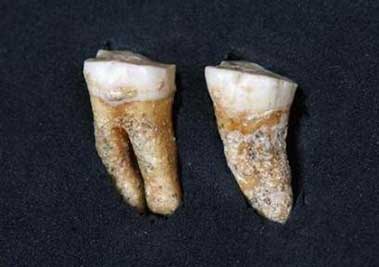
Judging by two Neanderthal molars recently found in the Madrid region, these human ancestors which today’s population often refers to as “cavemen” – meaning this in a derogatory way that suggests they were unclean, unhygienic, and unintelligent – apparently had far better oral hygiene than a good deal of the earth’s modern population…
That’s right – not only do dentists and health professionals implore you to brush twice a day, but it turns out that even Neanderthals knew the value of a clean mouth! These two teeth were perfectly preserved – even though they date to around 63,400 BC – and they show the same amount of wear that might be found on a typical 30-year-old human of today!
The clues that suggest these people took their oral health seriously are several grooves along the top of the teeth, which would have been formed by the passage of a pointed object across the teeth on a regular basis. This confirms that a small stick was used regularly to clean the mouth and teeth.
As predecessors of modern humans, some people may find it unusual to think that a population typically considered ‘less intelligent’ than today’s humans had the forethought to take their oral health into consideration – whereas there are plenty of countries in the world today where using a toothbrush simply isn’t a part of routine health care.
Determining the kind of implement that was used in Palaeolithic times to clean one’s teeth is another matter entirely, since the first “modern” toothbrush wasn’t thought to have been invented until sometime around 1600 AD in China. However, some Muslim populations actually still use something called a ‘miswak’ to clean their teeth, which is essentially a natural toothbrush that is made from the twigs of the Salvadora persica tree!
Want to read more?


Tomorrow: Ancient Egyptian flowers!
By: The Scribe on September, 2007
 In the end, Mary Baker/Wilcox was one of the most successful individuals to ever fool an entire class of people – in this case, the whole British upper crust. While it is absolutely incredible that she was able to maintain the hoax for such a long time, one of the leading theories on how she did it centers around the fact that people believed she could not read or understand English. Once people had that idea in their heads, they spoke openly and freely around her, probably providing her with most of the information she used and needed when eventually having ‘conversations’.
Of course, it would have certainly helped that people showed her books that described exotic locales and languages, thinking that she could not read, which only fueled her highly accurate and believable descriptions of faraway lands. Thus, as Mary continued to store up information from visitors to Knole Park – especially those who wanted to show off their knowledge and refined behaviors to this exotic princess – her own behavior became more convincing as she merely catered to other people’s expectations, unbeknownst to them.
It also probably helped that Mrs. Worrall seemed to desperately want to believe she was a foreign princess, and the presence of Princess Caraboo would have helped to fulfill a common desire and fascination for foreign lands that was prevalent in UK high society during this period. Foreign countries had a romantic appeal, and Mary’s performance hit right at the heart of it.
While it is entirely possible that Mary actually did spend some time with gypsies – after all, she had managed to integrate many of their words and phrases into her own language – it seems that she was simply a natural for improvisational acting, and developed the majority of her character on the spot at Knole Park. The clinching piece of the whole scheme also seems to hang on the appearance of Manuel Eynesso, who was able to ‘translate’ her foreign language – who he was, or why he worked with Mary to secure her position as Princess Caraboo will likely never be known, but his appearance and role in the drama seems to have sprung from her earlier experience when she met the ‘Spanish expert’ on the road to Clifton…
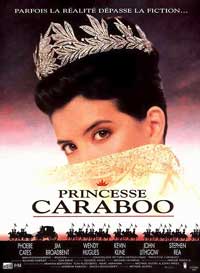
Although many details of Mary’s life still remain a mystery, her legacy endures as a young, country heroine who made a name for herself by deceiving the naïve, rich upper class of Britain. In 1994, a film studio made a movie based on her life, and in 2006, a blue plaque was placed at Number 11, Princess Street in Bristol, where Mary lived for the final eleven years of her life.
Want to read more?


Tomorrow: More Ancient Standard
Previous page | Next page
