Archive for the ‘Ancient Europe’ Category
By: The Scribe on August, 2007
 At the Parliament of Toulouse, a legal expert and judge named Jean Coras was charged to report on the case and make recommendations on the sentence. Although he decided to trust blood relatives above any other witnesses, minor contradictions even here, as well as legal technicalities, frustrated his ability to reach a decision. The new Martin argued his case with eloquence, convincing Coras of Bertrande’s innocence and that Pierre had forced her into perjury.
That, along with Coras’ established distrust of Pierre after the admission that he had lied about representing Bertrande in his initial accusation, saw Coras lean in favor of the accused. It didn’t help that Pierre also admitted to having participated in a failed conspiracy to kill the new Martin. Coras’ trust in Pansette, or the new Martin, only grew as the accused was able to recall perfectly almost every detail of Martin Guerre’s life. In addition, Bertrande was a reputable woman and Martin’s sisters were just as trustworthy – not to mention that they bore a physical resemblance to him! Believing firmly in the old Roman principle that it was “better to leave a guilty person unpunished than condemn an innocent one”, Coras decided to overturn the verdict at Rieux.
Thus, the Criminal Chamber of Parliament was ready to carry out Coras’ recommendations, when the most extraordinary thing happened: right outside the very building where the trial was being held, there appeared a man, hobbling on a wooden leg – and he introduced himself as Martin Guerre. Although in questioning the man, the new Martin could answer questions better than the old Martin, in the end it was Martin’s sisters – and eventually Bertrande – who conceded that this man was, indeed, the Martin Guerre who had left Artigat twelve years before.
It turned out that Martin Guerre had left Artigat and made for Spain, serving as a Cardinal’s lackey and later enrolling as a soldier in the Spanish army, even though Spain was a sworn enemy of France. It was during a siege against a northern French city that Martin was hit by a bullet from a French arquebus, forcing the amputation of his leg.
And so, Arnaud de Tilh was sentenced to death for fraud on September 12, 1560, finally confessing: after committing a series of petty thefts in Gascony, he had left the area to serve in the army of Henry II in Picardy. It turned out that this was the exact same area that Martin Guerre was in, fighting for Spain, and around 1553, Pansette left Picardy to return home. On his was back, he made a stop in a village near Artigat, where several friends of Martin’s mistook him for the missing peasant Martin Guerre.
Where he spent the next three years is unknown, however it is likely that he spent this time taking advantage of his highly photographic memory and clever acting skills, learning all that he could about Martin’s life and past surroundings – fully intending to establish himself as the new owner of Martin Guerre’s substantial landholdings and inheritance.
Why the real Martin returned when he did is a mystery, but in the end, Pansette was sentenced to hang for his crimes of fraud. Bertrande was spared, both because she was a woman and because Pansette begged the judges to accept that he had deceived her and that she was innocent. As he stood waiting for the gallows, Pansette apologized to everyone for deceiving them – and was hanged, with Bertrande forced to watch, in front of Martin Guerre’s house in Artigat later that week.
Want to read more?


Tomorrow: More interesting stuff!

By: The Scribe on August, 2007
 Although the soldier’s accusation spread to Pierre, the fact was that almost no one else had met the soldier – and in fact, Pierre had only learned this information through hearsay. However, it was shortly thereafter that a local seigneur’s barn burned down, and for some reason, the new Martin was charged with the crime. Martin was thrown into prison, and having him right where he wanted, Pierre pressured the seigneur to complain not only about the barn, but to also claim Martin had “usurped the marriage bed of another man”.
The people of Artigat were torn – they refused to believe that a woman of such high character as Bertrande could lie about something like this, and after all, Martin had become very popular and was considered one of the most upstanding men in the whole village! In the confusion, people began to take sides – but fortunately for Bertrande and the new Martin, all the ‘evidence’ against Martin’s arson was flimsy and easily dismissed, and he was soon released from prison.
Of course, this failed attempt simply made Pierre even more determined, and in 1559, the first fumble was made that finally saw Pierre gain the upper hand: Martin was recognized as someone else. In fact, the first person to call ‘Martin’ out on his falsehood was an innkeeper from a nearby town, recognizing him as a man named Arnaud de Tilh, nicknamed “Pansette”. Although the innkeeper agreed to keep quiet about the incident, someone else in the area also recognized him as Pansette – and, knowing who it was, the new Martin fell out of character and asked the man to take several handkerchiefs to his brother, Jean de Tilh. Despite Pansette’s efforts to keep things quiet, Pierre got word of the incidents and was now able to name his nephew’s imposter: it was Arnaud de Tilh, a man of questionable reputation from Gascony.
With a bit of legal conniving, Pierre initiated another case against Pansette, presenting himself as working on behalf of Bertrande de Rols. Somehow, he managed to have a formal inquiry opened concerning the identity of the man who had claimed to be Martin Guerre for the past three years – and under pressure from both Pierre and her mother, Bertrande was eventually forced to support the charges. He was arrested in the French commune of Rieux in 1560, where the initial stage of the trial was held.
Although Bertrande initially testified that she thought at first that Pansette was her husband Martin, and had only later realized her mistake, it did not take long before some of Pansette’s supporters informed the judge that she was testifying against her will. The judge was not impressed, and decided to call 150 witnesses from the surrounding area. All of the witnesses agreed only on one thing and one thing alone: that in the past, the accused had greeted each of them by name and recalled things about the past that they had done many years before. Some witnesses were members of Arnaud’s family, who swore they knew him as Pansette, while all of Martin Guerre’s sisters were determined that this man was their older brother.
During their independent questioning periods, Bertrande and the accused man each related an identical story – independent of each other – about their intimate lives before Martin Guerre’s disappearance in 1548. Later on in the proceedings, the new Martin even challenged his wife, asking that if she would swear that he was not her true husband, he would gladly and willingly agree to be executed. Instead, Bertrande remained silent.
Thoroughly confused, the judge decided he would simply declare Arnaud de Tilh guilty of fraud and abuse against Bertrande de Rols, leaving the door open for an appeal to the Parliament of Toulouse. Martin’s case was to be tried at the high court…
Want to read more?
Tomorrow: The real Martin returns
By: The Scribe on August, 2007
 The villagers of Artigat took no convincing – they readily accepted the returned Martin Guerre for who he claimed to be, as he looked like Martin and had detailed knowledge of his life. In fact, he joked with old friends and remembered things about their lives that Martin would have known from the past. The only person who seemed suspicious of the newcomer was Martin’s uncle Pierre – even his four sisters and even his wife accepted him back into the family.
Although the new Martin lived as Bertrande’s husband for three years, there are doubts about whether or not Bertrande realized this man was not actually Martin, and if she did know, how soon she made the connection. After all, Bertrande needed a husband – and with this newly returned Martin, she bore two more children and her status in society was restored.
It was after the death of Martin’s father that suspicions began to rise, for although he readily claimed his part of the inheritance – which was his right, and he was given his part without issue – he also sued ‘his’ uncle Pierre for part of Pierre’s inheritance. Outraged and convinced this could not be Martin, Pierre and Bertrande’s mother tried to convince Bertrande that the new Martin was an imposter. To make matters worse, the new Martin sold off some of his inherited land – something which no decent Basque would ever consider – causing Pierre to become even more adamant that this was not the real Martin. It also didn’t help that Martin didn’t seem to remember his family tongue.
Everyone else in the village, on the other hand, remained convinced. Of course Martin couldn’t remember how to speak Basque, and of course he wouldn’t follow all the old traditions – after all, Martin had been only two years old when his family moved away from Basque country, and he had grown up in this village speaking Provencal French! Plus, eight years away from the area was more than enough time to forget phrases in a difficult foreign language like Basque. And to be quite honest, Martin had never really been one for Basque traditions anyhow.
Pierre continued to rage – this Martin wasn’t interested in acrobatics or swordplay, which the real Martin had loved! And yet Bertrande stood fast, and if his wife knew he was the real man, why should anyone believe otherwise? This woman held a position of great respect in Artigat for living an honorable and virtuous life, and if she refused to separate and believed that it was Martin, then it was Martin.
Pierre’s case looked grim, and it seemed that new Martin had firmly established himself at home and in the village. However, in the summer of 1559, a soldier passed through Artigat, saw the new Martin, and apparently told one of the villagers a rather disturbing piece of information – this could not be the real Martin… because he had in fact fought in the war, and saw Martin Guerre lose a leg at the siege of Saint Quentin.
As this man clearly had two legs, it could not be the real Martin Guerre!
Want to read more?
Tomorrow: Knowing your part and playing it well
By: The Scribe on August, 2007
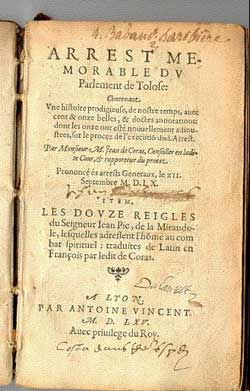 The tale of Martin Guerre is one of the most intriguing stories about everyday people to come down through history: it is a stranger-than-fiction tale of identity theft in the 16th-century, and it happened in an average, unassuming village in the French countryside. This is the story of the return of Martin Guerre.
Born Martin Daguerre around 1525 in French Basque country, Martin’s parents moved the family – Martin, his younger brother, and both parents – to the village of Artigat when he was two years old for reasons unknown to history. After the move, the Daguerres changed their name to Guerre and tried their best to adapt to the customs of their new neighbors, and it was during this time that Martin’s four sisters were born.
The family spent time learning the local language, Provencal French, and eleven years later – when Martin was almost 14 years old – he was married to a girl from a neighboring peasant family that was financially well established and highly respected in the local community. Bertrande de Rols was transferred with a substantial dowry to boot: a vineyard, bed with feather pillows, linen and wool sheets, a bed cover, cash, and other valuable household items. Following traditional Basque custom, Martin and his new wife moved in with Martin’s father: the young lord was to live with the elder lord and be his subordinate. Regardless of tradition, it was a good arrangement in the first place as Martin and his new bride were only just shy of their fourteenth birthdays.
Unfortunately for the two of them, Martin turned out to be impotent and thus was unable to consummate the marriage. Still, the Guerre family remained hopeful, and Martin continued to grow to become a very active young man, enjoying acrobatics and becoming very adept at swordplay. Meanwhile, Catholic canon law stated that an unconsummated marriage could be dissolved after three years, and Bertrande’s family pressured the young woman to separate – however, the Guerres continued to consult local ‘wise women’ and healers who eventually came up with a solution: they had the local priests sing four masses, took communion, and ate special cakes that allegedly would break the spell that Bertrande had come to believe was preventing them from consummating the marriage.
Whether Martin’s impotence was the result of a spell or not, it was not long after this ‘spell-breaking’ that Bertrande conceived their first child and gave birth to a boy. However, Martin was still unhappy – he detested Artigat, and couldn’t stand living under his father’s power. He felt confined by the routines, the daily fields, and even his marriage, and even tried at one point to leave and join the King’s army – and was only stopped when his father learned about the plan.
Then one day in 1548 – perhaps in retribution, or perhaps simply out of spite – Martin took some grain that belonged to his father, without asking permission. In traditional Basque custom, theft from a family member was the gravest crime of all. Realizing what he’d done, Martin left Artigat, leaving his patrimonial inheritance, his parents, siblings, wife and newborn son. Bertrande, it seemed, was in a catastrophic situation – without proof of her husband’s death, she couldn’t remarry, and without knowing whether Martin was alive or dead, she had no place in French peasant society as either a widow or a wife. How was she to be taken care of and how would she afford the means to live?
Time moved on… but one day in 1556 – almost eight years later – a man appeared in the village, presenting himself as the long-lost Martin Guerre…
Want to read more?
Tomorrow: The return of Martin!
Previous page | Next page
