Archive for the ‘Ancient Europe’ Category
By: The Scribe on August, 2007

In the summer of 2007, a collection of ancient sea spiders was discovered in French fossil beds around La Voulte-sur-Rhone, which has previously yielded other examples of ancient sea creatures. This trove of ancient spiders, however, now fills in a 400-million-year gap in their fossil record.
The scientific term for the sea spiders is ‘pycnogonids’, and they were found during routine work in the area. The fossils were extremely well-preserved, and the specimens are described in detail inside of a paper published online through The Proceedings of the Royal Society B.
The paper talks about 70 the specimens of ancient sea spiders, divided into 3 distinct species, all uncovered in the area’s Lagerstatte, which is a type of sedimentary rock formation. During the Jurassic period – which lasted from 199.6 to 145.5 million years ago – this Lagerstatte was actually covered by water that was 200 meters deep!
Although there are plenty of modern sea spiders, their relationship to the mysterious ancient creatures has remained mostly speculative. Researchers are hoping that this large cache of fossils will help to piece together the creatures’ evolutionary history, especially considering the very distant relationship between sea spiders and “true” spiders.
The current vein of thought is that the ancient pycnogodis appear to be remarkably similar to today’s living sea spiders, even though they likely began colonizing very deep parts of the sea well before the start of the Jurassic period.
Want to read more?


Tomorrow:

By: The Scribe on August, 2007
 It’s no secret that the British have a long history of following European fashion trends – however, it now seems that instead of a decades-long devotion, fashion-conscious Brits have been at it for centuries.
Studies on 1,700 Anglo-Saxon graves at several settlements from the mid-6th century have revealed that people living in England at the time often wore outfits that were more typically found in northern France and west of the Rhine. Some of these pieces were things like front-fastening coats with brooch clasps, which might not be all that out of place on the modern Parisian catwalk.
Although very few pieces of art that depict humans from the 5th to 7th centuries have survived from this area, the Anglo-Saxons preferred to bury their dead instead of cremate them, placing the bodies in graves while fully clothed. While none of the items of clothing have fully survived the passing centuries, some smaller squares of fabric have lasted, typically around the areas where the clothes were fastened.
This is highly fortunate, because in order to recreate a certain kind of fabric, all that is needed is a small square – it contains information about the weave structure and density, the kind of yarn or other material used, and in some cases, even the kind of dye.
Some of the French garment styles that the Anglo-Saxons copied 1,400 years ago include: the rounded neckline; A-line coats fastened with a brooch and cinched at the waist; modest, floor-length skirts; vertical, raised trimlines enhanced with various colors; naturally dyed or uncolored fabrics.
Want to read more?


Tomorrow: Ancient Olympians on the Atkins diet!
By: The Scribe on August, 2007

The earliest appearance of the German language came somewhere around the 6th century AD, known as Old High German, and is found from scattered ancient inscriptions know as Elder Futhark – which is essentially the oldest known form of the runic alphabet. This alphabet was used to write inscriptions on basic items such as jewelry, tools, and rune stones.
This runic language eventually developed into a more cohesive writing system, and somewhere around 765-775 AD, what is now considered the oldest book in the German language was written. The book itself is a dictionary of synonyms – similar to that of a glossary or word list – between Latin and Old High German. Only one copy of the book has survived to present day, and this is known as the Codex Abrogans.

The oldest coherent texts in Old High German date from the 9th century, and are generally works of epic poetry: the Hildebrandslied and the Muspilli, for example. Around this same period, there was also another form of German documented on the northwest coast of Germany and in parts of Denmark, spoken by the Saxons – it was called Old Saxon, or alternately, Old Low German. Only a few written texts survive from this language, mostly in the form of baptismal vows.
Middle High German made its appearance between 1050 and 1350 AD, and a good deal of texts survive from this period. It was essentially a development and transitional period for the language, while around the same period (about 1100 – 1500 AD), Middle Low German appeared around the North and Baltic Seas. In fact, although Middle Low German was quite widely spread around that area, it was not codified since a standard written language never fully developed.
Early New High German is the period of German language between 1350 and 1650, and it was this version of German that finally moved toward a standardized form of the written language – and not just written reflections of the local German dialect. When Martin Luther eventually translated the Bible in the 1520s and 30s, he based his German translation on this form of the language, which was the most widely understood version of German at the time.

Upon distribution of this Bible, supplementary lists had to be provided for each region that copies went to, in order to translate certain unknown words into the local dialect! However, the Catholic church’s opposition to Luther’s translation caused Early New High German to eventually fade, as it took until the mid-18th century before a standard of German finally became widely accepted!
As a result, standard German was almost exclusively a written language until about 1800. People living in other parts of Germany learned standard German as a foreign language, even making use of small pronunciation guides to help them speak it correctly, though this only resulted in the pronunciation varying between regions. Between 1852 and 1860, the Brothers Grimm tried to help correct the variations in German dialects by publishing a dictionary in 16 parts, which even today remains the most comprehensive guide to the German language’s wide lexicon.
In 1880, grammar and compositional rules appeared in the “Duden Handbook”, which was declared the official standard definition of the German language in 1901. Finally, the language had come into its own!
Want to read more?


Tomorrow: Fast food in Pompeii
By: The Scribe on August, 2007
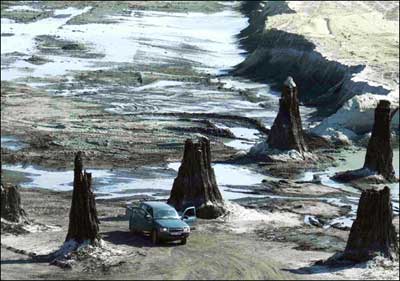
In a deep, open mine in northeastern Hungary, archaeologists have uncovered an 8 million-year-old forest of preserved cypress trees – and what makes them remarkable is that they’re not fossilized! These trees weren’t petrified nor turned into coal although they had been buried under sand for eight million years – which happened as a result of a sudden sandstorm that covered the forest floor up to about six meters high.
As a result, all that remains of the ancient forest are the tree trunks – 2 to 3 meters in diameter and six meters high, although the original trees would have stood about 30 to 40 meters high. Everything above these six meters is long gone… but the trunks themselves still feel like wood to the touch!
Over 10 million years ago, the area where these trees now stand was a giant, swampy, muddy lake, bounded by a marshy shoreline. This was during the Miocene period, and most of the trees themselves were likely around 400 years old when they died. The forest of 16 preserved trees was found when miners working in a brown coal mine first identified several tree trunks that had become coal over time, but upon digging further, they realized that there were trees in the ground that seemed intact.

In order to reach the ancient cypress forest, one must descend about 60 meters (or, 200 feet) into a 3,500 meter squared open mine – and to make matters more difficult, the trees simply cannot be removed from the area, since they begin to crumble almost immediately once exposed to sunlight and air. A similar forest found in Japan some time ago was preserved by encasing the entire area in a “cement sarcophagus”, however the cost of doing so to this forest would be over two hundred thousand dollars.
Since the trees retain their original wood and were not petrified, scientists are hopeful that the information gathered from them will provide useful and vital information about climate change in ancient Europe – more specifically, about global sea levels at the time, as this was during the Miocene period when it is known that the Mediterranean sea either completely or partially dried up!
Want to read more?


Tomorrow: More ancient stories!
Previous page | Next page
