Archive for the ‘Ancient Europe’ Category
By: The Scribe on September, 2007
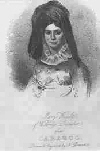 After bringing the girl back to her home in Knole Park, Mrs. Worrall decided to allow the girl to stay awhile – mainly, because she was curious about who this strange young woman could possibly be. She was able to learn that the girl’s name was ‘Caraboo’, and that she had somehow come to England from a ship – and because she showed an intense interest in some pieces of furniture containing Chinese images, there was speculation that she may have come from China.
Of course, there was one rather substantial error with that mode of thinking: the girl was obviously European in her features. The odd behavior only continued while staying with the Worralls, as she declined to eat any meat, and would only partake in vegetables and water. Still somewhat suspicious, Mr. Worrall finally decided to take her to Bristol’s Mayor for trial – on the grounds that she had been in possession of false currency.
The Mayor of Bristol certainly tried… but he could get nothing intelligible from the woman except for her name. Following procedure for these kinds of cases – namely, ones where not enough information was available or the sanity of the accused was in question – she was sent to St. Peter’s Hospital for further examination.
Once at the hospital, the woman continued to decline all manner of food, and she absolutely refused to sleep on the beds. It was a dirty, overcrowded place, and after only a week, Mrs. Worrall intervened – she removed the young woman from the hospital and took her to stay at her husband’s offices in Bristol. While staying there in care of the Magistrate’s housekeeper, many foreigners and supposed language experts came to visit, hoping to decipher the language. All attempts failed until, finally, a Portuguese traveler by the name of Manuel Eynesso claimed to understand what she was trying to say.
After conversing with the girl, Eynesso was able to relate her story: apparently she was a princess from an island called Javasu, located in the Indian Ocean, and had been kidnapped from her home by pirates. After a long journey on their ship, she was somehow able to escape by jumping overboard in the Bristol Channel and had swum to shore. Finally convinced of her identity, Mr. Worrall brought the newly revealed foreign princess back to his home in Knole, where Mrs. Worrall set up a room for her to stay.
While she lived with the Worralls, Caraboo entertained and fascinated visitors with her strange, ‘exotic’ behavior, including fencing with men and using a hand-made bow and arrow to hunt. She conducted exotic dances, often swam naked when no one was around, and frequently climbed to the top of trees so that she could pray to the supreme god ‘Allah Tallah’. During this time, she continued to eat and drink only select items, refusing meat of any kind.
As word of the strange princess began to spread, more and more people arrived at the Worrall’s home to see the exotic young woman. Instead of retreating for privacy, Caraboo responded well to the attention – her exotic idiosyncrasies increased, and she habitually related the story of her capture from Javasu and the escape from pirates through her elaborate language and dramatic gestures. At one point, she even agreed to write down several examples of her own language so that it could be sent off to Oxford and analyzed. Although it was returned and marked as ‘humbug’ soon afterward, the princess continued to be treated like literal royalty: her portrait was painted, and she sewed herself a ‘traditional’ and elaborate Javasu costume, using materials provided by Mrs. Worrall.
However, the truth was soon to be revealed…
…to be continued…
Want to read more?

Tomorrow: Part Three!

By: The Scribe on September, 2007
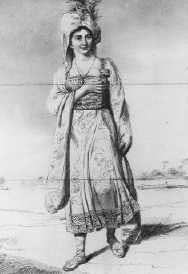 It was in April of 1817 that a cobbler in Gloucestershire, England, came across a disoriented young woman, dressed in exotic clothes – and she was speaking a language that no one in the town could understand. The cobbler brought the young woman back to his home, where his wife could tend to her and decide what to do. She certainly didn’t seem to belong to a local community – her thick, black hair, dark eyes, and black turban seemed to suggest she was a foreign beggar, at best.
After allowing the woman to sleep for awhile, the cobber’s wife decided to take her to the Overseer of the Poor, whose job was to arrest anyone begging, making trouble, or running rogue across the countryside – and then either place them in jail, a workhouse, or ship them off to Australia in chains. However, the Overseer was just as stupefied by the woman as the cobbler had been, and instead decided to pass her off to the county Magistrate, Samuel Worrall, since the Magistrate and his wife had a Greek servant who spoke several European languages.
Unfortunately, neither the Worralls nor their servant could understand what the girl was saying, although Mrs. Worrall became fascinated by her looks and exotic appearance. The Magistrate tried to follow protocol: he took a suspicious view, and tried to ask her if she had any papers. Seeming to understand, the woman emptied her pockets, which contained only a few halfpennies and a fake sixpence – which, under normal circumstances, would mean the death sentence for carrying around counterfeit currency.
The only other thing the girl had with her was a bar of soap, pinned inside her clothes on a piece of linen. Uncertain of what to do, the Worralls finally realized that if she was indeed a beggar or foreign slave, her hands would tell the truth – but when they examined her hands and fingers, they were soft and clean, which were certainly not a sign of hard work. Thinking it would probably be in her best interest to stay the night at a village inn, the Worralls sent the woman downtown with two of their servants.
Upon arriving at the inn, the woman noticed a picture of a pineapple on the wall, and began to gesture excitedly, saying “Anana!”, attempting to convey that this fruit was from her own country. Since ‘anana’ was the word typically used for pineapple in several European languages, the landlady offered her some, as well as a plate of dinner. However, the woman refused and instead insisted on drinking a cup of tea – and would only drink this after holding a hand over her eyes and repeating a prayer. Then before she would drink another cup, she insisted on washing the little cup herself and then repeating the hand-over-eyes and prayer ritual.
Fascinated by the woman, the inn’s landlady agreed to allow the stranger to stay for the night, but when she was shown her room, she didn’t seem to understand what the bed was for. Instead, she lay down on the floor, and would not get into the bed until the landlady’s daughter physically showed her that the bed was more comfortable than sleeping on the floor. Consenting to use the bed, the woman kneeled, said some prayers, and then went to sleep. The next morning, Mrs. Worrall could not contain her curiosity, and decided that the girl must come back home with her for awhile…
…to be continued…
Want to read more?
Caraboo: The Servant Girl Princess : The Real Story of the Grand Hoax
Tomorrow: Part 2!
By: The Scribe on August, 2007
 During the Neolithic period around 5000 years ago, some tasty new creatures arrived on the shores of Great Britain… namely, sheep, pigs, and cattle. Up until this time, the people of England had mainly subsisted on fish and other marine species for the majority of their diet – however, with the introduction of these domesticated animal species, along with some new domesticated plants like wheat, the palates of the ancient Brits took a bit of a turn.
Historians have been aware for quite some time that the ancient Britons stopped eating fish at some point along the way, but whether it was a gradual or rapid process has been up for debate. By 4000 BC, there is evidence that domesticated plants and animals were in the area, but did the people adopt these new food sources easily, or did they continue munching on fish sticks when a T-bone steak was available just a few steps away?
Studies of animal and human bones left around some Neolithic archaeological sites in Great Britain have revealed that, in fact, the ancient Brits heartily embraced their new culinary options. Believe it or not, the maxim “you are what you eat” actually rings true to a degree – human bone and tissue is made up of elements from the various foods ingested during a person’s lifetime. When that person dies, the bones retain what could be described as a ‘record’ of what someone has eaten over the course of their lifetime.
The bones examined from the ancient British sites showed that these Neolithic people – who had previously relied on marine species and fish to fill their diets – almost completely abandoned eating fish and seafood once the new domesticated plants and animals arrived. Apparently, the farming lifestyle seemed more attractive than sitting around and fishing.
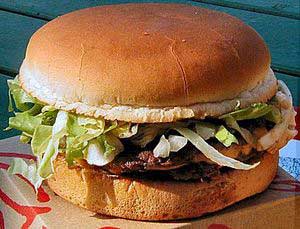
Farming plants and animals may have been preferred over eating fish due to several factors: the potential for a steadier, more reliable food source; climate change; or cultural pressure. According to the evidence, the fishing lifestyle that had been in place for hundreds of thousands of years was just given up – abandoned – over the course of one generation!
One thing is certain: it is only after this complete shift to domesticated plants and animals that larger populations and more complex societies began to appear in ancient Britain… and rather rapidly, as well. While historians are quick to point out that humans could produce and obtain more food through these domesticated species than they could gather through marine trapping and fishing, there is another explanation that no one seems to have bothered considering… maybe hamburgers just taste better!
Want to read more?


Tomorrow: Prosthetic…head?!
By: The Scribe on August, 2007
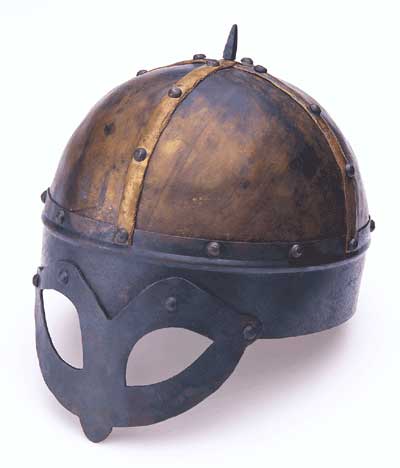
A recent study on genetics in England has revealed that ancient Britons were far more genetically diverse than those living in the country today! By studying the DNA from skeletal remains dating between 300 and 1000 AD, and comparing it to that of modern-day Brits, scientists have come to the conclusion that several deadly plagues in ancient times may have been responsible for the decline of the populace’s diversity.
Although modern England is considered to be a cultural melting pot, the 48 skeletons appeared to have even more diversity than those living in today’s continental Europe and the Middle East. However, it was after the Viking era that two severe outbreaks of bubonic plague swept across England and many parts of Europe.
The Black Death arrived and lasted from 1347 to 1351 AD, while the second outbreak that was known as the Great Plague lasted only two years, 1665-1666 AD. During the Black Death, as much as 50% of the European population is estimated to have died, with at least 1/5th of London’s population disappearing in the short span of the Great Plague.
Notably, the plagues did not affect people randomly – some people were simply resistant to the disease, while other entire villages of related families were wiped out, sometimes causing an entire genetic lineage to disappear at once. As a result, if there were many smaller populations with each type of DNA, and many died out because of these plagues, a significant number of DNA types could have easily disappeared.
Since that time hundreds of years ago, it seems that the British population has not been able to once again reach that same level of diversity. Although some scientists remain skeptical of this explanation, the results of the DNA study are undisputable – at the very least, something caused the British population’s DNA types to be significantly reduced. It certainly appears as though the ancient Britons were more tolerant of ethnic diversity than anyone had previously thought!
Want to read more?


Tomorrow: A brief history of zip…zero…nadda!
Previous page | Next page
