By: The Scribe on April, 2007
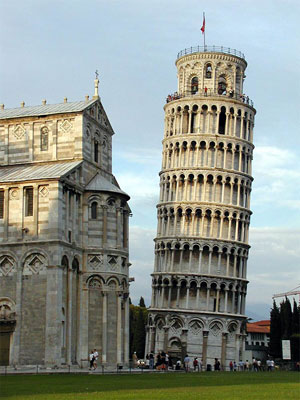 The Leaning Tower of Pisa, or Torre pendente di Pisa in Italian, is a freestanding bell tower (campanile) of the cathedral of the Italian city of Pisa. The tower stands behind the Cathedral as the third structure in Pisa’s Campo dei Miracoli (“Field of Miracles”).
The tower’s construction began in 1173, and it was intended to stand vertically as the Cathedral’s bell tower. However, before the structure was even finished, the poorly laid foundation causing the tower to begin leaning during construction. The tower itself was built in three successive stages, the entire process taking around 174 years. The bottom floor was built using white marble, and construction was led by Bonanno Pisano, a twelfth-century artist. The first floor is surrounded by pillars with classical-style capitals and arches.
Inside the tower, there is a winding staircase which leads to the top floor, a bell terrace. Before their removal due to weight concerns in 1990, the tower was home to seven bells dating from the 17th to 19th century. It was from this upper terrace that Italian scientist Galileo Galilei is said to have dropped two cannonballs of differing weights, in order to demonstrate that their descending speed was independent of their mass.
On the lowest side, the tower is 55.86m high, and 56.70m on this highest side. The spiral staircase inside has 294 steps.
Want to read more?


Tomorrow: Something that is hard to pronounce, but interesting anyway.

By: The Scribe on April, 2007

Underwater archaeologists at Loch Tay in Perthshire, Scotland, have discovered a well-preserved, drowned forest, dating to the Neolithic period around 5000 years ago. Archaeologists have identified fallen elm and oak trees, as well as upright oak trunks surrounded by organic material, including moss and hazelnuts. Many of the trees have been preserved in odd shapes, creating a “spooky landscape protruding from the loch bed”.
The radiocarbon dates for these trees fall between 3200 and 2500 BC; scientists hope that samples of the preserved wood and pollen will be able to assist them in tree-ring dating and climate-change studies.
Want to read more?


Tomorrow: The beginnings of literacy in China
By: The Scribe on March, 2007

In the years following Otiz’s recovery from a glacier in the Otztal Alps, seven people connected in some way with the mummy’s discovery and research perished under allegedly “mysterious circumstances”. Although likely influenced by the media’s infatuation with the ‘Curse of the Pharaohs’, it is curious to note that four of these deaths were the result of violent accidents…
1.) Dr. Rainer Henn, 64: a forensic pathologist, Dr. Henn was the first victim of the ‘curse’. He was the head of the forensic team that examined Otzi’s body, and once picked up the cadaver with his bare hands to place it in a body bag. His death came as a result of a head-on collision with another vehicle in 1992… while he was driving to a conference where he was scheduled to present new research on Otzi.
2.) Kurt Fritz: shortly after Henn’s death, the second victim was an experienced mountain climber who had led Henn and his team to the iceman’s body. He was the only member of his party to be stuck by falling rocks during an avalanche in a region he was supposedly familiar with.
3.) Rainer Hoelzl, 47: the third victim, Hoelzl was an Austrian journalist who had filmed an exclusive documentary of the body’s removal from the ice, which was broadcast internationally. A few months later, he developed a mysterious illness – speculated to have been a brain tumor – and perished in extreme pain shortly thereafter.
4.) Helmut Simon, 67: a German tourist, it was Mr. Simon who had been hiking through the alps with his wife when he happened upon Otzi’s body in 1991. He returned to the region on an unaccompanied hike in 2004, and when he did not return as scheduled, rescue teams were dispatched… only to find that the weather had shifted suddenly to blizzard conditions, causing Simon to fall 100 metres into a deep ravine. His body was found eight days later, covered in ice much like the mummy.
5.) Dieter Warnecke, 45: head of the mountain rescue team that searched for Simon, Warnecke died of a heart attack – although according to his family, he was in perfect health. What is more, this occurred less than an hour after Simon’s burial.
6.) Konrad Spindler, 66: Spindler was the leading expert on Otzi before his death. Spindler suffered from a pre-existing chronic condition known as amyotrophic lateral sclerosis, and it was in 2005 that complications with the condition arose which claimed his life. Before his death, he was quoted as being dismissive of the ‘Otzi’s curse’ theory, saying: “I think it’s a load of rubbish. It is all a media hype. The next thing you will be saying I will be next.”
7.) Dr. Tom Loy, 63: Dr. Loy died just prior to completing a book about Otzi, and had also on several occasions been in close physical contact with the mummy. His death came as a surprise to his family, though there is a possibility that Loy may have suffered from a pre-existing medical condition.

While the concept of cursed mummies is indeed intriguing, it is also worth noting that these deaths only totaled seven, even though there were hundreds of other individuals involved with Otzi’s discovery and the subsequent research on the body and associated artifacts.
Want to read more?


Tomorrow: Girls gone wild…in ancient Egypt??
By: The Scribe on March, 2007
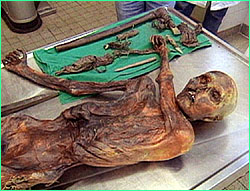 Although it was originally believed that Otzi the Iceman, Europe’s oldest known mummy, was ritually sacrificed by his people to appease the gods, further forensic analysis on the body has revealed that, in fact, ‘Frozen Fritz’ may have been the victim of an ancient murder!
A small tear on Otzi’s coat matched the shape of an arrowhead found lodged in his shoulder, suggesting that he may have bled to death after a confrontation with another individual, possibly from a competing tribe. However, Professor Annaluisa Pedrotti, from Trento University in Italy believes otherwise – according to her research, the type of arrowhead found in Otzi’s shoulder is known only from a very specific area in the southern part of the alps, suggesting that the attacker may have actually been one of his own people.
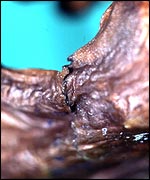 In addition, research done on the body in 2002 revealed a deep wound on Otzi’s right hand – cut down to the bone. Because his gear was found neatly arranged in the ice nearby, it appears that Otzi may have sat down to rest after the conflict and, weakened by blood loss, died shortly thereafter.
Unfortunately for Otzi, even if he had been able to avoid his fatal confrontation, he would have likely died in the near future regardless. At 46 years old, ‘Frozen Fritz’ already suffered from intestinal cancer as well as an intestinal parasite known as whipworm. It is thought that perhaps the 52 tattoos found all over his body – consisting of various lines and dots – were the results of a type of acupuncture, perhaps in an attempt to alleviate his suffering.
Tomorrow: Otzi’s Curse…?
