Archive for the ‘Ancient Europe’ Category
By: The Scribe on May, 2007
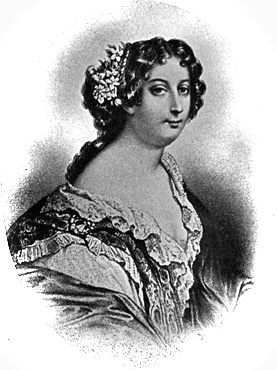 Marie Louise Elizabeth of Orleans, better known as “La Duchesse du Berry”, was a young woman who spent the majority of her life indulging in court pleasures, hiding behind the façade of joie de vivre to conceal her true psychological and emotional trauma. Born to Philip II of Orleans and the Lady Francoise Marie, Marie Louise’s mother ignored her from birth, causing Marie to grow up much more quickly than any child should.
When she was six years old, Marie became so gravely ill that the royal doctors believed she was basically dead and refused to attend to her any longer. Instead, her father Philip II nursed Marie back to health with his own hands – and being grateful that she was still alive, he proceeded to spoil her in every way possible, even giving her a little court of ladies for her own when she was only 14 years old. Her mother, seeing a way to consolidate power, arranged a marriage for Marie to the 23-year-old Duke of Berry and forced her to spend a year losing weight to ensure she was ‘able to conceive when married’.
Even after the marriage, Marie Louise did not like her husband, Prince Charles, and often acted rudely toward guests at court. When she was 15, Marie had her first pregnancy, which caused her to become extremely irritable – and since her husband wasn’t able to be of any comfort, Marie’s father often spent several hours with her each day. This gave rise to rumors about a possible love affair between daughter and father, which would haunt the family for years to come.
In the later stages of her first pregnancy, Marie was involved in a boating accident that caused her to give birth early – the child died only hours later. In 1712, she experienced her second pregnancy, though she went into labor early for a second time: the baby died only two weeks later. Although her husband did everything he could to try and love her, Marie developed a violent temper and often spent hours alone with her father. On one occasion, her father put his painting talents to use by painting his daughter in the nude, which did nothing but increase the swirling rumors of incest.
During mealtimes – which were apparently quite frequent for Marie – one historian wrote that Marie Louise would often drink to excess and eat so much that she would promptly throw up in the middle of dinner. She engaged in numerous affairs, and made no effort to conceal them from her husband.
Eventually, Prince Charles gave up his attempts to care for his wife, and the two engaged in a battle of affairs to try and out-do each other. They began to fight in public, and on several occasions were reprimanded by the king; on one occasion, it was reported that Charles kicked his wife and threatened to send her off to a convent. In 1714, Charles unfortunately fell from his horse while hunting, leaving his wife to become a widow at the young age of 18 – and in addition, Marie had just announced her third pregnancy. Ordering her room to be decorated completely in black, she remained in bed for months before the baby was born.
Want to read more?
Unruly Daughters A Romance Of The House Of Orleans
Tomorrow: Would this child be the one to live, changing Marie for the better? Find out tomorrow…

By: The Scribe on May, 2007
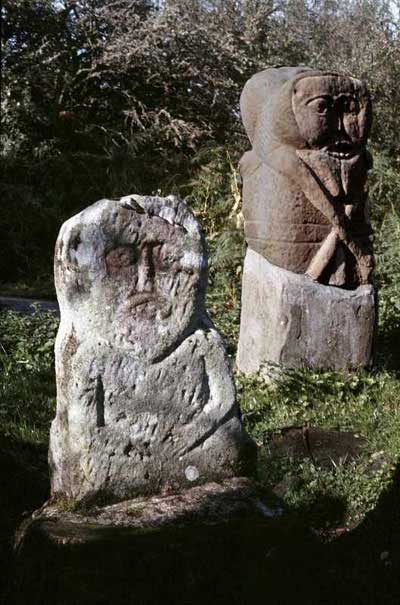
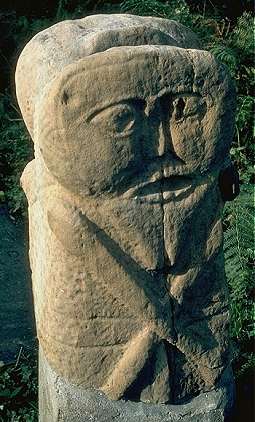 In Caldragh Cemetery on Boa Island, in the Irish county of Fermanagh, there stands two stone statues of unique variety, which may date as early as the 8th century AD. Famously used as the ‘token’ monument for Irish guidebooks, these examples of Celtic art are little understood.
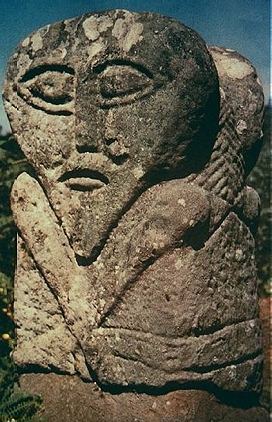
The larger statue of the two is a double-sided figure of two people in a squatting pose – and perhaps not surprisingly, one is male, while the other is female. Carved back-to-back, the male figure is identified by his genitalia depicted underneath crossed arms, while the female side has simply been depicted with a protruding tongue. Both statues have large, bulbous eyes, and it appears that the male is holding an object in his right hand. Between the heads is a carved zig-zag pattern, thought to represent hair, and each figure seems to be wearing a belt around their waist.
The larger figure has often been referred to as a Janus statue, however it should be clarified that ‘Janus’, in this context, is simply used in its literal Latin form meaning ‘two-faced’, and does not refer to the Roman god Janus. Precisely what this statue was meant to represent remains unclear, though since it dates from the pre-Christian period on Ireland, it likely held great meaning for the local pagan religion.
The smaller statue is not native to the cemetery, and was imported from nearby Lustymore Island; weathering on the statue has made it difficult to precisely identify its gender. The carvings on this statue are not very deep, and it also appears to be holding something. The arms rest on the figure’s lap, while the protruding tongue may indicate that this figure is, in fact, female. There are comparable figures to this one elsewhere on nearby islands, however the purpose or significance of this figure is unknown as well.
Want to read more?


Tomorrow: A brand new series of posts on the 7 wonders of the ancient world!
By: The Scribe on May, 2007
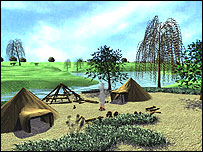 Researchers from the University of Birmingham have recently made the astonishing discovery of what may be an entire, prehistoric “lost country”, hidden underneath the UK’s North Sea. It appears that at the end of the last ice age, over 8000 years ago, rising water levels literally swallowed what may amount to an area of around 23,000 square kilometers – an area that is currently a part of the North Sea’s seabed.
The research team believes that this find could serve as a warning for the devastating impact of climate change on human populations, since these people would have lost their land as the rising water levels crept across the low-lying plains. Although the majority of the landscape’s change would have been gradual, some warmer years likely saw a rapid shift in the amount of land available to these people – a terrifying concept for hunter-gatherer populations that relied on their land to survive.
Professor Vince Gaffney, chair in Landscape Archaeology and Geomatics at the University, has surmised that as early as 10,000 BC, hunter-gatherers were living on the land in the middle of North Sea, but it was only 4000 years later – by 6000 BC – that Britain had fully become an island. Global temperatures and water levels rose, forcing people off the land and onto higher ground, namely the area that is modern-day Britain.
“It would be a mistake to think that these people were unsophisticated or without culture,” said Gaffney, “they would have had names for the rivers and hills and spiritual associations – it would have been a catastrophic loss.” Prehistoric groups often lived together in family units, and based on the previous evidence from other prehistoric groups in Britain, these people probably lived in small, thatched huts and hunted animals such as deer and rabbit for food.
University of Birmingham researchers are currently attempting to map the physical features of the seabed’s geological landscape, in hopes that it will shed further light on the specific locations of these underwater sites that might yield further evidence for how these people lived – and also hopefully avoid further destruction of the sites. Quoted as being the “best preserved prehistoric landscape in Europe”, it is likely that underwater excavations will be mounted in the future, to try and learn more about the people that lived in this enormous stretch of lost world.
Want to read more?


Tomorrow: Whipping = fertility??
By: The Scribe on April, 2007
 Son of King Philip II of Spain and Maria Manuela of Portugal, Don Carlos was born in the Spanish city of Valladolid; deformed from birth, his mother died shortly after the delivery. His shoulders and legs were of uneven height, and he was prone to feverish illnesses. It is thought that Don Carlos’ physical and eventual mental deformities were possibly the result of incestuous marriages in the Portuguese Royal Family – he had only 4 great-grandparents instead of the regular 8, and only 6 great-great-grandparents instead of the usual 16.
As he grew, Don Carlos began to show increasing signs of mental disabilities. Even as a boy, Don Carlos was rumored to have bitten the breasts of his wet-nurses, nearly killing three of them from the resulting wound. At the age of 9, he was known to torture other female children, as well as servants and animals. He quite enjoyed roasting small animals alive, particularly rabbits, and once bit off the head of a snake. On another occasion, he entered the royal stables and severely mutilated the horses to the point that twenty horses had to be put down.
In 1562, Don Carlos met with an accident – possibly while chasing women around, though this has never been confirmed – that caused a severe head wound. The wound soon developed a bacterial infection, swelling his head and causing a temporary blindness. Doctors even drilled a hole in his head, a procedure known as trephination, in an attempt to relieve the pressure. In desperation, Philip II called the local Franciscan monks to bring a holy relic to his son’s bedside – so they brought the remains of a holy man who had died one hundred years ago and placed the mummy in bed with the prince. Miraculously, Don Carlos’ health seemingly began to stabilize.
Though the prince regained some of his mobility, his ability to produce heirs was questionable. In fact, the only thing the prince seemed to enjoy doing with women was whipping them; record books detail the money paid to fathers of girls who were “beaten by order of his Highness.” His derangement only seemed to increase with time – on one occasion, a shoemaker presented boots to Don Carlos that he didn’t particularly approve of, so the prince forced the shoemaker to cut up the boots and eat them.
After a failed attempt to incite a plot against his father, Don Carlos was locked in solitary confinement in the tower of Arevalo castle, where his own ancestor Isabel of Portugal – also considered “mad” – had been locked up and died around a century before. In confinement, Don Carlos behaved even more irregularly, pouring ice water on the floor and lying naked it in, vomiting incessantly, or drinking over 10 litres of water with his meals. When given the last sacrament after a particularly violent bout of illness, he even vomited the communal host. On July 24th, 1568, Don Carlos was pronounced dead – rumored to have been poisoned by his own father. The public was told that the prince had “died of his own excesses”.
Want to read more?


Tomorrow: Another week long series: The burnt city!
Previous page | Next page
