Archive for the ‘Ancient Europe’ Category
By: The Scribe on June, 2007
 Back In 2003, scientists stumbled across the fossilized remains of what has been dubbed the world’s oldest land-dwelling creature. Discovered in eastern Scotland, paleontologists have determined that the fossilized millipede is more than 420 million years old, beating out the previous record of a 400-million-year-old spider-like creature that was also found in Scotland.
The millipede has been dubbed “Pneumodesmus” by scientists, and it was actually discovered by an amateur scientist who found it near the fishing port of Stonehaven, along the coast.
The fossilized remains show a highly developed system of breathing for the creature, which has caused palaeontologists to wonder whether there were even earlier versions of millipedes with more primitive internal systems, suggesting that this one was the result of natural micro-evolutionary processes.
In 2004, a second fossil from around 438 million years ago was discovered in Scotland’s Rhynie, and was inside a piece of old, red sandstone. This fossil is considered the world’s oldest insect, and has been dubbed “Rhyniognatha hirsi”. Although its lack of wings may cause some to wonder whether it should be considered a land creature, the mandible structure is definitely that of an insect.
Since Scotland seems to be the haven for ancient fossilized bugs, scientists are beginning to understand why there is such a plethora of bug life on Earth today. If insects and crawling bugs had a ‘head start’ on over other living creatures millions of years ago, the amount of diversity of insect and bug life certainly begins to make logical sense!
Want to read more?


Tomorrow: A brief history of ancient Greek coins.

By: The Scribe on June, 2007
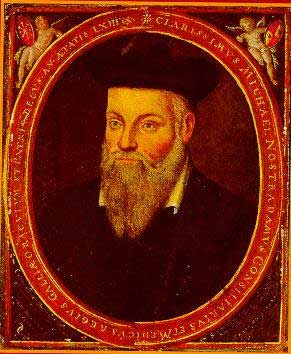
Nostradamus, born under the name Michel de Nostredame, was a French apothecary turned seer, whose book Les Propheties skyrocketed him to cult-like status after his death. Although often credited with predicting major events in the world, many of his “predictions” have been the result of misinterpretations or deliberate mistranslations of his extremely ambiguous quatrains.
As a child, Nostradamus grew up in Southern France’s Saint-Remy-de-Provence with at least eight other brothers and sisters. Although his family was originally Jewish, his father converted to Catholicism before Nostradamus was born. There is very little additional information known about his childhood, however when he was fifteen, Nostradamus attended the University of Avignon for studies. Only a year later, he was forced to leave the school when it was shut down from a plague outbreak, but he would eventually return to school at the University of Montpellier in 1529 to study medicine.
Unfortunately, Nostradamus was expelled from the school when they learned of his time spent as an apothecary before attending the University, which was a trade expressly forbidden by the school statutes. Undeterred, he continued to practice as an apothecary after the expulsion, and anyone wishing to read the expulsion document can actually still do so – it is still on file in the university library!
 In 1531, Nostradamus married, but it was only a few years later that his wife and both children died from plague. It was after their death that he began to travel more frequently, often spending time in various places in France and Italy. During one visit to Italy, his interest in medicine began to wane, and in 1550, Nostradamus wrote his own almanac – and, thrilled at its success, continued to write at least one per year for quite some time. With an estimated 6,338 prophesies contained inside the almanacs, high-born officials and nobles soon started seeking out Nostradamus for advice on personal and public matters.
It was after this success that he set out to write a book of a thousand quatrains, which he purposely constructed in an ambiguous manner so as to avoid criticism and attack from religious fanatics. When they were finally published in their final form as one book, Les Propheties, Nostradamus was labeled by many as insane or fake, though the elites of society still seemed to find inspiration in his words. This admiration may have led him to his claim of spiritually inspired writing, and while he did spend time in prison in 1561 for his writings, it was simply because he had neglected to seek the permission of a bishop before publishing his work, as was written in a royal decree for all publications.
Because he did not practice magic to support his prophesies, he could not be persecuted by the Inquisition, as some have suggested, and his relationship with the established church was actually quite jovial. In 1566, Nostradamus passed away after a long battle with gout: a skilled pharmacist, medical professional and self-professed prophet whose works would go on to become some of the most mistranslated writings in the entirety of history.
Want to read more?

Tomorrow: Ancient Egyptian Dentistry!
By: The Scribe on June, 2007
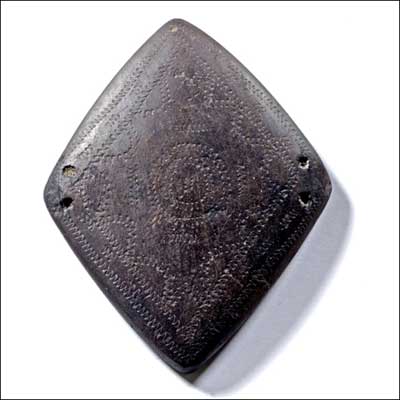
While excavating a site in Suffolk in 2007, archaeologist Clare Good stumbled across a diamond-shaped object made of mineral jet, incised with a geometric pattern. This 4000-year-old amulet bears a surprising resemblance to another gold geometric-style object from a site near Stonehenge in Wiltshire. Evidently, the two are strikingly similar, and experts have speculated that the black object is a ‘skeuomorph’ – a copy of the object in another material.
Located in the remains of a funeral pyre, Good suspects that someone placed a number of items, such as the jet object, some pottery, and a knife, inside the pit after the body on the pyre was burned. The object itself has several parallel lines drawn around the outside, with several semi-circles around the inside and double circle with center dot. What the meaning of this design was remains a mystery, though the type of material used to make this object is believed to have held significance for the ancient people who lived around Stonehenge.
Mineral jet has been used all over the world in ancient cultures to create religious artifacts such as amulets or beads, and thus it is believed that the item uncovered by Good was an amulet with ‘magical powers’ – possibly even commissioned by religious leaders or a wisdom healer in the area.
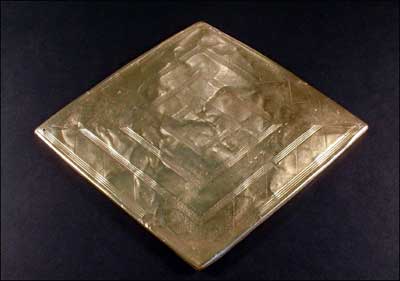
Traces of copper from several holes in the object indicate that the amulet was likely held onto a piece of clothing with copper pins – possibly leather clothing, due to the heavy-duty abilities of copper. Good believes that both the jet piece and the gold piece may have even been attached together onto someone’s leather garment, likely in a visible area to let others know of their supernatural protection.
Although it is not known to whom these amulets belonged, it is likely that they were wealthy elites, and more likely, elite religious leaders
Want to read more?


Tomorrow: The REAL Homer
By: The Scribe on May, 2007
 Perhaps not surprisingly, Marie’s third pregnancy also ended early, and the child died only 12 hours after the birth. This was the final link to whatever small remaining amounts of self-control and sanity she had, and from that point on, Marie became devoted to one thing only: indulging herself in excess.
Only a year later, the Sun King of France died, leaving Luxembourg Palace in the hands of Philip II. Marie asked her father for the palace, which he granted her, and she promptly kicked her mother and grandmother off the property. She began joining her father as he indulged in his excesses, and soon she developed a repertoire of her own vices. She gambled away family money, became a raging alcoholic, and often took meals with her father’s mistresses. On other occasions, she would attend her father’s private parties, featuring nude dancers who staged orgies to ‘recreate historic moments’ from the Classical era.
By the time she was 20 years old, Marie had earned herself the nickname “Princess Chubby” – she woke up at noon and would eat until three, rest for an hour, and then eat creams and salads again at four. In fact, the only exercise she ever did was hunt, and tended to simply lie around during the day. There is speculation from some historians that Marie suffered from bulimia, which may have been brought on by the excessive year of dieting before her marriage. She became morbidly large due to her binge-eating habits, however it was only a matter of time before she once again fell in love.
In 1716, Marie married her lieutenant, the Count of Riom. They were married in secret, and it didn’t take long before the obnoxious princess’ behavior took a drastic turn – the Count began to control his new wife’s behavior, even down to the clothes she wore. She became increasingly neurotic, experienced extreme mood swings, and by all outward appearances had returned to the church as a devoted follower – the truth was, she often returned to her previous indulgences, then became guilty and fasted, prayed, and visited nuns, only to once again return to the excesses in a vicious cycle.
Although the Count wished to make their marriage public, Philip II forbade it. In 1718, Marie became pregnant for the fourth time, and because she did not change her behavior even while pregnant, she became extremely ill in early 1719. The child was stillborn that spring, and her health never recovered. By July of that year, she died just before her 24th birthday – pregnant for a fifth time, and with what her physicians called a “deranged brain”. Though Marie’s mother hadn’t bothered to visit her while she was ill, her father, overcome with grief, died only four years later.
Want to read more?
Unruly Daughters A Romance Of The House Of Orleans
Tomorrow: Maybe Choose Dry Cleaning for 2,700-Year-Old Fabric?
Previous page | Next page
