Archive for the ‘Ancient Europe’ Category
By: The Scribe on July, 2007
 While typically attributed to the French as a delicacy of their own invention, more recent studies have shown that frogs’ legs were indeed eaten with some measure of regularity in Western Europe around 5,000 years ago. At the hill fort site of Kutna Hora-Denemark in Czech Republic, the remains of 893 frog bones have presented evidence of frog consumption during the Neolithic period.
Since the bones were found in five different pits on the site, excavators were able to rule out various possibilities for the frogs’ presence, such as hibernation, accidental trapping, or death from natural predators. Another giveaway was the fact that the majority of the bones were hind legs – the part of the frog typically eaten, as it is the meatiest part of the creature. Due to the high percentage of hind legs and lower representation of complete skeletons – which would be typical in the case of natural trapping or spot for hibernation – the best explanation is that these pits contained food waste.
In addition, most of the frogs’ legs came from male frogs, suggesting that Neolithic Czechs hunted the animals purposely during March or April, the height of frog mating season; studies have shown that this is the time when frogs tend to congregate in large numbers, making them easier to trap.
The manner in which Stone Age humans ate their frogs’ legs is indeterminate, though it is likely that they skinned the legs and then ate the meat – and it is rather unlikely that frogs were considered a delicacy to the ancient Czechs. At the very least, the discovery proves that humans have eaten frogs for thousands of years, eliminating the notion of eating frogs’ legs as a purely French invention. Instead, it appears that the frog population during the Neolithic period in Czech Republic was at the right place in the right time – for the humans, that is.
Want to read more?


Tomorrow: Richard the Lionheart and Mel Gibson would get along very well.

By: The Scribe on July, 2007

In the southwest of Germany, archaeologists from the University of Tubingen discovered an intact, carved woolly mammoth figurine from a location known as the Swabian Jura. Carbon dating placed the tiny figurine at 35,000 years old, placing its date of creation to around the same time as the first modern humans arrived in Europe.
Made of ivory, the mammoth is only 3.7cm long and weighs 7.5 grams – an incredible piece of skilled carving for such a small item. The mammoth is rather thin, with a pointed tail, arching trunk and thick, powerful legs. Decoration consists of six small incisions, and the soles of the feet have a delicately carved crosshatch pattern. The feet are also joined together at the bottom, suggesting that the figurine could have been strung onto a piece or rope or leather and worn as a charm.
Since mammoths became extinct around 4,000 years ago, this figurine is an interesting piece of insight into how humans viewed mammoths during the Ice Age – apparently they were familiar enough with the anatomy and cared enough for the creatures to depict them in art. Interestingly enough, parts of a lion figurine were also identified from the same deposit as the mammoth, though it is not as complete.
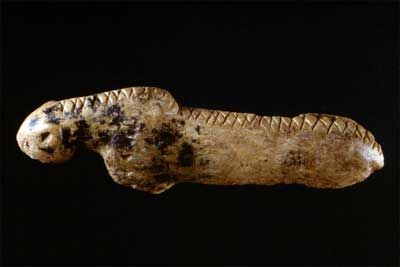
The lion figurine is 5.6cm long, and is depicted with an outstretched neck and head. Although the belly and legs are missing, the back of the animal is decorated with a crosshatch design that seems to represent fur. The muscular structure of the lion also seems to have been attempted, with defined leg joints that may be representative of the detailed limbs that have been lost.
These figurines are some of the most impressive examples currently known of figurative art from the Ice Age, and certainly help to understand the balance of life that existed between animals and humankind 35,000 years ago – not to mention the advanced level of human artistic skill!
Want to read more?


Tomorrow: Ancient Roman makeup
By: The Scribe on June, 2007
 According to recent studies, it appears that people in the Stone Age didn’t drink milk – at all. Although modern Europeans rely on milk as a part of their diet, ancient Europeans were only able to digest milk up until the end of childhood – after which their bodies simply weren’t able to process the lactose through their systems.
DNA analysis of Neolithic skeletons showed that there might be a reason why today’s Europeans have the highest percentage of lactose tolerance in the world, more precisely in Europeans from north and central regions. It turns out that before dairy farming, humans had no need to be able to digest milk during adulthood, and it was only after dairy animals were introduced in Europe around 8000 years ago that humans began to be able to drink milk without getting sick.
The truth is, most mammals lose the ability to produce lactase after childhood, an enzyme in the intestines that is needed to digest lactose – it turns out that humans who still produce lactase actually have genetic mutation that allows them to do so. Essentially, Neolithic humans were normal in their lactose intolerance – and most European and African humans are the weird ones with a genetic mutation that allows them to keep drinking milk.
Today, the only modern humans that can properly digest milk are those from European, African, and Middle Eastern descent – wherever prehistoric farming communities began to use dairy animals like cows, goats, and sheep in their farm habits. The mutation developed as milk began to be a regular staple in the diet, providing nutrients when other harvests were small, leaving the rest of the world behind in their ‘normalcy’.
So, although you may enjoy your ice cream today, if you’re ever given the opportunity to travel back in time to the Stone Age, leave the Yoplait behind – unless you really want to make your prehistoric ancestors ill.
Want to read more?


Tomorrow: Roman soldiers had to clear their rooms too.
By: The Scribe on June, 2007
 In a cave in southwestern Germany, three very small ivory figurines were discovered that seem to suggest Early Man wasn’t as artistically inept as once thought. These tiny figurines have been dated to around 30,000 years old, making them part of the period in time when scientists believe Neanderthals and Homo Sapiens lived as neighbors to each other.
All three of the figurines were less than 5 centimeters long, and are each very distinct forms: one is a bird that closely resembles a duck, one is a horse, and the third piece is a semi-human and semi-animal creature that appears to have the face of a lion and a man’s body.
Hailing from three additional sites not too far from Hohle Fels cave, where these figurines were discovered, archaeologists have a collection of 17 other artistic objects, including a rather complex musical pipe made of swan bone. These 20 objects in total, all from the Swabian Jura area in southwestern Germany, make the collection the “oldest body of figurative art in the world”, according to British archaeologist Anthony Sinclair.
These objects also refute the previously established notion that early humans were only capable of primitive cave paintings, and hadn’t yet developed their aesthetic senses. It was thought that early man slowly developed their skills over time, as they acquired better tools and materials – but looking at these figurines, clearly this evolutionary theory is now entirely unnecessary!
 The earliest objects considered to be art are still cave paintings, however, and these are located in underground chambers in the Ardeche region of France. At 29,000-34,000 years old, these charcoal drawings depict horses, rhinos, and a deer. There has been a small stone carving found in the Golan Heights near Israel, thought to be dated at around 200,000 years old, but this has yet to be confirmed – so for now, these tiny ivory figurines are our best link to the evident artistic proficiency of early humankind!
Want to read more?


Tomorrow: Milk – it does a body poor, apparently…
Previous page | Next page
