Archive for the ‘Ancient Greece’ Category
By: The Scribe on April, 2007
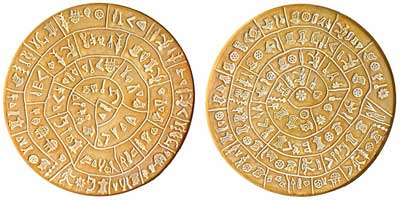
Found in 1908 on the island of Crete, the Phaistos disc remains one of the most disputed – and most mysterious – archaeological artifacts of the 20th century. Its purpose, meaning, and place of manufacture are still under debate, while the disc itself still cannot be translated. It was discovered intact at the site of Phaistos, a Minoan palace that may have collapsed due to an earthquake in the region.
The symbols on the disc bear some resemblance to Linear A and Linear B, causing many amateur archaeologists to attempt to decipher its meaning. However, unless some comparative examples turn up, there simply does not appear to be enough context available to decipher the text. In the past, almost everything has been speculated as potential content: a list of prayers; an epic story; a military announcement; a board game; even a geometric theorem.
The inscription itself was made by pressing seals into the soft clay of the disc, which was then baked in an extremely hot oven – probably a pottery kiln. There are 241 figures on the disc, and the symbols are of a very wide variety: fish, birds, human heads, a shield, a boat, plants, and many more. The inscription probably reads from the outside in, the text starting at the outer edge of the disc and spiraling inward. This is evident from the corrections made by the scribe while composing the text, which are still visible!
Want to read more?


Tomorrow: 4000 year old perfume

By: The Scribe on April, 2007
 After the Persians recovered the body of Leonidas, Xerxes was apparently so enraged at the loss of thousands of his own soldiers that he ordered Leonidas’ corpse decapitated and crucified. This was highly unusual for the Persians, who typically showed great honor and respect for those who fought against them. However, Xerxes’ temper had a reputation: in 482 BC, he attempted to build two bridges across the Greek Hellespont, but when they were destroyed by a storm, Xerxes ordered the sea to be punished with 300 lashes. He also had the builders of the bridges decapitated, as if they had caused the storm themselves.
Soon after the Persian victory at Thermopylae, the Athenians gathered their naval forces and met the Persians in the Battle of Salamis. The Athenian navy was so strong that Xerxes was actually forced to retreat, leaving behind his land force. The remaining Persian army was later defeated in the Battle of Plataea by another allied Greek army, also led by the Spartans.
It is also interesting to note that in the Battle of Plataea, the Phocians who had retreated from their post during the Battle of Thermopylae had now shifted their allegiance to the Persians.
After the Persians were defeated and driven from Greece, the Greeks were finally able to collect their dead. The 300 Spartans were buried on the hill on which they had made their last stand, and a monument was erected in their honor. Forty years later, the Spartans recovered the bones of Leonidas from this gravesite and buried them in Sparta, where he was reburied with full honors and the establishment of an annual games competition in his memory.
Want to read more?


Tomorrow: The real Immortals
By: The Scribe on April, 2007
 Near the end of the second day, Xerxes received a visitor that would change the entire course of the battle: a traitor named Ephialtes, motivated by the potential of reward from the Persian king, told Xerxes of a path around the Hot Gates. Ephialtes offered to lead the army through the pass – and so Xerxes, clearly unwilling to give up this opportunity, sent 10,000 more of his Immortals and 30,000 additional troops to flank the Greeks… at night!
Leonidas had stationed 1,000 Phocian volunteer troops along the path to guard it, and ensure that the Persians would not take the pass before reinforcements were able to stabilize the situation. However, the Phocians did not hold their position – they fell asleep, and upon hearing the Persian force approach, awoke startled and then retreated at the first sign of Persian arrows.
Just before dawn, Leonidas learned that the Phocians had failed to hold the pass. He called a council of war, where some Greeks argued for withdrawal in the face of seemingly inevitable loss. Though some Greeks pledged to remain with the Spartans, who refused to leave, Leonidas allowed all those allied Greeks who wished to leave – instead of fight a losing battle – to depart without consequence.
Having pledged themselves to fight to the death – indeed, the oath required of every Spartan warrior was to “stand in place, win or die” – the remaining Spartans and Greek allies moved away from the Phocian wall to a wider part of the pass, in an attempt to slaughter as many Persians as possible. They fought with spears until they broke, whereupon they switched to swords.
Upon learning the location of the Immortals, the Spartans withdrew from the pass and took their last stand on a small hill. Some Spartans still had their swords, others fought only with their hands and teeth… tasting victory, Xerxes tore down the wall, surrounded the 300 Spartans, and ordered arrows rained down upon them until every Greek was dead. Archaeological excavations have found evidence for this final shower of arrows, and it was in this place that a monument was later erected to honor the bravery of the 300 Spartans against Xerxes’ hundreds of thousands of warriors. It read:
Go tell the Spartans, stranger passing by,
That here, obedient to their laws, we lie.
Want to read more?


Tomorrow: The aftermath
By: The Scribe on April, 2007
 While readying themselves for battle, the Spartans had rebuilt an old Phocian wall, which sat at the most defensible position in the pass – here, the cliffs squeezed the land to less than 20 yards across. Xerxes sent in the Medes to gather Greek prisoners, however because the Spartans were using the wall as a reference line for battle, it was said that the Greeks killed so many Medes during this wave of assault that Xerxes stood up from the seat where he was watching the battle three times, startled.
What battle tactics were used are not quite as well known, however it is likely that the Spartans led the rest of the Greeks in a phalanx formation, which is a wall of overlapping shields with spear points in between. This likely spanned the width of the pass, making the army’s front lines impenetrable. Since the Persians fought with short spears and arrows, there was no way for them to move past the points of the long spears. Some scholars have argued that in order for even one Greek soldier to be killed, it would have taken three Persian warriors working together.
It was then that Xerxes realized that his reserve unit of elite forces was needed: the Immortals. This was an elite corps of 10,000 men, but when Xerxes realized that almost the entire force had been cut down, he sent in another 20,000 men – and these also failed to get through the pass, even though many were whipped by their own generals in order to make certain they kept attacking. As for his own forces, Leonidas had arranged a shift-like system, whereupon fresh troops would spell each other on the front lines after a set period of time.
Realizing that not even his elite forces could break through the Greek lines, Xerxes recalled his army. The following day, another 50,000 soldiers were sent, and again met with failure. Considering the amount of Persian bodies on the battlefield by this point, it is highly likely that the mountains of corpses may have detracted from the Persian morale.
Indeed, it seemed as though the campaign of Xerxes against Greece seemed to be heading to a close, in favor of the Spartans and the other Greek allies…
Want to read more?


Tomorrow: The final stand
Previous page | Next page
