Archive for the ‘Ancient Greece’ Category
By: The Scribe on June, 2007
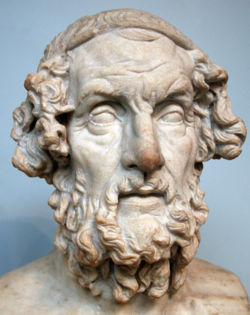 ‘Homer’ is the name of the ancient Greek poet traditionally attributed to the composition of the famous poems Iliad and the Odyssey: the Iliad tells the story of the Trojan War, while the Odyssey details the journey of the warrior Odysseus as he attempts to make his way home after the war has ended. Dated to around the 8th or 7th centuries BC, it is debated whether Homer actually composed the poems, or simply borrowed them from an already established oral tradition.
Almost nothing is known concretely about the life of Homer or who he even was, though tradition claims that he was blind – various Ionian cities also claimed themselves as his birthplace, confusing the matter further. Indeed, there is no definitive evidence to even say that he ever existed as a real person, however the ancient Greeks were highly familiar with these poems and seemed to accept that a poet named Homer did, at some point, live and compose tales of the Trojan war.
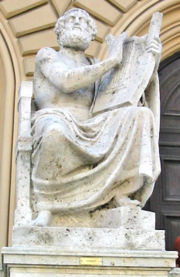 At the very least, it seems that Homer drew on the local ‘oral tradition’ of stories and tales about the Trojan War, known as the ‘Epic Cycle’, and re-wrote them as one large, coherent story. In fact, it is even possible that Homer did this without writing the poems down, and simply passed on his extensive repertoire of poetry through oral transmission – much like bards in Medieval Europe – and that they were not physically written down by a scribe until much later.
Scholars have also wondered about the level of truth in Homer’s poems – did he compose the Iliad and the Odyssey based on real events? Did a war against a city called Troy ever take place? It is possible that stories about a real war had been passed down and elaborated upon for generations, eventually reaching the point of legend – the events of which could then be composed as an entertaining, dramatic performance-driven piece of poetry.
The ancient Greeks revered Homer, and greatly admired his contribution to their culture and literature. Some Greek colonies, such as the city of Argos and the later Hellenistic city of Homerion, even developed ‘hero cults’ for Homer, and carried out ritual sacrifices in his name.
Want to read more?

Tomorrow: More interesting history!

By: The Scribe on May, 2007

During excavations at the town of Argos in Greece, archaeologists discovered a 2,700-year-old copper urn inside of a burial. The burial was oddly reminiscent of the elaborate cremation rituals for soldiers as described in Homer’s Iliad, but it was what they found inside of the urn that was the most shocking: a yellow, brittle material which could be nothing other than a piece of ancient fabric.
In places like Egypt and the Near East, it is quite common to find fabric from thousands of years ago, due to the dry climate which prevents humidity from causing organic fibers to decompose. However, in places like Greece and along the Mediterranean coast, organic material decomposes very easily, due to the high levels of humidity. Very few organic artifacts have been found in the past in Greece, making this small piece of fabric of enormous historical value.
Conservation experts explained that because the fabric was placed inside a copper burial container, which began to corrode over time, copper oxides from the urn were able to kill the microbes that normally destroy fabric. In order to learn as much as possible from this find, the fabric is scheduled for testing that will determine the what kind of fabric it is, and what weaving techniques were used.
The fabric was not the only item inside the urn – there were also dried pomegranates, ashes, and charred human bones. The actual burial itself is also unique, because cremation was not a normal practice in Argos during this time. Of the six burials that
were closely grouped together on this same plot of land, the urn was the only cremation burial. One possible explanation for this is that the person in charge of this burial had a personal desire to imitate the ‘heroic’ funerary custom as described in the Iliad, for the purpose of making this burial stand out among the others.
Since Argos is one of the cities mentioned in the Iliad as the home of a the great Mycenaean warrior-king Agamemnon, it is possible that the individual buried here thought himself associated with the legendary ruler in some way.
Want to read more?
The Iliad of Homer
Tomorrow: Ancient Jewelry
By: The Scribe on May, 2007

Standing near the harbor entrance of the island of Rhodes, construction of the Colossus began after the small island was attacked by the Antigonids of Macedonia – rivals of the Ptolemies in Egypt, with whom Rhodes had a strong trade alliance. Incredibly, the Macedonians were unable to take the Rhodian capital, and instead were forced to make a peace treaty in 304 BC. When they left the island, the Macedonians left behind a substantial amount of military equipment – which the Rhodians promptly sold, and then used the money to create a giant statue of their sun god, Helios.
Although the Colossus only lasted for 56 years, from building to destruction, the statue likely stood at the eastern promontory of the Mandraki harbor, or possibly even further inland. While it has been long believed that the statue stood straddling the harbor entrance, due to the height of the statue, width of the harbor mouth, and the fact that the fallen Colossus would have blocked the entire harbor, the idea is simply not conceivable.

The outer skin of the statue was cast in bronze, while the base was made of marble. Using an iron and stone inner frame, the structure was gradually erected, making use of an earth ramp to reach the upper sections. Its final size was around 33 meters high.
Construction of the statue took 12 years, until an earthquake around 226 BC shook the island and shattered the Colossus’ knee. Although Ptolemy III of Egypt offered funds to cover restoration of the statue, an oracle forbade any reconstruction work and thus the offer was declined. Despite this, the Roman philosopher Pliny the Elder still remarked that “even lying on the ground, it is a marvel.”
Want to read more?
Seven Wonders of the Ancient World
Tomorrow: The Pharos
By: The Scribe on May, 2007

Created by the Classical sculptor Phidias in the 5th century, the statue of Zeus at Olympia was a tourist destination for the ancient Greeks as early as, well…its completion! Phidias was famous in ancient Greece for his incredible gold and ivory statues – however the statue of Zeus was considered his greatest accomplishment.
Housed in the Temple of Zeus at Olympia, the chryselephantine statue reportedly took Phidias 12 years to complete. The frame of the statue was likely made of wood, with ivory sheets used to create the white flesh of the god, embellished with gold sheets for drapery. At 12 meters (40 feet) tall, the statue occupied the entire rear of the temple aisle and nearly touched the ceiling.
Phidias’ Zeus was seated on a wooden throne, with ivory, ebony and gold inlay; Zeus’ right hand would have held a small statue of Nike, with an eagle-topped scepter in his left hand. His head would have been crowned with an olive wreath, and in true Greek style, on the god’s feet were sandals – in this case, made of gold. In front of the statue, Phidias placed a shallow pool of oil, in order to prevent the ivory from eroding in the humid climate.
The Greek historian Strabo commented on the statue’s height in one his writings: “it seems that if Zeus were to stand up, he would unroof the temple.” In fact, according to Strabo, Zeus’ entire chair was carved with images from Greek mythology: Apollo and Artemis killing the children of Niobe, sphinxes, and the three Graces.
The statue remained in the cella of the temple for upwards of 800 years, and the cause of its destruction is heavily debated. Some scholars assert that it was destroyed by fire around 475 AD, while others suggest it was destroyed along with the temple itself – probably by earthquake – sometime in the 5th century AD.
Want to read more?


Tomorrow: The Mausoleum
Previous page | Next page
