Archive for the ‘Ancient Greece’ Category
By: The Scribe on July, 2007
 According to the Greek historian Herodotus, Aesop’s fables were composed by a slave who lived in ancient Greece sometime during the 6th century BC. Whether or not Aesop himself was the person who committed his fables to writing is another debate entirely, however there is no doubt that Aesop actually existed – many other famous Greek authors mention his name in their writings, such as Aristophanes in his play The Wasps, and Plato in the work Phaedo, where he reports that Socrates actually spent some of his time in jail turning Aesop’s writings into verse. Another ancient Greek by the name of Demetrius of Phalerum compiled Aesop’s fables into a set of ten books that orators could use for their speeches, however these have long since been lost.
A man by the name of Phaedrus was the first person to translate Aesop’s writings into Latin, during the 1st century AD. Sometime either before or after Phaedrus, another Greek writer by the name of Babrius compiled his own edition of the stories, which is thought to have been a major source of inspiration for many subsequent versions. Later during the 4th century, a Latin author by the name of Avianus translated 42 of the fables and turned them into a kind of Latin poetry called ‘elegiac’.
Intriguingly, a number of Eastern and Oriental sources picked up the fables and translated them for their own reading, helping to preserve the stories throughout the centuries. Thus, it was only in the 14th century when a monk by the name of Maximus Planudes re-translated and put together the collection of stories known to modern audiences as Aesop’s Fables.
In 1484, the first English version of the fables was printed by William Caxton, the man who introduced England to the printing press. It was subsequently updated in 1692 and then again in the mid-1800s, and many of the more recent publications of the fables now omit some of the stories from certain major ancient sources, including some from Babrius and Phaedrus.
Whether Aesop was the originator of all of the fables is debatable, as many of the stories seem to have been crafted out of the Eastern sources, possibly borrowing from their folk tales just as much as they originally borrowed from Aesop. Many tales from the Sanskrit Panchatantra are morality-themed or didactic tales centered around animals.
But who, exactly, was Aesop himself?
Want to read more?

Tomorrow: The truth behind the myth

By: The Scribe on July, 2007
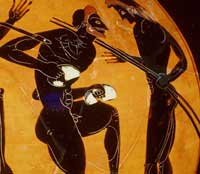 While long jumpers at the modern Olympics have the advantage of a running start before their jump, athletes in ancient Greece did things a little differently. They started their jump with both feet flat on the ground – but with a weight in each of their hands. These weights were called halteres , and their shape and size are visible on a number of vase paintings that survive from ancient Greece.
How could a heavy weight possibly help an athlete jump further? The technique was to swing both arms backward and forward before the jump, slowly gaining momentum, with the arms thrust forward at takeoff. This would allow the jumper to propel himself into the air with more force – after all, leg muscles actually become more efficient when contracting against a load. The result could be likened to a springboard effect.
With their weight shifted upward at the beginning of the jump, the athlete would then need to shift his center of mass in midair – he would thrust the halteres back behind him, and possibly even let go just before landing. This would allow his feet to push forward just a bit further, which is what counts in the long jump: where your heels land is where your distance is measured.
 The weights were made out of stone or lead, and could weigh anywhere between 2 and 9 pounds, depending on the size and arm length of the athlete. They were carefully carved to provide maximum comfort when gripping the weights, and each long jumper probably had at least two sets, in case one broke when thrown back.
During the 18th Olympics in 708 BC, the role of long jumping was altered somewhat, and instead of being included as an event on its own, it was incorporated into the pentathlon. In 656 BC, although he didn’t necessarily win the entire pentathlon, a man named Chionis of Sparta earned the ancient long jump record at 7 meters and 5 centimeters – and that’s without a running start! If he had completed this jump during modern times, Chionis’ feat would have won him the long jump title at the modern Olympics in 1896, and placed in the top ten at another 8 Olympic summer games.
Want to read more?

Tomorrow: Ancient cancer clues
By: The Scribe on July, 2007
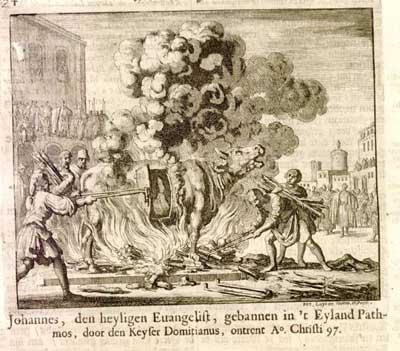
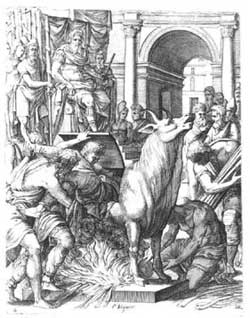 Sometime during the 6th century BC, a brass-founder by the name of Perillos of Athens made a proposition to Phalaris, the tyrant of Acragas. He had come up with a new means of execution for criminals: he would make a hollow brass bull with a door in the side, and the condemned could be shut inside. A fire would then be set underneath the bull, heating the metal to extreme temperatures and thus causing the person inside to slowly roast to death.
According to tradition, Phalaris had a penchant for cruelty and highly approved of this new device, and commissioned Perillos to ensure that the bull’s head be constructed in such a manner that the screams from the inside would pass through a complex system of tubes and stops, causing a noise to sound like the bellowing of an angry bull. Once the device was completed, the story goes that Phalaris asked Perillos to show him how this brazen bull worked – and once Perillos had climbed inside to demonstrate, Phalaris promptly locked the door and lit a fire underneath.
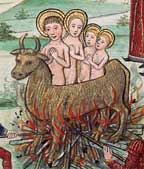 Although some historians have dismissed this story of the brazen bull as an invention of later, creative imaginations, the Roman historian Pindar – who lived a century after Phalaris – clearly associates the tyrant with the torture device in his own writings.
Later use of a brazen bull, however, is clearly documented during the Roman era. A number of Christian martyrs were reported to have roasted to death inside a bull, including Saint Eustace who was apparently roasted with his wife and children at the order of Emperor Hadrian. During the time of severe Christian persecutions under Emperor Domitian, Saint Antipas met his fate in a brazen bull, while Saint Pelagia of Tarsus was burned inside a bull in 287 AD at the orders of Diocletian.
Want to read more?


Tomorrow: The four ancient books of Wales!
By: The Scribe on June, 2007
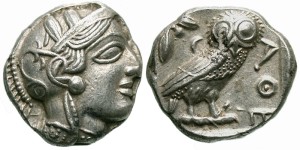 Looking at almost any modern coin, it’s rare to find one that contains anything other than this standard decoration: an important civic symbol on one side, and a bust of a ruler on the other. Believe it or not, this traditional coin setup actually began several thousand years ago in ancient Greece.
The first coins to be minted actually came from two places, where the idea of making small metal medallions that could be traded as currency seems to have developed simultaneously. At the end of the 7th century, both China and Lydia had begun to make plain, round coins for trade. The Greek historian Herodotus, in his work the Histories, briefly mentioned that the Lydians were minting coins around 600 BC. Either way, it wasn’t for another 150 years that coins became prominent around the Greek city-states.
Before the Greeks used minted coins, they made use of small iron rods for currency, called ‘obols’. Since around six obols could fit into the hand of an adult, six obols became equivalent of one drachma coin, once the system transferred over to coinage. In ancient Greek, the word drachma actually means “the graspable” – thus making it a logical choice of name.
The island of Aegina was the first place in Greece to mint coins, made out of silver with a very basic geometric shape on either side. Around 500 BC, the Attic drachma had become widely used in the cities, but hadn’t yet spread to the outlying areas. These early Greek coins had Athena’s owl stamped on one side, the head of Athena on the other, and were made of almost pure silver.
The Athenians produced huge quantities of coins during the Classical era, around 450 BC, in order to finance their enormous building projects on the Athenian acropolis. They also needed finances to pay for the Peloponnesian War, and it wasn’t long before Athens was demanding the required tribute payments from surrounding city-states in coinage.
Although the pictures on ancient Greek coins remained the same basically until the rise of Alexander the Great – when he would mint his own coins with his image on them – this means that the artistic history of the ancient Greeks can be traced with these coins, as artists’ techniques and tools developed over several centuries.
Want to read more?


Tomorrow: More great ancient history!
Previous page | Next page
