Archive for the ‘Ancient Greece’ Category
By: The Scribe on July, 2007
![Venus de Milo, one of the most famous pieces of Greek sculpture.]](http://ancientstandard.com/images2/venus.jpg "Venus de Milo, one of the most famous pieces of Greek sculpture.]") As one of the most famous and identifiable pieces of sculpture in the world, the Venus de Milo would be hardly recognizable if restored to her original state. She was created from a block of marble by a relatively unknown wandering artist by the name of Alexandros of Antioch, identified from an inscription that was once part of the statue’s plinth – reversing the previous belief that credited the famous Athenian Praxiteles for the work.
As one of the most famous and identifiable pieces of sculpture in the world, the Venus de Milo would be hardly recognizable if restored to her original state. She was created from a block of marble by a relatively unknown wandering artist by the name of Alexandros of Antioch, identified from an inscription that was once part of the statue’s plinth – reversing the previous belief that credited the famous Athenian Praxiteles for the work.
The Venus de Milo is a depiction of the Greek goddess Aphrodite, created slightly larger than a life-sized human at 203 centimeters high. She was sculpted using a combination of Greek sculptural styles: although created during the Hellenistic period where there was a focus on realism, her mask-like face and perfect proportions are reminiscent of the idealistic Classical era.
Although her arms and most of the original base have been lost, disallowing any certain knowledge of what the statue was actually meant to depict when it was created, there is speculation that it was meant to be a representation of Aphrodite holding the golden apple that was presented to her by Paris of Troy from the well-known story of the Trojan War. If this was the case, it would have also been a pun on the island’s name – Milos – which meant ‘apple’ in ancient Greek. There were several fragments of a left arm, left hand, and what seems to be an apple found near where the statue was buried, which are thought to be parts of the original arms.

What most people do not realize when looking at the Venus de Milo is how she would have appeared in ancient times – the image would have been far, far from the creamy white marble that remains today. Instead, the statue would have been painted in a gaudy display of red, yellow, blue, green, and any other color that could have possibly been created at the time. Not only that, but she would have been covered in jewelry and situated inside a wall niche, probably at a gymnasium.
This was standard practice for Greek statues, and was actually meant to help them appear more lifelike and appealing! Of course, all the jewelry has been long lost – but the evidence for their existence remains in the small, drilled attachment holes on the statue’s ears, wrists, neckline, and at the top of the head.
Want to read more?


Tomorrow: All hail the sacred bean!

By: The Scribe on July, 2007

Clearly, Aesop’s most enduring legacy was his fables. Though the majority of his personal history remains unclear, many of his tales have survived for thousands of years, often read to children at bedtime or to teach them a moral lesson. However, Aesop’s stories were never meant for children – in fact, more often than not, he used them in a public forum to win an argument or make a point, and it is likely that he told many of his tales while conversing with some of the greatest Greek philosophers of all time.
Here are the names of some of Aesop’s best-remembered tales and the wisdom they were intended to teach:
The Grasshopper and the Ants: A grasshopper (or cicada, in the original Greek) spends the warm months singing and playing while the ants work for months to store food for the cold winter…when winter comes, the grasshopper begins to starve, while the ants reap the benefits of their hard work.
Moral of the story: Hard work pays off, while improvidence is peril.
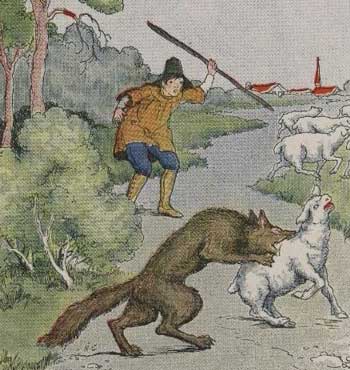
The Boy Who Cried Wolf: A bored shepherd boy amuses himself by calling “wolf” so that the villagers will run to help him… only to find that it’s a false alarm. When a wolf actually comes, no one takes his cries for help seriously, so he loses his sheep to the wolf.
Moral of the story: “Even when liars tell the truth, they are never believed. The liar will lie once, twice, and then perish when he tells the truth.”
The Goose That Laid the Golden Eggs: A farmer and his wife are fortunate to have a goose that lays a golden egg every day, but soon they begin to think they aren’t getting rich fast enough… so, thinking the goose must be golden inside, they cut him open to get all the gold – only to discover he is just like any other goose. Now they can neither get rich quick nor enjoy a bit of wealth each day.
Moral of the story: Greed destroys the source of all good. Much wants more yet often loses all.
The Tortoise and the Hare: One day, a hare mocks a slow-moving tortoise – so the tortoise challenges him to a race. The hare pulls ahead quickly in the race and decides to take a nap, confident in winning. But, when he wakes up, he discovers that the slow tortoise has already won.
Moral of the story: Slow and steady wins the race.
Want to read more?

Tomorrow: Ice, Ice, Britain…
By: The Scribe on July, 2007
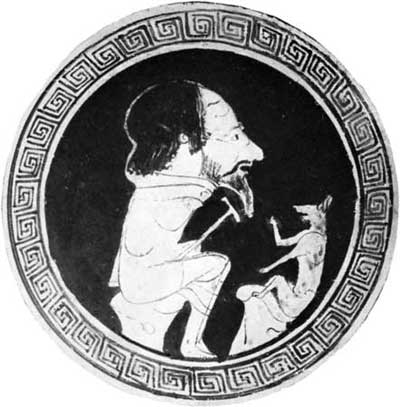
It was during the reign of Peisistratus that Aesop visited Athens, where he told a fable called The Frogs Who Desired a King, in an attempt to dissuade the Athenian citizens from deposing Peisistratus in favor of another ruler. Although his words were successfully received here, further travels across the Greek world would prove his downfall.
It was upon a visit to Dephi that Aesop met a violent end at the hands of the inhabitants there. The cause of this remains unknown, as Herodotus does not explain why Aesop was killed – of course, various theories have emerged on their own, such as the suggestion that Aesop directed highly insulting sarcasm toward certain well-known people, or that he embezzled money that was trusted to him by Croesus, or that perhaps he stole and defiled a sacred silver cup.
After Aesop’s execution, Delphi was apparently fraught with a pestilence, which caused the inhabitants to agree to make compensation for their actions – essentially, realizing they had killed the wrong man. For lack of a closer connection with anyone else, the compensation was claimed by the young Idamon, grandson of Aesop’s former master.
After his death, it was said that the Athenians erected a statue in Aesop’s honor, created by the extremely famous sculptor Lysippos. In fact, the knowledge that this statue was placed in a public area in Athens decries the false but traditional assertion that Aesop was ‘ugly and deformed’, a rumor circulated in the 14th century by a German monk and scholar. Since none of the other Greek writers ever made their own comments on Aesop’s appearance – only referring instead to his previous servile status – there is no reason to believe that there was anything abnormal about his outward appearance.
Instead, it seems that Aesop met his end as a result of a misunderstanding – however, because of the Greek world’s appreciation for his tales and contribution to their storytelling repertoire, his work has continued to be read and loved by many people for thousands of years after his death.
Want to read more?
Tomorrow: How many of these ancient fables do you remember?
By: The Scribe on July, 2007
![Portrait of Aesop as published in the Nuremberg Chronicle in 1493.]](http://ancientstandard.com/images2/aesop2.jpg "Portrait of Aesop as published in the Nuremberg Chronicle in 1493.]")
Although it is known for certain that Aesop was born a slave and lived during the 6th century BC, his actual place of birth was disputed during ancient times – and the controversy remains unsolved today. Various places, including Phrygia, Thrace, Ethiopia, Egypt, Samos, Athens, Amorium and Sardis have all claimed him as their own – but of course, none can actually prove he was born there.
One theory, however, suggests that he may have been from Africa, since his name could have been derived from the word “Aetheopian”, a word which the Greeks used to refer to dark-skinned people from the inner parts of Africa. Also, many of the animals in the stories are typically considered foreign to Greece and native to Africa, though the true extent of this remains debatable. Also, it was not unusual for Greeks to travel extensively – after all, Herodotus described the wonders of Egypt and the Near East his own writings.
Regardless of the origins of his birth, the rest of the details surrounding Aesop’s life are also highly obscure. The rather sparse ancient accounts from other Greek writers place him living as a slave in Samos around 550 BC, under the employ of some men named Xanthus and then Idamon. He must have proven himself loyal and been highly favored by Idamon, because a later account from Aristotle describes Aesop’s public defense of a Samian demagogue – meaning he must have been freed by his last master.
After this, his social status grew to the point where he was invited to dine and converse with some of ancient Greece’s most prominent public figures. He is known to have remained at the court of Croesus, King of Lydia, for some time, whereupon he met the famous Greek political and social reformer Solon, a man considered one of the Seven Sages or wise men of ancient Greece. It was here that he also dined with the Seven Sages of Greece, including the tyrant Periander of Corinth.
However, he was not to be well-received by everyone across the Greek world…
Want to read more?
Tomorrow: Aesop’s downfall
Previous page | Next page
