Archive for the ‘Ancient Greece’ Category
By: The Scribe on September, 2007
 According to a 2000-year-old recipe for hair dye, the ancient Greeks and Romans were harnessing a scientific force that they had no idea even existed – they were using nanotechnology on their very own heads.
The Greeks and Romans used hair dye with some measure of frequency, most often for the purpose of dying their gray hair to black. Their dry mixture contained ingredients such as slaked lime and lead oxide, which – when exposed to human hair for approximately 3 days – causes nanocrystals made from lead sulfide to form inside the shaft of hair.
This reaction is caused when sulfur from the amino acids that are naturally present in hair keratins mix with the lead in lead oxide – initially, this is what causes the hair to turn black, but it apparently also causes lead sulfide nanocrystals that are highly similar to those found in modern, advanced scientific processes!
In simpler terms, the chemical compound that forms inside of the human hair is what colors the hair without damaging it – and the process by which the hair is dyed black is very similar to modern nanotechnology. Fortunately for the Greeks and Romans, this kind of lead-based hair dye is safe for human use, since the compound typically has trouble penetrating the skin.
Interestingly enough, the chemical engineering that came from this dye process – where the tiny crystal structures line up to form ‘quantum dots‘ – is something that scientists have admitted is a “current challenge in nanotechnology”, and is actually a process that researchers are currently trying to figure out how to develop on their own.
Turns out there really is some truth in the saying “it’s all been done before”…!
Want to read more?


Tomorrow: More Ancient Standard!

By: The Scribe on August, 2007
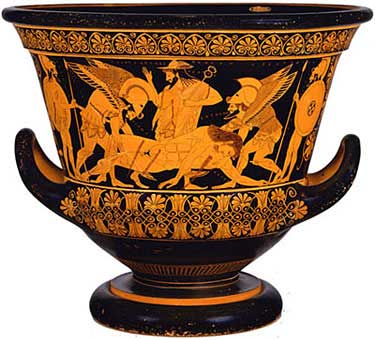
The two-handled ancient Greek bowl shown here was created around the year 515 BC, and is considered to be one of the finest existing Greek vases today. Referred to fondly as the ‘Euphronios krater’, the bowl was made out of terracotta in the calyx-krater style, and would have been used to mix wine with water. It can hold about 45 liters of liquid, and was decorated with the red-figure pottery style.
The bowl represents a collaborative effort between two men who were known as some of the best artists to have lived in the 6th century BC in Athens. The potter’s name was Euxitheos, and the painter was Euphronios – looking at the vessel, it is not difficult to see that the shape of the bowl and the figural composition work together almost perfectly to create a vivid scene that conforms precisely to the proportions of the vessel.
Quite unusually, both the painter and the potter signed their names to this bowl! Usually it was only the painter who signed his name, however on this piece, both men who worked on it gave themselves credit for the work – which seems to suggest that they both believed that it was one of their best pieces ever created.
There are two scenes on the Euphronios krater . The first side depicts an episode from the Trojan War: the death of Sarpedon, son of Zeus. On either side of the dying man, personifications of Sleep and Death lean over to pick up Sarpedon and carry him off to his homeland for burial. Behind the youth is Hermes, directing the way for the body to be carried. The level of detail in this scene is so intense and graphic that not only did Euphronios choose to illustrate the scene while Sarpedon is still bleeding profusely from his wounds, but you can also see extremely delicate details such as his eyelashes and toenail cuticles!

On the opposite side, Athenian youths arm themselves for war or training – the scene seems rather generic, however the ideal of young, fit, trained men ready for battle was an important part of Athenian culture at the time the vessel was crafted.
Along with the painters’ signatures, there is an inscription on one side that reads: “Leagros is handsome.” Incredibly, this inscription was what allowed historians to date the bowl accurately to around 520-510 BC, because it was at this time that textual evidence explains that Leagros was considered by many people to be the handsomest man in Greece!
Want to read more?


Tomorrow: More Ancient Standard
By: The Scribe on August, 2007
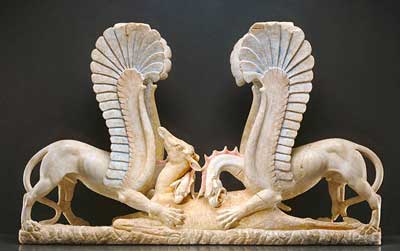
In this marble table support piece, two griffins with upraised wings tear violently into the flesh of a fallen doe – a symbol of civilization’s oppression of barbarism, or perhaps more candidly, the oppression of any group of people who did not conform to the ‘proper’ Greek way of life. Mythological creatures that blended together elements of lions, snakes, and eagles were quite popular in Greek art around 300 BC, and images of these creatures were often used as a metaphor for the struggle and confrontation between life and death.
Aside from some very minor additions, this piece of sculpture was carved from one, single block of marble – but it did not always appear the way it now stands. In fact, the entire sculpture was once covered in richly colored paint, some of which still remains in trace amounts. There are small spots of blue still visible on the griffins’ wings, bright red on their manes, traces of brown on the deer’s body, and some remnants of green on the base.
Adding an element of the macabre to an image that already exudes violence, small traces of red paint that represent blood remain around the mouths of the griffins and inside of the claw scratches on the deer’s body. If it were not for the cut marks along the top and inner surfaces of the wings, it would not be obvious that the 3-foot-high sculpture served as the base for a table!
Although very few examples of furniture of this elaborate magnitude have survived, the unfortunate truth is that the exact provenance of this piece is unknown – it is only known to have come from someplace in Southern Italy, called “Magna Gracia” in ancient times – and it was probably looted many years ago from a site near the Italian town of Foggia. While it is currently on display at the Getty Villa, it is under negotiations to return to Italy in the near future.
Want to read more?

Tomorrow: Mmmm Manioc…Ancient Manioc!
By: The Scribe on August, 2007
![The ancient training grounds at Olympia.]](http://ancientstandard.com/images2/palaestra.jpg "The ancient training grounds at Olympia.]")
While the modern-day Olympics have certainly changed since their inception in 776 BC, one thing has certainly remained the same: all athletes, past and present, have been concerned with their diet. An athlete’s mealtime can make or break his performance, which the ancient Greeks were well aware of. In fact, food historians are realizing that the diet of the first Olympians wasn’t that far off from what people in the 21st century would identify with the popular “Atkins” diet!
There are a wealth of Greek and Latin texts, such as The Deipnosophists – or in English, The Philosopher’s Banquet – which is a 15-volume tale of a long feast that was written around 200 AD, wherein food origins and quality are discussed at length. This tale, written by a Greek named Athenaeus, centers around a banquet where diners talk extensively about all different kinds of food and where it came from – and not only that, but each character provides the ancient literary source for their own words! Essentially, it’s an ancient document wherein the characters talk about food using quotes from other real, ancient documents.
Unfortunately, out of the 1,500 documents that were cited in the work, only 15 still survive. Still, these documents provide valuable insight into ancient Mediterranean cuisine and how it was prepared.
For most people, a regular diet would consist of items like bread, fruit, and vegetables, while fish was the primary meat source for an average citizen. But Olympians, who typically came from the upper social classes in ancient Greece, had families who could afford to feed their children heartier meats and other protein-rich foods that helped to condition and build muscle.
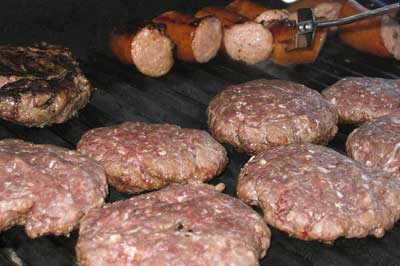
Although the earliest reports of Olympic diets seemed to center around eating mostly cheese and fruit, the focus was shifted toward meat somewhere along the way. Apparently, this happened after one ancient Olympic runner won multiple competitions after eating a meat-only diet – which naturally started a copycat craze. The athletes were also advised to avoid eating bread right before their competition, and to snack instead on dried figs.
The Deipnosophists also includes this intriguing tale about a wrestler named Milon of Croton, who is recorded to have attended six different Olympic games and won competitions at each one:
“Milon of Croton used to eat 20 pounds of meat and as many of bread, and he drank 3 pitchers of wine. And at Olympia he put a four-year-old bull on his shoulders and carried it around the stadium; after which, he cut it up and ate it all alone in a single day.”
– Theodorus of Hierapolis’ “On Athletic Contests”, cited by Athenaeus.
Want to read more?


Tomorrow: Pointy teeth are not just for vampires.
Previous page | Next page
