Archive for the ‘Ancient Greece’ Category
By: The Scribe on November, 2007
 A 2,400-year-old shipwreck off the coast of the Greek island of Chios in the Aegean sea contained a rather tasty surprise – DNA testing on the insides of some of the amphorae yielded a recipe for Greek salad dressing! The shipwreck currently lies 70 meters deep, and is located about a kilometer away from Chios.
Scientists were able to obtain samples of the ancient dressing after sending several underwater robots down to the shipwreck to collect two of the jars. Amphorae were used by the ancient Greeks and Romans to transport liquids and other commodities – things like wine, oil, spices, grain, or olives – and are shaped like large cones. Since they’re made out of earthenware pottery, they have an incredible lifespan, preserving for hundreds of thousands of years, even underwater!
Studies on amphorae from shipwrecks often help to reveal the country of origin of the ship and how old it was, and it isn’t unusual for the jars to often still contain remains of their original contents – finds like this have helped to dramatically increase the amount of information available on trade in the ancient Mediterranean.
 The DNA contents of the amphorae from this shipwreck revealed several common yet interesting ingredients: the jars contained olive oil mixed with oregano. This came as a bit of a surprise to archaeologists, since the island the ship had left from was a major exporter of fine wines – it had been assumed that any ship leaving Chios would have held plenty of amphorae full of wine.
While further investigations revealed that another amphora from the ship likely contained wine – which means there was probably plenty aboard – the oregano-flavored oil seems to have been the primary trade item on this vessel, making up at least two-thirds of the 350 amphorae found on the ship.
It’s likely that strong winds developed soon after the ship left port, causing it to capsize without warning. It is fairly common for the area around Chios to develop sudden storms or fluke winds that are exceedingly dangerous for sailing, however since they are unpredictable, sailors couldn’t simply not leave port for sake of potential trouble.

As a result, it turns out that not only did the ancient Greeks like their salad dressing, but the island of Chios was responsible for a more diverse agricultural program than previously assumed. These people certainly knew what they were doing, as well – in the rural areas of modern Greece, the older women are well aware that adding oregano and other spices to oil helps not only to increase the flavor, but also to preserve the life of the oil much longer.
By exporting flavored oil with an intentional longer lifespan, it’s possible that this ancient preservation method accidentally helped to preserve the oil’s DNA for archaeologists to find two thousand years later.
Want to read more?


Tomorrow: Baby Spears – but not the Britney kind.

By: The Scribe on November, 2007

When talking about art in ancient history, it’s not unusual to stumble across unfamiliar pieces of terminology – and sometimes, the jargon is so obscure that there’s no way you’ll understand what it means unless someone explains it to you.
One of these random pieces of art terminology is the term ‘bilingual pottery’, which was a type of pottery that existed in ancient Greece around the 6th century BC. These vases almost exclusively came from Athens, and included the older black-figure style of decoration on one side of the pot and the newer red-figure style on the other side. Often, both sides would show the same scene, just each one done in a different style!

So, instead of having pots that spoke two languages, the ancient Greek bilingual pots actually showed a period of style-change in the artistic community. Why did the painters and potters decide to showcase both styles at once? It may have come about as a reflection of potters’ uncertainty as to whether or not the public would be willing to accept this new style of decoration – after all, if the public didn’t buy it, they’d have to come up with some new decorative style to market.
They need not have worried, however – red-figure decoration soon took off, and pieces of bilingual pottery became rarer and rarer. In fact, the period in which they were produced was quite short, which may be why so few examples have survived into the present day.

The names of potters who produced these kinds of pieces still survive, however – among those who created bilingual vases are included the Andokides Painter, the Lysippides Painter, Psiax, and Oltos. Of course, the painting style wasn’t limited to vases – Epiktetos the painter created some bilingual cups, while the Andokides Painter worked on both vases and bilingual amphorae.
Want to read more?


Tomorrow: Etruscan terracotta… forgeries!
By: The Scribe on October, 2007
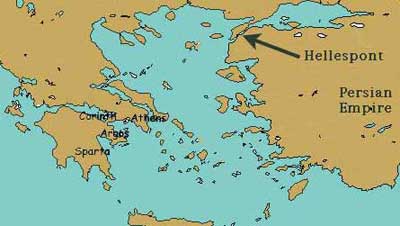
Often referred to by its contemporary European name ‘the Dardanelles’, the Hellespont is actually a long, narrow strait that divides the Balkans from Asia Minor. While that may seem relatively unimportant, the Hellespont also connects the Aegean Sea to the Sea of Marmara, which leads inward toward the Black Sea.
The Hellespont is 61 kilometers long, but only 1.2 to 6 kilometers wide at any given point – which is very, very narrow when it comes to sailing down the strait… not to mention the difficulties and danger that would be involved if a ship needed to be turned around at one of the narrowest spots. In addition, if ships needed to enter the Hellespont from the Black Sea – since that was the only way out – they had to wait on a little island called Tenedos until the winds were favorable enough to allow them to enter the strait. As a result, in ancient times, whoever controlled Tenedos basically controlled the Hellespont – and subsequently all traffic in and out of the Black Sea.
According to Greek legend, the little island of Tenedos was situated near the city of Troy – and after the Greeks left the Trojan horse at the gates of Troy, they went into hiding on Tenedos before conquering the city… and as later mythological events progressed, the strait became named after the mythological Helle, a woman who drowned there during the events of the myth of the Jason and the Golden Fleece.
History’s dealings with the Hellespont were no less dramatic: around 482 BC, King Xerxes I of Persia attempted to have a bridge built across the Hellespont’s width so that his army of “5 million men” (so Herodotus claims) could cross to the other side. Unfortunately for the architects, the first bridge was destroyed by a storm before anyone could cross. Of course, this caused Xerxes to lose his temper as only Xerxes could, and he had the heads of both his bridge architects cut off and ordered the river to be whipped three hundred times – that’s right, he had the water beaten. Thankfully for the next crew, the bridge was a success.
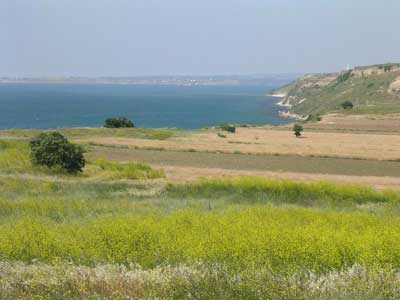
Later on, the Athenians would fight the Spartans at the Hellespont during the final battle of the Peloponnesian War. Unfortunately for the Athenians, the Spartan general Lysander managed to reach the Hellespont first, securing his position before the Athenian navy could arrive. If the navy had made it there first, history would have told a very different tale… but whoever controlled the Hellespont controlled the battle, and at the end of this battle, the Athenian Empire was no more.
In 334 BC, Alexander the Great would cross the Hellespont to invade Persia, an ironic twist on Xerxes’ invasion from the opposite direction just over a century before. Indeed, the Hellespont is full of spilt blood from centuries past – but its history teaches a lesson about the importance of strategic military positioning.
Want to read more?


Tomorrow: The Female Judge
By: The Scribe on September, 2007
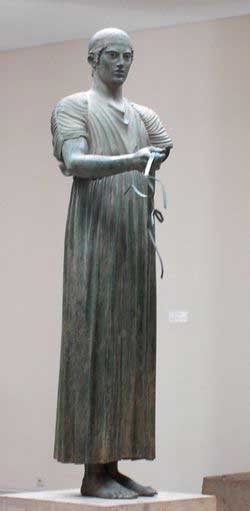 The ‘Charioteer of Delphi’ is one of the most famous surviving statues from ancient Greece, and is considered by many to be one of the best and finest examples of ancient bronze statues. Found in the Sanctuary of Apollo at Delphi during the late 1800s, the Charioteer is a rare example of an almost complete statue, dating to almost 2,500 years ago.
Also referred to as ‘Heniokhos’, the rein-holder, the statue was erected in Delphi to commemorate the victory of a specific chariot team at Delphi’s Pythian Games. The Pythian Games were held once every four years in honor of Delphi’s patron god, Pythean Apollo, and it is suspected that the Charioteer was part of a much larger statuary group that probably included several groomsmen, a chariot, and up to six horses. Although some fragments of the horses were found in the same vicinity as the Charioteer, there isn’t enough evidence to conclusively say how many animals were included in the group.
According to an inscription on the base of the statue, the piece was commissioned by Polyzalus, the tyrant of a Greek colony in Sicily called Gela. He dedicated it to Apollo as tribute for the god’s help during the chariot race, which had allowed him to win. Literally, the inscription reads: “Polyzalos dedicated me…make him prosper, honored Apollo.” Unfortunately, the name of the sculptor is unknown, but most scholars believe that the style of the statue suggests it was cast in Athens.
The Charioteer himself is mostly complete, with only his left arm missing – even his inlaid glass eyes and copper detailing on the eyelashes and lips still survive! The headband around the top of the statue was made of silver, though any precious stones that may have adorned it have long since disappeared.

The soft curls on the head of the statue indicate that the Charioteer was meant to represent a young man, tall and nimble, which was typical of ancient chariot racers – and modern jockeys, for that matter (Ed.’s note: Sometimes we make mistakes! Michael Escher quite accurately pointed out that modern jockeys are certainly nimble, but definitely not tall! Thanks for pointing that out Michael!). The cloak the statue wears is a xystis, which was the traditional clothing for a chariot driver: the base of the garment rests just above the ankles, and the waist is secured with a belt placed high up on the torso. Two straps cross his upper back, which prevented the garment from catching wind and ‘ballooning’ in the midst of a race.
In terms of style, the Charioteer of Delphi is considered to be an example of ‘Early Classical’ or ‘Severe’ style, and while his pose is more naturalistic than the preceding Archaic period of Greek art, his stance is still quite rigid when compared to some later works.
Want to read more?

Tomorrow: Fire Fishing!
Previous page | Next page
