Archive for the ‘Ancient Mesopotamia’ Category
By: The Scribe on September, 2007

Fishing gear found in a shipwreck from the 7th century AD, off the coast of Dor in Israel – a location west of Galilee – suggests that fishermen in this area tended to work the night shift… and did so far more often than anyone had previously believed.
Among other things, the shipwreck yielded something called a ‘fire basket’, which is the first evidence in the ancient eastern Mediterranean for a practice known as fire fishing. Although several ancient images and writings had suggested that people in this area practiced fire fishing, there had previously been no evidence for its actual use.

Fire baskets were mounted onto the end of fishing boats by being placed on the end of giant lantern-like devices, which kept the fire suspended overtop the water. The light from the fire would then attract fish to the boat, and the fishermen would be able to see the fish in the water far more easily than they could without a fire illuminating the surface.
The fishermen would then be able to easily spear the fish or other creatures that swam near the boat, or they could throw their nets into a spot in the water where the most fish congregated. In fact, this practice may date back to around 400 BC, when the ancient Greek philosopher Plato wrote about a similar practice that involved striking at fish from above the water.

This evidence, combined with some pieces of ancient art and Plato’s writings, suggest that fire fishing was very important in the ancient Mediterranean, and was likely practiced throughout New Testament times and well into the Byzantine era.
Other finds from the 7th C shipwreck included: an iron five-pronged fishing spear; a pile of rectangular, lead fishing net sinkers that would have been used to weight down nets; a bronze weight in the shape of a woman; and a tubular, iron “sounding lead”. The sounding lead was perhaps the most intriguing of the additional finds, since these were actually metal bobs used to measure water depth.
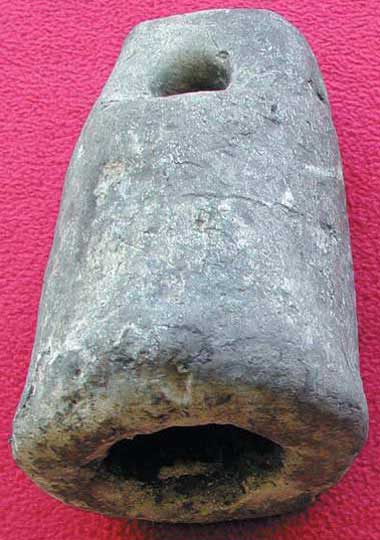
What the ancient fishermen would have done with the sounding lead was: fill the hollow middle of the lead with tallow, attach the lead bob to a sounding line, and then throw the line and lead over the side of their boat. The length of the line, combined with the amount of debris stuck to the tallow, would then indicate a depth measurement to the fishermen. This information could then be used to return to a specific fishing ground – particularly at night or during low visibility, when a sounding lead functioned as a vital navigational aid.
Want to read more?


Tomorrow: 3500 year old baby!

By: The Scribe on September, 2007

It turns out that the Biblical “land of milk and honey” may be just that after all… and lots of honey, for that matter. It turns out that the inhabitants of northern Israel developed their own beekeeping industry about 3,000 years ago – and the beehives are still intact today. Thirty beehives found in the city of Rehov date to around 900 BC, and give all indications that a healthy, thriving honey industry was well established during the Biblical timeframe.
Although beekeeping in the ancient world wasn’t an unusual practice in itself – beeswax was often used to create molds for metal casting and to create writing surfaces, while honey made an excellent medicinal substance, was added to food, and could often be used for religious purposes – nothing like the intact hives at Rehov in Israel have ever been found. Next to the hives were also remnants of ancient honeycomb and pieces of beeswax!
The beehives were made of straw and unbaked clay, and each one had a hole at the end where bees could move in and out of the hive. There was also a lid at the opposing end, allowing beekeepers to easily access the honeycombs inside. All 30 hives were discovered sitting in an orderly fashion: they sat in rows of three hives high, inside a room that could have comfortably held 100 hives. Clearly, beekeeping was an organized industry – after all, the population of the city at the time these hives were in use was probably about 2,000 people, and was made up of Israelites, Canaanites, and other individuals from the surrounding tribes.

While it may seem unusual to have a beekeeping industry located right in the center of the city, a consideration must be made of the religious use of honey – next to the hives, archaeologists located an altar that was decorated with fertility figurines, which likely links this hive collection to religious practices. Also, it’s entirely possible that the ruler of this city simply preferred to have such a lucrative industry under his control – namely, in a location where he could keep an eye on things.
Want to read more?


Tomorrow: Greco-Roman… nanotechnology?!
By: The Scribe on July, 2007

The Saluki is possibly the oldest known breed of domesticated dog, and its origins are traceable back to the time of the Pharaohs of ancient Egypt… and even further back than that. They seem to have originated in the Fertile Crescent area of Mesopotamia, and carvings from the Sumerian period around 7000-6000 BC have produced what appear to be images of Saluki dogs working alongside humans.
Saluki are ‘sighthound’ dogs, meaning that they hunt by sight instead of scent. With a powerful build and the modern nickname ‘Persian Greyhound’, the Saluki may actually be ancestors to today’s greyhound breeds. Another very early instance of sighthounds in ancient art comes from around 3000 BC, where the image of a dog resembling a Saluki was found on a stamp seal near Nineveh.
Egyptian tombs as early as 2100 BC have revealed paintings of Saluki dogs, including the tomb of an Egyptian governor named Rekh-ma-re, whose tomb images show a procession of people bringing him offerings. Among the offerings are three Saluki dogs of different colors: red, white, and golden. On the wall of a tomb for an Egyptian named Nebamun, dating around 1490 BC, there is an image of a multi-colored Saluki wearing a broad collar. Many other tomb carvings – such as the images of the young Tutankhamun riding in his chariot on a hunt – include depictions of dogs accompanying the Pharaohs as they hunted for sport or went into battle, and it is widely believed that these dogs were the domesticated Saluki.
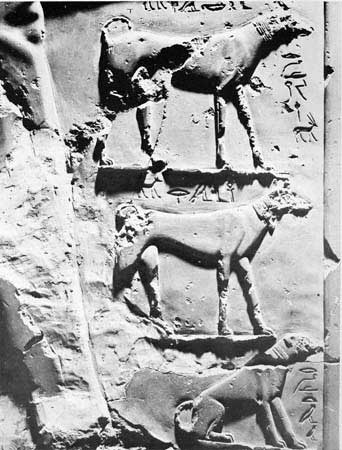
Due to the great respect and reverence for this breed, the breeding line continued for thousands of years, stringently kept pure by royal dog breeders and even the nomadic Bedouin! Bedouin tribes often owned Salukis and kept them apart from their other dogs, not only to preserve their genetic purity, but also to ensure their behavior and effectiveness in hunting was not tainted. Later during the Roman period, it is suspected that the Romans brought back Saluki from their conquests in Egypt – and then proceeded to crossbreed the dogs into today’s modern greyhounds.
Evidence for the continual respect held for Salukis since ancient times also survives in the form of a poem, written by an Umayyad poet sometime between 661-750 AD: “They have with them their hounds of Saluq, like horses wheeling in battle, dragging on their halters.” Pretty intense for a dog now kept as a typical household pet…
Want to read more?


Tomorrow: More viking goodness!
By: The Scribe on May, 2007

The ancient Babylonians were very keen on learning about the sky above them, and in fact, many modern astrological traditions actually stem from early Babylonian observations about the night sky.
Although undoubtedly limited by the lack of technological advancement available to today’s astronomers, the Babylonians made some remarkable deductions using their own scientific knowledge, and they would pass this on to many other ancient civilizations as the centuries moved onward.
For the Babylonians, it should first be noted that astronomy and astrology were intricately intertwined, since science was primarily concerned with the religious revelations it would bring. The physical world was understood within the context of their religious knowledge, and unlike many people might suppose to be the case for modern science and religion, this did not seem to present any sort of barriers or contradictions in understanding.
To begin, the Babylonians were the first people to develop a theory of the ecliptic: that is, the path of the sun in relation to the stars and its planetary alignment throughout a calendar year. The Babylonians recognized that this area was divided into twelve sections at 30 degrees longitude – this is where the twelve signs of the zodiac originated, when the Babylonians gave names to the twelve sections. Notably, this ecliptic division was proven to be correct, and the ecliptic theory is still used in modern astronomical study.
The Babylonian calendar was actually divided up according to the lunar year, with twelve months, but because the months were somewhat shorter than the modern calendar – which is based on the solar year – on occasion, an extra month would be added into the year to ensure the agricultural seasons stayed on track. Weeks were divided into seven days.
In terms of astrological observations, the Babylonians were very interested in the possibility of knowing the future, and believed that the movements of the sun, moon, and the five planets they identified could be interpreted to know what the gods were planning to do. The planets they knew, though given different names than what they are currently called, were: Jupiter, Venus, Saturn, Mercury, and Mars. The planets were each associated with a particular Babylonian god, and specific priests were assigned to astrological divination – not only attempting to interpret the signs in the sky, but also constantly striving to perfect their understanding of the heavens.
Want to read more?


Tomorrow: City of the bird men
Previous page | Next page
