Archive for the ‘Ancient Mesopotamia’ Category
By: The Scribe on May, 2007
 From the slopes of Mount Carmel in Israel and the site of Oued Djebbana in Algeria, it appears that archaeologists have discovered the oldest examples of jewelry in the world. The three shell beads date to between 90,000 and 100,000 years old, predating other ancient jewelry finds by 25,000 years.
The shells are all very small, and come from a genus of marine mollusk similar to the Nassarius, and it is believed that they were selected because of their small size and thin fabric that can be easily pierced by a sharp tool. These three shells each have one hole, made by a sharp flint tool, which would have allowed them to be strung together as a bracelet or necklace.
Speculation is that these pieces of shell jewelry had some sort of social meaning, possibly representative of some symbolic behavior or assertion of status. It may be one of the earliest examples of modern behavior by humans of the ancient past, since previous evidences have not been identified as earlier than 50,000 years ago. Something like creating and wearing jewelry is an example of thoughtful creativity, and in the case of these shell pieces, there is no doubt that some forethought went into creating the items.
Namely, the sea isn’t anywhere near Mount Carmel – and in Algeria, the closest shoreline to Oued Djebbana is 200 kilometers away. The shells would have had to be located, gathered, and transported here by people either migrating into the area or perhaps simply brought as items gathered on a seasonal expedition. Either way, the minute size of the shells and the precision of the holes indicate a significant leap in human creativity for which scientists have had no previous evidence.
Want to read more?
A History of Ancient Israel and Judah
Tomorrow: A coal miner’s rain forest

By: The Scribe on May, 2007

The second wonder of the ancient world, in chronological order, is the Hanging Gardens of Babylon. Believed to have been built around 600 BC by King Nebuchadnezzar II, there is actually little to no archaeological evidence for the existence of these gardens – instead, knowledge of the gardens comes from Greek historians such as Strabo and Diodorus Siculus.
These Greek historians lived several hundred years after the gardens were supposedly built, and it is quite odd that there are no Babylonian records that mention the gardens – however, there are tablets from Nineveh that describe gardens at that city, and so it is possible that ancient Greek travelers merely had their information a little jumbled when they returned home to recount tales of their travels!
The commonly understood story of the gardens is that Nebuchadnezzar II constructed them for his wife, a Mede, who was homesick for the lush trees and flowers of her homeland. The garden supposedly had a wide variety fruits and plants from across the ancient world, waterfalls, exotic animals, and other plants drooping from the palace terraces, to give the garden its appearance of ‘hanging’.
The major problem with the gardens’ existence is simple enough to conceive of: how were the gardens watered? How could enough water for entire terraces of plants possibly be transported to the roofs of buildings and palaces in order to keep the plant life thriving? And how is it possible that the water’s run-off wouldn’t cause the entire palace to weaken and collapse from water damage?
Diodorus Siculus attempted to explain the watering issue in his writings:
“the approach to the Garden sloped like a hillside and the several parts of the structure rose from one another tier on tier… on all this, the earth had been piled… and was thickly planted with trees of every kind that, by their great size and other charm, gave pleasure to the beholder… The water machines [raised] the water in great abundance from the river, although no one outside could see it.”
Conveniently concealed water-transportation mechanisms? The Babylonians were spectacular engineers, and thus it is a plausible suggestion. Presumably, some sort of complementary drainage system would have been implemented as well, possibly making use of terracotta pipes on each terrace level so that the roofs would not weaken and collapse.
Want to read more?


Tomorrow: Temple of Artemis
By: The Scribe on April, 2007
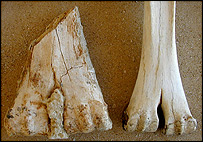 About twice the size of a modern camel, and standing about shoulder height of most African elephants, archaeologists unearthed the fossilized bones of a 100,000 year old camel from Syria. Standing about 12 feet high, human remains from the same period as the camel were also discovered nearby, suggesting that perhaps this camel was killed by a human.
 The camel remains were discovered by a joint Syrian-Swiss team at al-Hemel in the Palmyra region, about 250 km from the Syrian capital of Damascus.
It is unknown whether the human remains, which consist of a tooth and an arm fragment, may be attributed to a homo sapiens (a modern human) or a Neanderthal. The site of this discovery was next to a spring, where it is thought that the human may have stalked and killed the camel.
Archaeologists are still baffled as to where this species of camel originated, and why it disappeared, since this size of camel has not been attested to in any other country.
Want to read more?


Tomorrow: Get a-“head” in migration.
By: The Scribe on March, 2007
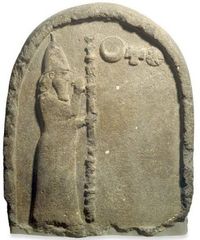 The last king of Babylon, Nabonidus was a monarch who truly wished that he had been born into another family – he simply was not interested in the job. Passionate about the ancient history of his own time, Nabonidus had a reign characterized by a lack of interest in the politics of his own kingdom, as well as the rejection of the traditional Neo-Babylonian religious practices.
A scholar and a recluse, Nabonidus decided that instead of worshiping Marduk, he would build a temple to the moon god Sin, and give his mother and daughter the jobs of temple priestesses… after which he went into self-imposed exile at the Oasis of Tema in the Arabian desert, making himself absent for about 10 years from the city he was supposed to be ruling!
According to writings in the Dead Sea scrolls, the accounts in the Hebrew scriptures which suggest that the previous king of Babylon, Nebuchadnezzar, was mentally unstable, may have in fact been referring to Nabonidus, whose reign followed that of Nebuchadnezzar. In the Hebrew scriptures, the tale talks of the king “imagining he was a goat” and that he “ate grass with the cattle”, after being cursed by God for not following Him. However, this may have been a reflection of Nabonidus’ refusal to conform to the traditional Babylonian religious practices, and perhaps somewhat reflective of his demeanor after his rather lengthy seclusion in the middle of the desert – alone… in the sun… – for so many years…
Indeed, upon hearing reports of the Persian army encroaching upon Babylon, Nabonidus returned to the city, but it was too late. Babylon was sacked and conquered in 539 BC by the Persians and their famed leader, Cyrus the Great.
Want to read more?

Tomorrow: All about Otzi
Previous page
