Archive for the ‘Ancient Rome’ Category
By: The Scribe on November, 2007
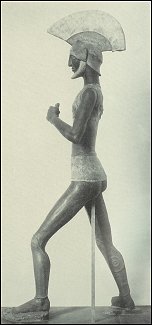 For a few years between 1915 and 1921, the Metropolitan Museum of Art in New York was thrilled to have acquired three statues created by the Etruscan civilization in Italy, which flourished between the 8th and 2nd centuries BC. Unfortunately, what the Museum didn’t know at the time was… they were forking over thousands of dollars for fakes.
The perpetrators of the scheme were two young men by the names of Riccardo Riccardi and Alfredo Fioravanti, who were rather skilled in the visual arts. As it turns out, Riccardo’s father and brothers were pottery “specialists” – read: forgers – but Riccardo was the most skilled out of his family. Along with his friend Alfredo, he decided that he’d like to make himself a little extra cash.
The first Etruscan warrior statue was modeled as a large, one-piece figure, but since the kiln wasn’t large enough to fit the whole thing, it was broken up into 24 pieces for firing and then rebuilt. The right arm of the warrior is missing, because the forgers couldn’t agree on how it should be positioned – and in order to avoid more arguments and potentially getting it wrong, thereby resulting in the Museum’s discovery of forgery – they simply broke off the arm and threw it away before presenting the piece to the Met.
After the successful sale of the ‘ancient’ figure to the museum, the pair began to work on another piece: a giant warrior’s head. Using a description by the ancient writer Pliny, who had once described a 25-foot tall statue of the god Jupiter from an ancient Roman temple, the head was created to stand four and a half feet high. Naturally, this was broken into pieces as well – 178 this time – then fired, and shipped away to the museum.
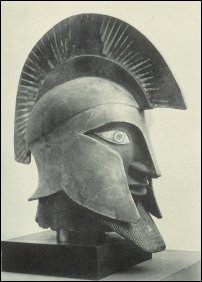 The pair was thrilled at their success! They’d expected things to go over well, but the Museum didn’t suspect a thing. Experts had been brought in to study the ‘ancient’ pieces and reports had been published on their meaning and place in the Etruscan culture… so the two men decided to embark on their most ambitious project thus far: the Colossal Terracotta Warrior. As they worked, the warrior took on a height of eight feet tall… but unfortunately, Riccardo was killed when he fell from his horse before the project was complete.
To replace him, Alfredo called upon two of Riccardo’s cousins, who weren’t nearly as skilled as he was. As they worked, the team became aware of a severe problem – the statue was going to be too large for the room they were creating it in! By the time they’d reached the waist, they realized that the well-known classical proportions of Etruscan sculpture was going to have to be ignored, since there was simply no space in the room to create a proper upper body – they’d have to open a hole in the ceiling to do that! The end result was a statue with perfectly proportioned legs… and a stocky, squat torso.
The Metropolitan Museum purchased the statue for an amount that is rumored to be the equivalent of around five million dollars today, and although the odd proportions were found troublesome by some scholars, the piece was still put on display. Still, rumors began to circulate as the art community tried to reconcile this piece with traditional Etruscan statues. Talk about the statues’ origins continued quietly for several decades, but the Museum refused to admit that anything had been amiss – after all, for the curator who’d acquired them, these pieces had been the distinguishing moment of her career.
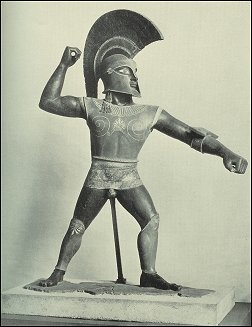 In 1959, an Italian scholar visited the Museum and was offered a tour through to see the Etruscan statues – but oddly enough, he mentioned that he didn’t need to see them since he already knew the man who had created them! Finally, the Museum admitted that something might be wrong. In 1960, a number of tests were conducted on the statues’ glazes – and it was revealed that the pieces contained chemicals that had not been used before the 17th century.
In 1961, Alfredo Fioravanti confessed to creating all three statues, signed a written version of the confession, and presented one of the statues’ missing thumbs to prove it. The scandal of the Etruscan terracotta warriors was valuable in at least one respect: it revealed how much damage can be done when Museums become too eager to acquire pretty objects rather than truly inquire into their historical value.
Want to read more?


Tomorrow: Ancient Bulgaria’s Pliska

By: The Scribe on October, 2007

The Ancient Standard has decided to offer up something a little different this Halloween – we’ve decided that in honor of this infamous “holiday”, we’ll let one of the ancient writers give you a bit of history in his own words… namely, an ancient Roman ghost story which he recounted sometime around 100 AD. Ghost stories are anything but a modern phenomenon – as proven by the tale below, written by Roman writer Pliny the Younger, they’ve been around for at least two thousand years. Sit back, relax, and enjoy the harmonies of an ancient ghost story brought back to life once more…
An Ancient Roman Ghost Story (in translation from the original Latin) – as originally recorded by Pliny the Younger
There was in Athens a house, large and spacious, which had a bad reputation as though it was filled with pestilence. In the dead of night, a noise was frequently heard resembling the clashing of iron which, if you listened carefully, sounded like the rattling of chains. The noise would seem to be a distance away, but it would start coming closer… and closer… and closer. Immediately after this, a specter would appear in the form of an old man, emaciated and squalid, with bristling hair and a long beard, and rattling the chains on his hands and feet as he moved.
The unfortunate inhabitants of the house went sleepless at night due to unimaginable and dismal terrors. Without sleep, as it had happened to others, their health was ruined and they were struck with some kind of madness – as the horrors in their minds increased, they were led on a path toward death. Eventually even during the daytime, when the ghost did not appear, the memory of their nightmares was so strong that it still passed before their eyes, every waking moment. Their terror was constant, even when the source of fear was gone.
Because of this, the house was eventually deserted and damned as uninhabitable, abandoned entirely to the ghost. In hope that some tenant might eventually be found who was ignorant of the house’s malevolence, a bill was still posted for its sale. As it happened, a philosopher by the name of Athenodorus came to Athens at that time. Reading the bill for the house, he easily discovered the price – and being an intelligent man, he was suspicious at its extremely low cost. Someone did tell him the whole story, and yet he wasn’t dissuaded, but was instead eager to make the purchase. Thus, he did.
When evening drew near, Athenodorus asked for couch to be readied for him at the front of the house. He asked for his writing materials and a lamp, and then asked his retainers to retire for the night. In order to ensure that his mind stayed focused and away from distractions of stories about imaginary noises and apparitions, he poured all his energy into his writing.

For awhile, the night was silent. Then the rattling of fetters began. Athenodorus would not lift his eyes or set down his pen. Instead, he concentrated on his writing and thereby closed his ears. But the noise wouldn’t stop, and it only increased and drew closer until it seemed to be at the door and then standing in his very chamber! Finally, Athenodorus looked away from his work… and saw the ghost standing just as it had been described. It stood there, waiting, beckoning him with one finger.
Athenodorus held up his palm as though the visitor should wait a moment, and once again bent over his work. The ghost, impatient, shook his chains over the philosopher’s head, beckoning again. This time, Athenodorus picked up his lamp and followed the ghost as it moved slowly, as though it was held back by its chains. Upon reaching the courtyard, the ghost suddenly vanished.
Now on his own, Athenodorus carefully marked the spot where the ghost vanished with a handful of leaves and grass. The following day, he asked the magistrate to have that spot dug up, and in that spot was found – intertwined with chains – the skeleton of a man. The body had lain in the ground a long time and had left the bones bare and corroded by the fetters. The bones were then collected and given a proper burial at public expense – and since the ghost’s tortured soul had been finally laid to rest, the house in Athens was haunted no more.
Want to read more?


Tomorrow: More Ancient Standard
By: The Scribe on October, 2007
 A study done at Newcastle University in the UK revealed something about the Romans that was previously unheard of: it appears that the Romans had no qualms about Africans holding various positions within Roman society, regardless of whether that position was the Emperor of Rome or a domestic slave. Judging by the evidence… it appears that Romans were colorblind when it came to people with differently colored skin.
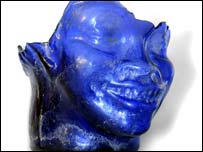
The University holds a rather substantial collection of what has been termed ‘Romano-African’ artifacts, and these objects point quite blatantly at the presence of Africans on Rome’s military frontier, especially along Hadrian’s Wall. One of the objects was a blue, mould-blown glass vessel that was shaped like the head of an African man – and while there are have only been three of these found thus far, the fact that it was made from a mould suggests that these kinds of vessel may have been popular items.
According to historical documents, out of all the people who helped to build Hadrian’s Wall, there were actually very few “Romans” involved – there were plenty of Spanish, Gallic, and Germans working on the project, while a number of auxiliary units that were stationed on garrison duty actually came from North Africa.
Aside from the privileges of thorough military training, well-known Africans in the Roman Empire included a man named Victor, who was a freed slave from Morocco, and even the Emperor Septimius Severus, who came to Rome from Lepcis Magna in Libya! Evidently, color and country of origin were moot points when it came to social participation in the Roman Empire.
Skin color aside, what the Romans were well known for was their deep-seated prejudices against a whole host of other kinds of people, such as those they called ‘barbarians’ – ie. anyone outside of the Roman Empire’s control – and… they weren’t particularly fond of men who wore earrings. But prejudices based on color? The Romans were far beyond that.
Want to read more?


Tomorrow: More Ancient Standard
By: The Scribe on October, 2007

While the scribes here at the Ancient Standard would never stoop so low as to fabricate history for the sake of the reader – there is more than enough interesting ancient history to begin with! – it seems that an author living during the Late Roman Period didn’t necessarily subscribe to this commitment of authenticity.
The Historia Augusta – or in English, Augustan History – is a collection of supposed biographies about a number of Roman Emperors who lived during the second and third centuries AD. The history is constructed as though it was written by six different authors during the reigns of Constantine and Diocletian, however the true nature of the authorship – not to mention when it was written and why – remains to be seen. The fact of the matter is, it’s not a history of the Emperors at all – most of the book is complete fiction, plain and simple, from the narrative details all the way down to the quotations included from supposedly ‘historical’ documents!
First of all, the most likely period in which the Historia was written was the 4th century, during the reign of Emperor Theodosius I, since it seems to quote some material from contemporary authors of this period. However, it’s rather difficult to say with any authority when it was written. The consistency of style throughout the text does reveal one thing – there certainly weren’t six authors involved in writing it, and in fact it was probably written by only one author, who for some reason felt the need to play this practical joke on future historians.
Why would an author in the 4th century AD feel the need to fabricate over 130 fake documents – quoting from them, using anecdotes and “facts” from them – and then use them to not only substantiate some claims but in many cases to disagree with them?! Was this intended to be a real history, but the historian was lazy? Or, as has been suggested by others, was this intended to simply be a work of fiction or satire to entertain readers? Some historians believe that this is an early case of historical fiction, produced by an author who wanted to make fun of the “antiquarian tendencies” of the period he lived in. In fact, in the introduction to one section of the book entitled ‘The Life of Aurelian’, the “author” Flavius Vopiscus has recorded a conversation he had with the City Prefect of Rome, in which Vopiscus is urged by the Prefect to write whatever he wants, and invent the parts he doesn’t know.
As much as it is a work of fiction, the Historia Augusta cannot simply be dismissed as a lacking any historical value, because as much as it isn’t a reliable source for the period it claims to document, it is one of the only sources of information available about the years 253-284 AD. The key is in separating the fact from the fiction, and historians agree that the book actually contains a number of important pieces of information about ancient Rome that no one else mentions – things that can be fit into the real line of history and that can be substantiated with comparison to other texts written about the time period.
In effect, the Historia Augusta is a work of historical fiction, written during a period of ancient history about ancient history! And like any good piece of fiction, real events have been combined with figments of the author’s imagination to create a good, compelling story, leaving it up to the reader to discern reality from fiction. After all, it’s not like ‘imagination’ was something invented recently – humans have always created stories. It just so happens that this author chose to do something a little more complex – and isn’t that what makes fiction interesting?
Want to read more?


Tomorrow: Egyptian fortress of kings!
Previous page | Next page
