Archive for the ‘Ancient Rome’ Category
By: The Scribe on September, 2007
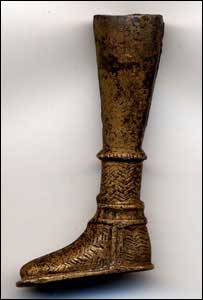 It is no secret that the Roman Empire once controlled more territory than any other empire in history – and it now appears that perhaps the secret to Roman success has been revealed! No, it wasn’t impeccable strategy, courageous generals, or unparallel war tactics… instead, the success of the Roman armies hinged on one crucial element: they always had warm toes.
Indeed, if there is one thing that’s important when it comes to war, it’s the comfort of the soldiers – after all, if you’re freezing cold, how can you possibly swing your sword at full strength? So, it appears that the Roman armies who went northward to conquer England took all necessary precautions to ensure that they were properly equipped for battle – including bringing along some very heavy woolen socks.
This is now known because one of the artifacts found at an excavation in Durham, England, was a highly unusual Roman razor handle: it was 5 centimeters high, made of copper alloy, and was shaped like a human leg and foot. The very unusual part is that the foot is wearing a common soldier’s sandal – but it also has a thick, woolly sock on at the same time! Socks and sandals together in Roman times? Clearly, comfort came before fashion on the northern frontier.
However, whether it was fashionable among the ranks to wear socks and sandals or whether the soldiers were simply protecting themselves against the harsh cold of the British north, there is one piece of evidence from another archaeological site that suggests Roman soldiers took their foot care very seriously – a letter was once found at the Roman fort of Vindolanda near Hadrian’s wall, in which a soldier actually wrote home to ask for… more socks!
Turns out socks are a handy gift after all…
Want to read more?


Tomorrow: Egyptian hieratic script

By: The Scribe on September, 2007
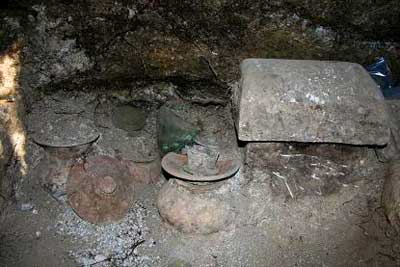
Shocking archaeologists and historians around the world, it was in August 2007 that an undisturbed Etruscan tomb was found was completely intact, full of human remains and stunning personal possessions of about 30 people. The tomb was located in the woods near Tuscany, about 70 miles south of Florence.
The tomb consists of a 2 meter long stone chamber, buried in the ground inside the nearby woods and containing at least 30 jars of human ash – consistent with the Etruscan tradition of cremation instead of full body burials. Three of the burial urns were made of stone, two were bronze, and the last 25 were made of a reddish ceramic known as terracotta. A likely explanation for the amount of people buried here is that they were all members of the same family, and the smaller burial urns probably contain the ashes of their servants.
Archaeologists are at a loss to understand how, in the whole of 2,200 years, no one managed to find and break into this tomb and steal the artifacts. As a result, everything the people were buried with was still there: bronze coins, rings, several bronze mirrors, some small terracotta plates, and a stunning black stone amulet.
The Etruscan people existed in the area before the Roman empire began to conquer their territories and eventually eradiated them, and this tomb would have dated back to around the same time as the period when Etruscan settlements in the region were being taken over by the Romans. At this time in history, the Etruscan cities had already been demolished and claimed for Rome, which meant that only those people who dwelt in the countryside still held onto the culture’s traditional practices and rituals.
As a result, the intact tomb found here represents one of the last vestiges of the Etruscan people before they completely disappeared – something which is very valuable in helping to understand their ancient culture and lifestyle. Since this tomb was found undisturbed, it is now thought highly likely that there are more tombs buried in the woods across the Tuscan countryside… who knows what else may appear here in the future?
Want to read more?


Tomorrow: Viking Elf Blot!
By: The Scribe on August, 2007
 While Roman soldiers stationed at the northern front of the empire and Hadrian’s Wall did battle to stave off attacks from “barbarian” tribes, they were also doing battle with a smaller, less obvious foe: those devious creatures now commonly known as head lice.
An excavation outside of Carlisle Castle in Cumbia revealed an ancient soldier’s haircomb, excellently preserved and including a fully intact, 3mm long louse. Based on stratigraphy, the comb and louse are about 2,000 years old!
The Roman fort of Luguvalium, an ancient site located near Carlisle Castle, was founded around 72-73 AD to help defend the Roman Empire’s border along Hadrian’s Wall. Since the Roman ground layers where the comb and louse were found is largely waterlogged, it’s quite the feat that both these items survived until present day. Thousands of additional artifacts were also found at the site, but the louse was among the most intriguing – according to site archaeologist Carol Allen, the louse is one of the largest and more complete examples of the creature ever found in the Roman world.
Along with pieces of wood and textile that normally don’t survive in this environment, it is hoped that the louse and assorted items will help to shed some light on what it was like to live inside a Roman fort in the 1st century AD. Unfortunately for the people who once lived there, at first glance it now appears as though the situation was less than hygenically ideal.
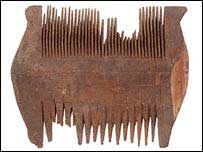

For the record, it is already known that lice have been around for hundreds of thousands of years, though complete ancient specimens such as the one found inside the Roman comb are rare, if not nonexistent in most parts of the world. However, it’s worth noting that the treatment of head lice has not changed much since ancient times – take a look at the ancient Egyptian louse comb and the modern louse comb pictured above.
Resilient, those lice.
Want to read more?


Tomorrow: Euphronios Krater
By: The Scribe on August, 2007
![A “fast food” stand where Romans could purchase breads and drinks.]](http://ancientstandard.com/images2/romanfastfood.jpg "A “fast food” stand where Romans could purchase breads and drinks.]")
While it’s often thought that fast food was a modern invention of a society bent on immediate gratification… well, that theory can now be placed to rest. A study on the remains found at Pompeii has revealed that, more often than not, ancient Romans ate their food while “on the run”.
Although the concept of Roman fast food eateries has been around for awhile, after excavating an entire city block from Pompeii, archaeologists realized that the distinct lack of tableware, formal dining areas, or even full kitchens in Roman homes seems to indicate that cooking – and eating together as a family – wasn’t necessarily at the forefront of ancient Roman concerns. Instead, isolated plates in various corners of the homes turned up, even in places that were previously thought to be unrelated to eating, such as in the bedroom.
This seems similar to how today’s children and adults will take a plate of food into another area of the home while working on something else, instead of always sitting down at the kitchen table to eat. In fact, many of the homes also contained mini-barbeque style implements, which would have certainly allowed someone to cook their meat faster and could eat it on the go.
In addition, there are literally remains of fast food restaurants from Pompeii. These places resemble something like a cross between McDonald’s and a British Pub, in the sense that you could purchase both food and alcohol, and could either grab it and go or sit down at little tables inside the eatery. These fast food places were open to the street, and had a large counter area with a reception area in the middle where the food and drink would be served.
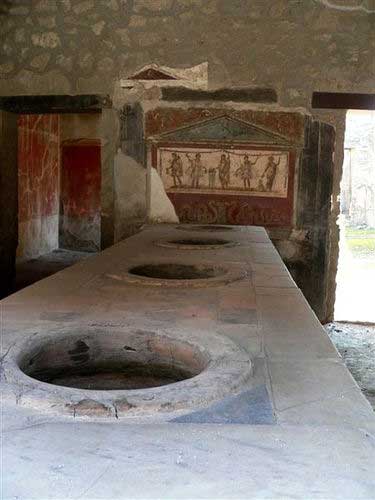
Then, if you wanted, you could sit down at one of the picnic-style tables and quickly munch down your bread and hot sausage (with cheese!), or carry it off as you went about your business – or perhaps bring the food back home for the family, if the wife didn’t want to cook that evening. And while it may seem strange to think that people in ancient times could support these kinds of establishments, many of the people living in Pompeii specifically were comparatively wealthy – local artisans, shopkeepers, potters, weavers, and so on – and could therefore afford to eat out on a regular basis.
Pompeii was also a bit on the touristy side, attracting people from all over the Roman Empire, which must have helped business along as well – seemingly to the point where individuals could own more than one fast food shop, as there is a known inscription that indicates one man owned over ten “franchises” in Pompeii alone!
Based on these finds, it is extremely likely that there were also fast food shops elsewhere in the ancient Roman world, however it is doubtful that there were quite as many as there seemed to be in Pompeii. Of course, as much as the Romans liked their fast food, it should be remembered that it was undoubtedly much healthier for them to eat out on a regular basis than the choices offered to the modern consumer these days!
Want to read more?


Tomorrow: More ancient goodness
Previous page | Next page
