Archive for the ‘Ancient Rome’ Category
By: The Scribe on July, 2007
 In the 1970s, excavators working at Hadrian’s wall came across a large number of ancient documents – Roman letters, contracts, and other writings – in and around the area. The documents are actually pieces of wood that had originally been composed using wax drawn onto wooden tablets with a stylus, but after sitting in the ground for 2000 years, the wax had long since decomposed – leaving only faint scratches in the wood where the writing had once been.
Hadrian’s wall is one of the most important Roman monuments in Britain, as it was the marker for the British northern border of the Roman Empire. In fact, Hadrian’s wall was the most heavily fortified border in the entirety of the Empire, and was a strong military defense against raids by Scotland’s Pictish tribes.
With a heavy military presence at the wall, perhaps it is not surprising that the first document to be deciphered from the cache was a Roman soldier’s shopping list! It seems that this soldier was heading to an auction with several key purchases in mind: a general outfit of clothing, which would have cost him around 8 percent of his annual income, and another 10 percent of his annual income would go toward the purchase of a new cloak. With Britain’s often harsh climate, a new cloak would have been absolutely necessary for a soldier’s well being – which is probably why it cost him a small fortune.
The list was deciphered by exaggerating the stylus markings on the tablet through digital imaging and virtual reconstruction technology. Noting the shadows that the etchings cast when low, focused light was shone on the wood, researchers were able to analyze the scratch marks and make out distinct letters.
Want to read more?


Tomorrow: Talk about an old dog…

By: The Scribe on July, 2007
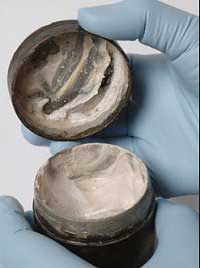 For anyone who thought women’s obsession with skin products was a thing of the modern age, a discovery at the site of a Roman temple on the banks of the River Thames in London has challenged the known history of women’s makeup. A 6 cm x 5cm tin container was found, and inside was a white cream with a very pungent odor. Although a product such as this should have decomposed and disappeared from the archaeological record long ago, the canister was of high enough quality and was closed tightly enough that it held its contents in stasis for nearly 2,000 years!
Found in a ditch with other ceramic pots – whose contents have long since disintegrated – excavators suspect that the ditch was a site of religious significance, where visitors to the temple would place offerings inside of pots or tins and leave them for the god. This cosmetic tin in particular was extremely well crafted, and must have been owned by someone of very high status as it would have been a valuable object at the time.
Roman women often put makeup on their faces before entering a temple, and it was not unusual for priests to have specific requirements concerning their adornment and cosmetic appearance. In the case of this tin, there were finger marks found on the lid once the container was opened – indicating that the last person to use this cream had taken the substance out from the lid, which is not an unusual practice for women today when opening a container of cream or facial product!
Tests on the Roman cosmetic revealed that the cream was made of refined cattle or sheep fat, starch, and tin oxide. A synthesized version of the cream, made by a team from the University of Bristol, revealed that the cream had a soft, pleasant texture when rubbed into the skin – although it felt greasy at first, the starch allowed the cream to create a smooth, powdery feel as it was applied. Intriguingly enough, starch is still used in modern facial and cosmetic products for this same reason! In addition, there did not appear to be any added perfume or scented components to the cream, making it a very ‘natural’ product.
Want to read more?


Tomorrow: Giant penguins, you don’t wanna miss this!
By: The Scribe on July, 2007
 As the only known woman from ancient Rome whose poetry has survived into modern day, Sulpicia’s poems stand out as a bold female voice in a male-dominated field of ancient literature.
Sulpicia was likely the daughter of Servius Sulpicius Rufus and the niece of Roman politician Messalla – powerful members of the Roman elite, called the patrician class. Messalla was well known as a patron of literature and art, and combined with her station of birth, Sulpicia would have been very highly educated by personal tutors.
Very little remain of her writings, however of the eight rather demure poems that have survived, at least half of them are addressed to a lover by the name of Cerinthus – most certainly a pseudonym for her real lover, if not a fictional character in the style of other Roman poets like Ovid or Catullus.
Her work managed to survive the centuries by preservation through the writings of another poet named Tibullus, and for many years, scholars attributed Sulpicia’s writings to Tibullus himself. However, they are now known definitively as written by this high-born woman, and serve as a little piece of insight into the inner workings of a woman in love in ancient Rome!
Here is one of Sulpicia’s poems, translated by Jon Corelis, where Sulpicia seems to suspect that her lover has become interested in a prostitute – and naturally, is furious at such insulting behavior.
Sulpicia 4: A Curt Reply
I’m glad you take me for granted enough to show me
what kind of man I almost let possess me.
Go chasing after hookers and spinning-girls and whores:
forget Sulpicia, daughter of Servius.
But I have friends who care, and who will spare no pains
to see that no cheap slut humiliates me.
Want to read more?


Tomorrow: Crocodilopolis (no we didn’t make that up)
By: The Scribe on June, 2007

Contrary to popular belief, it appears that women had a very high presence in Roman military forts, living and working alongside the men even in wartimes. Although previously it was thought that the forts were exclusive to men, a number of objects and their distribution pattern throughout a number of Roman forts have begun to dispel that notion!
A typical Roman soldier was not legally allowed to have a wife, although commanding officers frequently had wives and children. The belief was that the only women in a Roman fort would have been these officers’ wives, and that any other women inside the forts were prostitutes or concubines – women who didn’t live there on a regular basis. However, it is likely that this concept was reinforced by male military historians in the 19th century, who believed that women were merely a distraction and a disruption to military life.
In direct contract to this outdated belief, over 30,000 objects such as hairpins, beads, perfume bottles, and spindle wheels have been found all across the fort buildings and in along their streets. These kinds of artifacts show that women played roles as craftspeople, traders, and shopkeepers, in order to keep the small town-like economy of the forts running smoothly. After all, if the men were expected to receive military training and work for the army all day – who would be left to negotiate shipments of food supplies and mend clothing?
Another intriguing piece of the puzzle comes in the form of 11 babies, buried underneath the barracks of one of the forts. Historians who still believe the forts were segregated have tried to explain this phenomenon as coincidence, claiming the babies’ remains were accidentally brought into the fort in shipments of soil and then laid down in the barracks’ foundations unawares, however that is highly unlikely – a coincidence of 11 burials transported from elsewhere is rather impossible.
According to archaeologists, tombstone inscriptions in and around the Roman forts detail how many soldiers left property to women upon their deaths, which is a very significant act for any Roman male, and not something he would have done for a concubine or prostitute. These Roman soldiers were forming long-term relationships with women while inside the forts, and though they may not have legally been allowed to wed, it appears that women still lived and worked alongside the soldiers as common-law wives, taking care of the soldiers and bearing their children.
Want to read more?


Tomorrow: All hail the god of…. lettuce?
Previous page | Next page
