Archive for the ‘Ancient Rome’ Category
By: The Scribe on June, 2007
 Macrinus was proclaimed emperor on 11 April 217 AD, only three days after the assassination of Caracalla, having managed to distance himself from the deed. Notably, Caracalla had died without a son, and since there was no obvious heir, Macrinus was able to take over the position with relative ease.
Although Macrinus was the first emperor to never have served in the senate, he needn’t have worried about gaining their support – the senate was happy to see Caracalla go and have his reign of terror ended! By reversing some of Caracalla’s harsh taxes and allowing political exiles to return to Rome, Macrinus’ acceptance as emperor was secure – or so he thought.
His first snag came when Julia Domna, mother of Caracalla, seemed to have gained some inkling of Macrinus’ role in her son’s death. She began to conspire with the military against Macrinus, however he soon caught wind of her dealings and ordered her to leave the city of Antioch, where the Severans had been ruling. In protest, she refused – and instead starved herself to death. It didn’t take long – she was already at an advanced stage of breast cancer.
Meanwhile, Macrinus was discovering that being emperor wasn’t as easy as he had originally thought. He was very reluctant to engage in military conflict, instead choosing conciliation and treaties with enemies. While this was very good for the area, since it promoted peace and a significantly lower loss of life, it also meant that the soldiers were getting restless – and when they finally did engage in battle against the Parthians, a historically inferior enemy, the Roman army suffered humiliating defeat.
 Even worse, Macrinus had failed to pay a visit to Rome after becoming emperor, thereby neglecting to gain the support of the empire’s main city. The failure of his own prefect to restore the city after several summer floods and fires also put a harsh damper on Rome’s appreciation of their new leader.
To make matters worse, after Julia Domna’s death, her sister Julia Maesa decided she’d had enough of her family being deposed. Though all the Severan women were evicted from the imperial palace, they returned to their original home in Syria and began to plot against Macrinus. Using their influence, they proclaimed Julia Maesa’s grandson Elagabalus the “true successor” of Caracalla.
Woman are good at spreading rumors, and in this case, it helped their cause – they managed to spread word across the Roman empire that Elagabalus was the illegitimate son of Caracalla, born of a union between first cousins. That was good enough for the malcontented army, and they proclaimed him the true emperor at a military camp on 16 May 218 AD. Less than a month later, although he had desperately attempted to regain support by increasing military pay and handing out a bonus, the Roman legions deserted him to follow Elagabalus, and the army marched against him on 8 June 218 AD. Macrinus was soundly defeated, and although he attempted to flee, he was soon captured and executed – with his own 9-year-old son’s execution soon to follow.
The moral of the story? Looking at both Caracalla and Macrinus’ reigns, it would seem that if you’re the Emperor of Rome, keep the army happy above all else – they hold the power to make or break your reign, even if you’re a sadistic terror to the rest of the Roman masses.
Want to read more?

Tomorrow: King Tut and his love of red wine

By: The Scribe on June, 2007
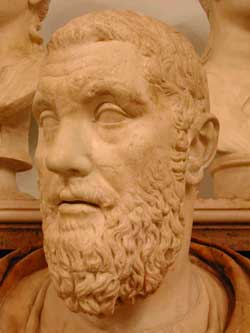 As prefect of the Praetorian Guard – the personal bodyguards of the emperor – Marcus Opellius Macrinus was privy to many of the goings on in the palace, whether he should have been or not. Having grown up in a middle-class family in Caesarea, Macrinus had somehow managed to gain the opportunity to study law and finance, and would later move to Rome to make a name for himself as a lawyer.
With his high reputation, the Roman emperor Caracalla appointed Macrinus prefect of the Praetorian Guard in 212 AD, a position that made Macrinus second in command to the emperor, and head of the only military body allowed inside Rome’s boundaries. Unfortunately for Rome, Caracalla didn’t seem to care for petty things like ruling the Empire, and instead spent a great deal of time in the field with the army, leaving Macrinus to deal with all of what should have been the emperor’s correspondence.
This, of course, is not the most intelligent way to rule an empire, especially when you’ve sent off a request by mail to have the head of the Praetorian Guard – the same man who you’ve personally assigned to read and reply to all your mail – arrested and executed. Naturally, Macrinus intercepted this little piece of correspondence, and decided he had better do something to save his own skin.
Why Caracalla had decided to kill off his most trusted ally in Rome is still a bit of a mystery, though the traditional explanation is that Macrinus received a prophesy that he would depose and succeed the emperor. Although he tried to keep it quiet for the sake of self-preservation – Caracalla was widely known for his merciless executions of rivals – it would have been relatively difficult to quash all the rumors that undoubtedly circulated in the palace. Well aware of Carcalla’s murderous streak, Macrinus decided that the only way to save himself was… to kill the emperor first.

In the spring of 217 AD, Caracalla went east with the Roman army, his Praetorian Guard alongside him. Macrinus had formulated his plan, making select choices of other guards to include in the plot. It was April 8th when the emperor and his guards made their way to visit a Temple of Luna in the area – and while in the temple, one of the Praetorian Guards named Martialis stabbed the emperor with a dagger, grateful for the opportunity, since he held a personal grudge against Caracalla: he’d been passed over for a promotion he had thought he deserved.
Of course, the only way to ensure the plot fully succeeded was to kill Martialis, and it was only a matter of days before Macrinus had proclaimed himself emperor. In order to distance himself from the assassination – since the Roman army had rather liked Caracalla, probably because of the amount of time he’d spent with them – Macrinus immediately proclaimed Caracalla a god, which earned himself the army’s support.
Want to read more?

Tomorrow: Part 2, the Emperor Assassin
By: The Scribe on June, 2007

Previously here at the Ancient Standard, we brought you a story about a gladiator graveyard recently discovered at the site of the ancient city of Ephesus in Turkey. Now, it appears that forensic analysis of 70 gladiator skeletons has revealed some startling news about gladiator lifestyles – or rather, what they ate during their lives as gladiators.
Instead of conforming to the modern media image of gladiators as muscle-bound Playboys, gladiators in ancient Rome were actually overweight vegetarians – strong and muscular, yes, but with more than a little extra pudge around the middle. Using a method known as elementary microanalysis, palaeoanthropologists were able to determine that ancient gladiators lived off a diet that consisted mainly of barley, beans, and dried fruit.
A simple diet such as this, while increasing bone density and actually allowing the gladiators to become much stronger than normal, would result in a zinc deficiency, causing an imbalance in the gladiator’s internal chemistry. There would be too much of a natural chemical called strontium built up in the body, which would result in the gladiator becoming – rather literally – fat.
Why was this beneficial? Primarily, these layers of fat would have helped to protect their vital organs against piercing blows from opponents. It may have also helped them to heal much more quickly after being injured. Considering that most gladiators only survived for an average of three years in the ring, it was likely the case that gladiators “beefed up” during the fighting seasons and training, and then lost the weight soon after retirement (if they survived that long).
So, as much as Hollywood would like everyone to believe that gladiators were poster boys for fitness, the truth of the matter is that even though they were incredibly strong and relatively attractive men – in fact, unattractive men weren’t even considered for gladiatorial training – they were actually relatively overweight, moreso resembling lightweight sumo wrestlers than Russell Crowe’s movie-gladiator Maximus.
Want to read more?


Tomorrow: 380 Million year old tree…
By: The Scribe on June, 2007

While the notion of pay-toilets may seem rather off-putting and a little unfair – after all, why should someone be charged money to conduct a necessary bodily function? – it seems that the ancient Romans were all too familiar with this concept…
In the first century AD, the Roman emperor Nero levied what was known as the vectigal urinae, or simply put, “urine tax”. The tax was placed on the collection of urine, since the lower classes of society had to urinate into small pots that were then emptied into cesspools. Liquid could then be collected from these cesspools, as well as from the public toilets of the upper classes, and recycled for a number of chemical processes: animal skins could be soaked in urine to remove the hair fibers before tanning, and Roman launderers could use urine as a source of ammonia to bleach and clean wool garments.
 Although the tax was eventually removed, it was reenacted around 70 AD with the succession of emperor Vespasian. Known for his love of money and ruthless taxation – which, to his credit, eventually brought the Roman empire out of debt and left a surplus in the treasury for the next emperor – Vespasian re-applied the tax to urine collection, and extended it to the use of public toilets.
The Roman historians Dio Cassius and Suetonius wrote about Vespasian’s unpopular tax in their own history books, reporting that when Vespasian’s son Titus expressed his disgust over such a tax, the emperor simply showed his son several gold coins and asked: “See, my son, if these have any smell.” When Titus agreed that they had no odor, Vespasian replied: “…and yet, they come from urine!”
As undignified as Titus may have believed his father’s urine tax to be, in the long run Vespasian’s taxes actually benefited the Roman empire – perhaps the most evident example of this is in his most famous monument: the Roman Colosseum.
Want to read more?

Tomorrow: The magic amulets of Stonehenge
Previous page | Next page
