Archive for the ‘Ancient Rome’ Category
By: The Scribe on June, 2007
 While it is well known that the Romans simply borrowed and renamed the Greek gods for their own religious purposes, it is often forgotten that the Romans tended to get creative with these divinities, and created various ‘epithets’ for them – versions of the gods based on certain aspects or characteristics.
So, naturally, the gods would have epithets concerning important buildings or aspects of Roman society that they were supposed to look after – and if there was something that the Romans were very proud of, it was their sewage system that helped to keep the city clean. Thus, why not appoint a goddess to take care of it?
Venus Cloacina, which translates as “Venus of the Sewer”, or more subtly “Venus the Purifier”, was the Roman answer to such an important issue. A fusion of the Roman Venus with the Etruscan water goddess Cloacina, the choice probably came from the placement of a well-known Venus statue near the entrance to the Cloaca Maxima, Rome’s major sewage system.

Since she was originally an Etruscan goddess combined with Venus, she kept some of the characteristics ascribed to these two, in combination with her role as the protector and controller of sewers. She was a protector of the marriage-bed – namely, sexual intercourse in marriage, and she was worshipped in her own small Shrine of Venus Cloacina in the Forum. The shrine was conveniently situated right above the Cloaca Maxima, and it was only a matter of time before the Romans began to mint coins with her image and images of her shrine on one side. Some evidence has also been found for a small poem or prayer that devotees could recite when making an offering at her shrine.

As odd as it may seem, one might consider that in a city the size of Rome, the last thing anyone would ever want was for the sewage system to break down, leak, or overflow. Having a goddess making sure the sewers stayed in proper working order was probably somewhat of a comfort, really…
Want to read more?

Tomorrow: More ancienty goodness!

By: The Scribe on May, 2007
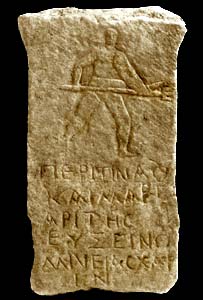 Among the ruins of the city of Ephesus in Turkey, archaeologists believe that they may have found an ancient gladiatorial burial ground – something never seen before, even in Rome itself. A major city in the Roman empire, this Ephesian graveyard contained graves with thousands of bones as well as three gravestones with carved images of gladiators.
For several years since the bones’ discovery, a team of pathologists at the University of Vienna have studied and catalogued the bones for age, injury, and cause of death. It appears that the graveyard contained bones of 67 individuals, almost exclusively between the ages of 20 and 30 years old. In addition, many of the individuals appear to have healed wounds – one body even showed evidence of surgical amputation, suggesting a high level of medical care that was rather unprecedented for the average Roman citizen.
A lack of multiple wounds on the bones also suggests that the individuals here were not involved in large, mass battles, but instead were participants in some form of controlled combat. Indeed, several bones showed evidence for mortal wounds, which would not be unreasonable in gladiatorial combat. Ancient written sources on Roman sports tell that in some cases, if the defeated gladiator had been a coward or unsportsmanlike in combat, the crowd would shout to have the losing party killed.
Relief depictions from Roman art show images of a kneeling man having a sword thrust down his throat, into the heart – evidently an efficient method of execution. Marks found on the vertebrae of several bodies from Ephesus show that this may have actually occurred to some of the individuals interred here. Some skulls were also found to have sets of three holes at irregular intervals, consistent with the possible damage done by a three-pronged weapon such as a trident. Other rectangular wounds may have come from a hammer.
If a gladiator survived three years of fighting in the arena, the ancient sources explain that he would win his freedom, and often these ‘retired’ gladiators became teachers in a local gladiator school. One of the skeletons from Ephesus was identified as the potential body of a retired gladiator, as he was middle-aged and appeared to have many healed wounds from previous fights.
Since gladiators had approximately a one in three chance of dying in each battle, the chances of survival for a gladiator was fairly bleak. It is therefore not unreasonable to consider the creation of cemeteries specifically for gladiators, though the graveyard at Ephesus is the first to be found.
Want to read more?
The Age of the Gladiators: Savagery & Spectacle in Ancient Rome
Tomorrow: Pre-Incan metal working
By: The Scribe on May, 2007
 Every year on February 15th, the ancient Romans celebrated the Lupercalia festival in honor of the she-wolf who suckled their founders – twin brothers Romulus and Remus – when they were infants. The festival was meant to purify the city and ensure fertility… however, the rituals involved were perhaps some of the strangest traditions ever practiced in ancient Rome. Oddly enough, by the time the festival was at the height of its popularity in the 1st century BC, the Romans had forgotten most of the festival’s origins, even to which gods it was originally dedicated.
The religious ceremonies of the Lupercalia were directed by the Luperci, or “brothers of the wolf”, and began at a cave on Rome’s Palatine Hill – where Romulus and Remus were believed to have lived with the she-wolf as children. These male priests were responsible for the ritual sacrifices of two male goats and a dog, after which two young Luperci would be led toward the altar to have their foreheads ‘anointed’ with the sacrificial blood.

The priests wiped the blood off their knives with a piece of wool soaked in milk before smearing it on the mens’ foreheads, after which these young Luperci were expected to laugh and rejoice. Some studies have speculated that the ritual blood-smearing was a remnant from another ancient ritual originally practiced at the festival, but long forgotten: human sacrifice.
After the sacrifice came a feast for all the participants, after which the priests would cut thongs from the skin of the sacrificed goats and dress themselves in the rest of the skin. Then, the priests would run around the boundaries of the city holding the leather thongs and whipping people with them – in fact, young women would line up along the city limits and bare their flesh praying to be whipped, as this ‘ritual whipping’ was believed to bring fertility and ease the pain of childbirth.

This festival was so popular that it continued to be celebrated long after the Christianization of the Roman empire, until 494 AD when the Pope shifted the festival’s focus and refashioned it as the “Feast of the Purification of the Virgin Mary.”
Want to read more?


Tomorrow: Having a good hair day, in ancient Egypt
By: The Scribe on April, 2007
![wall painting, Pompeii, ca. 70 AD]](/images/fruitbasket2.jpg "wall painting, Pompeii, ca. 70 AD]") One of the common “facts” taught about ancient Rome, both by public schools and uninformed historians, is that Roman houses contained a special room called a vomitorium, which was set aside for the purpose of purging one’s insides from a recent meal… in order to make room to eat more. The word itself comes from the Latin word vomere, which means “to vomit”.
One of the common “facts” taught about ancient Rome, both by public schools and uninformed historians, is that Roman houses contained a special room called a vomitorium, which was set aside for the purpose of purging one’s insides from a recent meal… in order to make room to eat more. The word itself comes from the Latin word vomere, which means “to vomit”.
Fortunately for the Romans, this is simply a misconception. Vomiting, for those who have experienced such a phenomenon in the past, is typically not an event that any human wishes to endure any more than absolutely necessary – say, during illness – and thus it would be absolute falsity to claim that the entire Roman upper class was semi-bulimic.
Ancient Rome did have vomitorioums, however, but their purpose was entirely unrelated to the consumption of food! Vomitorium was the proper name for an architectural feature of ancient Roman theatres: it was a wide corridor situated below or behind a tier of seats, through which thousands of spectators could file in and out of quickly (or “spew out of”, to keep the nuance of the Latin word).

The vomitoria of the Colosseum in Rome were reportedly able to allow 50,000 people to enter and be seated within 15 minutes; presumably they would be able to exit in an equally rapid manner, thus earning the passageway its name. The misconception of meaning for this term probably came about in the early 1900s, when historians were writing history texts without a correct understanding of Latin… which meant that they could not read texts of the ancient authors… who, when writing about eating excessively and illness afterward, never once mentioned the existence of special room in which one could throw up.
Want to read more?


Tomorrow: A Minoan mystery!
Previous page | Next page
