Archive for the ‘Ancient Rome’ Category
By: The Scribe on February, 2011
Many ancient rulers were revered as gods by their people and had those people pray for their safety or health during times of trouble or sickness. It was not uncommon for ancient peoples to vow to give their lives or sacrifice animals or other items to the gods in order to ensure that their rulers would recover from illness or injury. When the ruler recovered life would continue as normal. It was rare that any individual was taken up on their promise of self-sacrifice. 
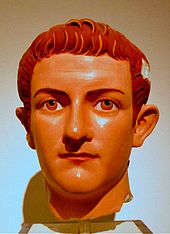
It pays to be careful who you are making the vows for and who you tell about your willingness to sacrifice yourself. Sometimes, just sometimes, the odd ruler will take you up on your promise. A Roman plebian by the name of Publius Afranius Potitus had made no secret of the fact that he would be willing to give his life if the Emperor Caligula were to recover from an illness. Caligula had been in power for a mere six months at that time and was still a popular ruler because of the extravagant shows that he put on for the entertainment of the Roman people. Caligula recovered from his illness and, instead of rewarding Afranius for his loyalty, gave the man what he wished. Afranius was executed. Some accounts state that Caligula had Afranius dressed as a sacrificial animal before he was sacrificed.
Afranius was what is known as a devotio. Becoming a devotio was a Roman tradition in which a person would dedicate themselves to the gods of the Underworld. In later days, the term was also used to describe someone who was willing to sacrifice themselves for the health and well-being of the emperor. As Caligula wanted to be worshipped as a living god, he likely felt that this vow was a most welcome one.
Perhaps it would have been better if Afranius had never made his vow. Caligula is widely regarded as one of the cruelest of the Roman Emperors. He was a big spender who rapidly emptied the Roman treasury of the money his predecessor Tiberius had saved. He used that money to throw lavish feasts and public spectacles.
Caligula was perhaps best known for his sexual excesses. Two sources, Philo of Alexandria and Seneca the Younger both painted Caligula as being insane. He was known for throwing lavish feasts at which he bedded his guests’ wives. He was rumored to have carried on incestuous relationships with his sisters Agrippina the Younger, Livilla and Drusilla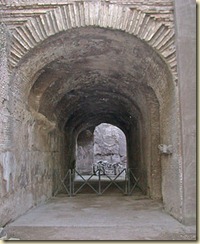 .
.
Caligula’s reign did not end well. He was particularly disliked by the Senate, the equestrian order and the Roman nobility. He was stabbed 30 times by a group of men led by Cassius Chaerea, an officer who was part of the Praetorian Guard. The attack took place in a cryptoporticus or underground corridor. The location made it difficult for the Germanic Guard, which was loyal to Caligula, to arrive until after the deed had been done.
Perhaps Caligula wished that he had let Afranius live after all.

By: The Scribe on January, 2011
It is likely that many people have heard of the Great Fire of London which swept through the city in 1666 and which burned for four days. Rome also suffered a devastating fire that burned through the city for five and a half days in 64 CE. Like the Great Fire of London, this blaze consumed much of the city of Rome. This was the blaze that earned Nero his nefarious, but untrue reputation. Although he was believed to have been responsible for the fire he would not have been able to fiddle while the city burned, since it took another thousand years for the instrument to be invented.
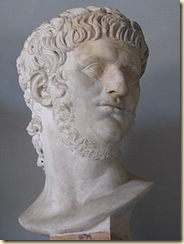 Nero was not a popular Emperor, so it is no wonder that he is held at least partly to blame for the blaze. Nero ruled Rome from 54 to 68 CE. He was known for two main things: his focus on diplomacy and his persecution of Christians. He was also known for executing his mother and stepbrother and as a ruler who was extremely extravagant. It was no wonder that an angry population blamed him for the fire even though he was, according to the accounts of the historian Tacitus, away in Antium at the time that the fire broke out.
The fire destroyed a massive portion of the city and left many people homeless. The city at the time was divided up into fourteen separate districts. Of these, three were completely destroyed by the fire. Seven others were damaged and four were left untouched. When the blaze came under control almost a week after it began, a tenth of the city had been burned by the fire.
This left a large number of people homeless. When Nero returned to the city, he opened up his own residence in order to provide shelter to people who had been burned out of their homes. As the supply of food was also an issue, Nero paid to have food delivered as well.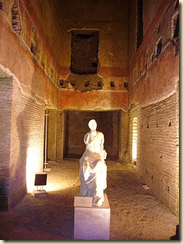
The city was rebuilt. One new structure was the Domus Aurea, a new palace complex. Some rumors hinted that Nero had actually arranged for the city to burn just so that he could build his majestic new residence but that theory is debated simply because the fire started some distance away from where the palace was built.
One other theory was that Christians had started the blaze. At that time, they were not welcome in Rome and were subjected to horrific treatment at the hands of Nero. Some were thrown to dogs as a way of torturing them for their beliefs. There were also accounts of Christians being set ablaze and used as lighting for some areas at night. Although some Christians did confess to starting the Great Fire of Rome it is suspected that they only did so after being tortured so that they could serve as scapegoats.
Although this was one of the largest fires that Rome experienced there were several others that are worth noting. The fires took place first in 69 CE, during the reign of the Emperor Vitellius and again in 80 CE during the reign of the Emperor Titus.
By: The Scribe on January, 2011
For some ancient cultures, bathing was a necessity. Others avoided keeping clean for a multitude of reasons. For the Romans, not only were baths important for maintaining health, they were also an important part of social life. Roman public bath houses were centers for socialization and in some areas, were quite large and lavish indeed.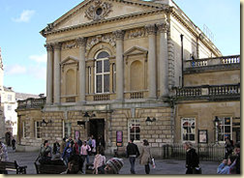
Roman baths actually fell into two categories: balneae and thermae. Balneae were built on a smaller scale than thermae. There were public balneae as well as private ones that were attached to homes. Their main function was to enable people to clean themselves. Although these were popular and the Romans did enjoy using them to get clean it was at the thermae that the action really happened.
This is because thermae (some of which were large Imperial bath complexes) were much larger and were designed to allow a person to spend an entire day relaxing and getting clean. Some of the Imperial Roman bath complexes were absolutely massive. For example a public thermae that was constructed n 19BCE was a large complex that featured a 25 meter rotunda. It also featured a pool and an artificial river as well. Later complexes, such as the Baths of Diocletian were larger. Over 3,000 bathers used the Baths of Diocletian each and every day.
A Roman bath complex featured three main rooms. Two of the rooms contained pools of water. There was a frigidarium, a room with a pool of unheated water. In some baths, the frigidarium pool was large enough for swimming. This was the room that bathers entered first and where they would disrobe. After plunging into the cold water, a bather could decide whether they wanted to enter the tepidarium to be anointed, or whether they wanted to move on to the caldarium.
The caldarium was a room with a pool of hot water in it. It was built directly over a hypocaust. This was a form of central heating. A raised floor allowed hot air from a furnace to move around underneath and this warmed the entire room or complex. Because the caldarium was located directly over the furnace, the room was extremely warm and the water inside was very warm as well. Although women were welcome at the baths they did not use the same rooms as the men. Their rooms were generally smaller and configured differently although they did serve the same purpose as the men’s bath did.
Bathing was a process that could take hours. It was not uncommon for individuals to spend the day at the bath moving from one room to another. In some bathing complexes there were additional areas as well. One was the palaestra. This was an outdoor gym where men could exercise. Some thermae also had libraries and areas where food could be purchased and consumed. It was not uncommon for people to meet at the baths and make social plans or to us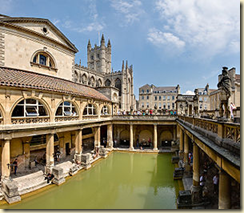 e the baths to find an audience for political speeches.
As the Romans spread out and exerted their influence in other areas in Europe, they brought their baths with them. Some, like those built at the hot springs in Bath, England still have ruins that are visible today.
By: The Scribe on December, 2010
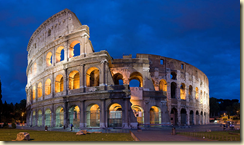
The ancient Romans loved their entertainment. The Coliseum was very popular and a variety of different entertainments were staged there. From full on naval battles to gladiatorial combat, Romans flocked there in order to be entertained. And although the Romans could accept quite a bit, one thing that they could not accept was an Emperor fighting in the ring like a gladiator.
Now, while it is true that the masses loved gladiators (in much the same way that we love professional athletes) there was a problem with an Emperor acting like a gladiator. Gladiators were slaves, plain and simple. They were bought, trained and forced to fight in the ring to the death. So, when an Emperor decided to fight like a gladiator and act like a slave in public, that public was not impressed.
Anyone who has seen the movie Gladiator remembers the Emperor Commodus fighting in the ring. In real life, not only did he do so to prove a point or to destroy an enemy, he did so regularly and enjoyed it immensely when he did so. But who was Commodus? What kind of man could be raised to wealth and privilege and still feel compelled to fight like a common slave?
The Emperor’s full name was Lucius Aurelius Commodus. He was the son of Marcus Aurelius who was one of the best loved emperors to rule Rome. He knew from a very early age that he would rule after his father. Much of this had to do with the fact that he was the only male child to make it to adulthood. Although many people think that the position of Emperor normally passed from father to son this was actually not usually the case. In fact, the fact that Commodus was born during his father’s reign was something very unusual indeed. Before Commodus, no other emperor had been born during the reign of their father.
Although Marcus Aurelius was known as being one of Rome’s “Five Good Emperors”, Commodus was not. He was known as being petty and megalomaniacal. He saw himself as having god-like power, something that is bound to go to the head of anyone given enough time. He loved the myth of Hercules and often compared himself to the Greek hero. A large number of statues were put up around the city that showed Commodus dressed as Hercules.
Of course, getting in the ring and fighting as a slave was not Commodus’ only unpopular action. He also changed the names of the calendar months and became known for killing his enemies regardless of whether they were real or imagined. Although his father had introduced a number of very popular policies, Commodus decided to discard many of them and began to lead a lifestyle that was full of cruel practices and wild excesses.
When Commodus entered the ring, he usually squared off against amputees, wounded soldiers, and citizens that were unable to fight. Of course, no citizen would fight back against the Emperor so it was unlikely that they would have won even if they were up to fighting.
Commodus’ lifestyle was so cruel and outrageous that it was no wonder he was assassinated in CE193, beginning a period that would see five different men take the position of Emperor in a single year.
Previous page | Next page
 .
.


