Archive for the ‘Ancient Rome’ Category
By: The Scribe on November, 2010
If you think that modern elections and politics can be confusing, be thankful that you didn’t live in Ancient Rome. Rome was always a place where an unpopular ruler could run into problems but one year in particular was really bad for anyone who wanted to call themselves a Roman Emperor. It has become known as the Year of the Five Emperors and was a tough time for anyone who wanted to rule the Empire.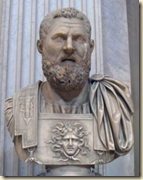
Picture the scene: the year is 193AD. Commodus, that unpleasant emperor made famous by the movie “Gladiator” has just been assassinated. Since he was just about as bad a fellow as was portrayed in the movie it is no wonder that his reign did not end well. The problem was a simple one: who would take over? The first Emperor was a man by the name of Publius Helvius Pertinax. Pertinax was fairly down to earth and wanted to work with the Senate instead of against them. The politicians loved him. The common people loved him. The problem was that the soldiers did not.
Pertinax had only paid them half of the large sum of 12,000 sesterces that he had promised them for their support following Commodus’ assassination. Unfortunately, when you have underpaid soldiers they tend to react badly. Soldiers burst into the palace on the 28th of March and Pertinax was assassinated. This paved the way for his successor, Marcus Didius Severus Julianus to assume the position of emperor.
The problem with Julianus is that while the soldiers liked him the common people did not. Julianus found that wherever he went, mobs would call out insults and would often throw stones. Although the military that was based in Rome supported Julianus the outlying legions did not do so. They advanced and overthrew Julianus who was later executed. He had bee n Emperor for three months.
The final three emperors were actually generals who vied for the position. Gaius Pescennius Niger took power next. Although a general named Lucius Septimius Severus actually overthrew Julianus it was Niger that seized the title of Emperor. Severus did not agree and fought Niger. Niger was defeated. In the course of fleeing to Parthia, Niger was killed.
One would assume that Severus would seize power and be the next in line but this was not the case. The fourth Emperor was a man by the name of Decimus Clodius Septimius Albinus. Again, Severus did not agree with this and brought his legions to bear against those of Albinus. They met and fought the Battle of Lugdunum. Albinus definitely did not come out on top. He was defeated and was then decapitated and trampled by the horse that Severus rode. 
Lucius Septimius Severus was the final Emperor in the Year of Five Emperors. Not only did he manage to hold on for the rest of the year, he actually reigned until the year 211. During this time Severus waged war on the Parthian Empire, fought Picts in Caledonia and was involved with the strengthening of Hadrian’s Wall. He was able to leave the empire to his sons Caracalla and Geta and provided a period of stability following the turbulent Year of Five Emperors.

By: The Scribe on November, 2010
Many people think that the only thing deadly about a volcanic eruption is the lava. All you have to do to realize that this is not the case is to look at the residents of Ancient Pompeii. Their city was destroyed in CE 79 when it was buried, not by hot lava, but by hot ash and gasses. Over nine feet of hot ash completely blanketed the city of Pompeii but it was the gasses that came first that did much of the damage and which killed many of the residents.
Before the volcano erupted, Pompeii was a very busy city and one that had much to offer in terms of culture and commerce. The town was located near where the city of Naples is located today. A large number of frescoes have shown archaeologists a lot about what daily life was like in Pompeii. It was a popular destination for many Romans who wanted an escape from the city and many holiday villas were located in the city.
Part of the reason that the area was so popular was the incredible richness of the soil. This made farming easy. Unfortunately, that rich soil had developed from years of repeated volcanic eruptions. Because there had been a number of smaller eruptions in the area for many years, the residents of Pompeii and its sister city, Herculaneum, felt secure that they would not be harmed should the volcano erupt again. They were very wr ong.
ong.
Unlike previous eruptions, the eruption of CE 79 did not produce gouts of flame and rivers of molten rock and lava. In the earliest stages of the eruption, the cap blew off of the crater and the cities surrounding the volcano were pelted with rocks and other debris. The volcano also produced a lot of ash that choked the residents of Pompeii and its sister city, Herculaneum. The eruption had several stages and it was these later stages that proved to be so deadly.
The ash, rocks, gas and debris that had formed a massive cloud began to roll down the side of the mountain. It swept through Herculaneum first and killed the residents in an instant. A total of four surges of ash, toxic gas and rocks flowed through Herculaneum and Pompeii.
The destruction of Pompeii was terrifying both for the residents and for those that witnessed the destruction. Pliny the Elder (23 AD – August 25, 79), a Roman philosopher and author, and Pliny the Younger (61 AD – ca. 112 AD) a lawyer, both wrote about the destruction of the city in a number of their writings.
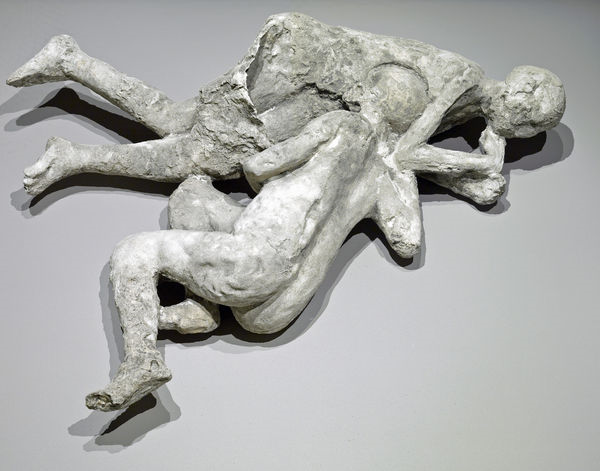
Excavation of Herculaneum and Pompeii involved digging down through the meters and meters of thick ash. A number of voids had been found in the ash. These were where the bodies of victims had fallen after they succumbed to the hot ash and toxic gas. As they decomposed, they left behind vacant spaces. These were later filled with plaster and the shapes of these lost victims again came to light. Many of these can be seen in various museums as well as in the city of Pompeii itself, which has become a UNESCO World Heritage Site
By: The Scribe on January, 2010
Roman cooking was well known for its excesses. While meals were often quite simple and basic in the early days of the Republic they eventually evolved into very elaborate affairs. The main meal of the day was the cena, which would usually begin at 4pm and often lasted late into the night. When guests were present, the meal could go on for hours. Diners were often entertained by acrobats and other professionals while they ate and meals were often made up of a number of different courses.
There were three main additives that were used in Roman cooking. These included carenum, defrutum and sapa. These ingredients were all made in much the same way. Grape juice or must was boiled down in pots so that water would evaporate. This left a liquid that could be used to sweeten or preserve various types of food and drink. Sapa was created when the liquid had reached one third of its regular volume. When half of the volume had been reduced, the liquid was known as defrutum. When only one third of the liquid remained, it was known as carenum.
The problem with these ingredients is that they were made in lead lined pots. This meant that lead acetate crystals would work their way into the liquid and were therefore consumed along with the food or drink. The lead was actually what caused the mixture to become sweet. When defrutum is made properly it can reach lead levels that are as high as 29,000 ppb. Drinking liquid that has this much lead in it can easily cause acute or chronic lead poisoning.
There were many rules that surrounded the making of defrutum. Pliny the Elder, a well-known Roman historian and author, felt that defrutum needed to be made during the New Moon. He also warned that defrutum should never be made in copper or bronze kettles. He felt that this would cause the defrutum to take on an unpleasant metallic taste.
Cato the Censor, a Roman statesman, felt that the quality of the grape juice would affect the taste of the defrutum. He felt that it was important to use must that was as sweet as possible and that boiling it in a lead pot was most important.
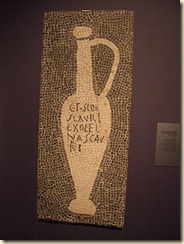 Defrutum was not just added to wine in order to make it sweeter. Romans would add it to meat dishes to make them sweeter. Some ducks and suckling pigs were fed defrutum in order to make their meat sweeter before being cooked. The most popular condiment in Rome, oenogarum, was made up of a mixture of defrutum and garum. Garum is a fermented fish sauce that was a staple of every day cooking in Rome. Defrutum and sapa were both used to preserve fruit such as quince and melon. Roman soldiers were often given food that had been preserved in defrutum as part of their standard rations. Roman women would often use defrutum or sapa as a cosmetic as well.
Because of the high levels of lead that are found in defrutum, it is now believed that this substance, along with the dishes used to eat and drink from, may have actually contributed to illness and the overall decline of the Roman Empire.
By: The Scribe on January, 2008
 The government in ancient Rome was similar to governments found in many Western countries today – convoluted and with too many levels! But, the Romans liked it that way, as it allowed them to keep track of all the goings-on in the Empire. One of the offices of government was something called a ‘censorship’.
Censors in ancient Rome were responsible for an odd mixture of tasks. Their primary purpose was to take a census of citizens within the Roman Empire every five years: they would write down each citizen’s name, their age, and what amount of property they owned. This was done so that the information could be taken to the quaestors, who would estimate each person’s taxation levels, the Empire’s budget, and the amount of soldiers commanded by Rome.
Although the number of censors and their terms changed throughout the centuries, the tradition of the post held that two censors would serve together for 18 months – one was from the patrician class, while the other was a plebeian.
Once they gained their census information, censors had the charge of determining who among the population was allowed to be counted among certain class levels – for example, who was worthy of senatorial rank as opposed to equestrian, and so forth. This was called the ‘regimen morum’ (public morality), and was an extremely important duty. Other duties of the ‘regimen morum’ were also the verification and stamping with the Imperial Seal any weights or measures, and managing the books of financial institutions.
Apart from their census task, the censors were often responsible for funding and managing public projects. Conquered land was leased out and recorded by censors, while a more important task – or at least in the eyes of the Romans – was for them to choose a farmer who would feed the Capitol’s holy geese for a 5-year term.
Consuls were elected officials by an assembly of Roman citizens called the ‘Comitia centuriata’. They were required to wear a toga bordered with purple, in order to denote their important class, though unlike other elected officials they were not given bodyguards.
As the Roman Empire grew in size, the job of the consulship became rather overwhelming – there were simply too many people for only 2 men to account for, and so the office was eventually abolished. It was replaced with generic officials who would be sent out to count the people on the Emperor’s orders, and they would be counted according to province. For example, the Gospel of Luke discusses how in 8 AD, Caesar Augustus issued a census of the entire Roman Empire.
Want to read more?


Tomorrow: More Ancient Standard!
Previous page | Next page

 n Emperor for three months.