Archive for the ‘Ancient Rome’ Category
By: The Scribe on December, 2007
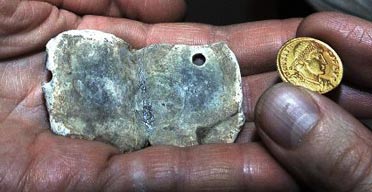
It was somewhere around 1,650 years ago that someone living in the Roman Empire became more than a little ticked off with how things were going – and so they committed a small act that could probably be called ‘treason.’ Or blasphemy, for that matter… not to mention that they were criminally defacing state coinage.
The ruler of the Roman Empire at this time was the Emperor Valens, and Roman Britain was experiencing a period of extreme turmoil and unrest – and it didn’t help that an exiled Roman aristocrat named Valentinus was trouncing around the British countryside and stirring up trouble in the form of negative attitudes toward the Roman leadership.
And while curse charms are nothing unusual – Greek and Roman curse objects and tablets are fairly common finds, usually consisting of a curse scrawled on a piece of lead and then thrown into hot springs, or with a hole punched into the lead to hang it up somewhere – a curse object against an Emperor is more than unusual… it’s absolutely unheard of.
Absolutely no curse objects or tablets against an Emperor have been found from Roman times until now, as such an act would have been extremely dangerous. The item which changes all that, is a piece of scrap metal that was found in a Lincolnshire field: whoever cursed the Emperor hammered a coin with an image of the Emperor’s face into a piece of lead, and then folded the lead overtop his face. The piece of lead would have then been taken into a temple and hung up, where the curse could be enacted through the power of the gods.
Since Roman Emperors were often treated as god-like figures – in fact, many were deified after their death – anyone who was discovered cursing an Emperor would have likely suffered extreme torture and death, and their families would have faced possible exile or imprisonment.
Want to read more?


Tomorrow: More Ancient Standard

By: The Scribe on December, 2007
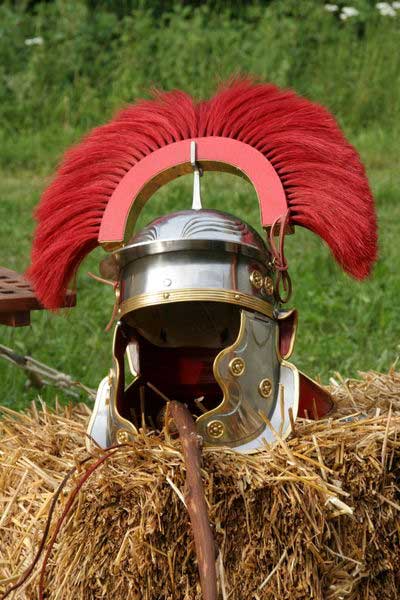
Archaeologists working near the town of Xanten – an area of land which was a part of the Rhine riverbed for nearly 1,500 years – were thrilled to find an iron legionnaire’s helmet that had once been worn by a Roman soldier… and they were even more ecstatic to realize that the helmet held trace elements of glue on its exterior!
When researchers were handling the helmet for restoration purposes, they removed a tiny sample of metal with an extremely fine saw – not an unusual practice, since restorers need samples of ancient items in order to make sure the restorative chemical won’t damage the artifact – and were shocked to see that the tool’s heat was causing little silver laurel leaves that decorated the helmet to peel off, leaving threads of glue behind.
It seems that since the helmet was on the riverbed for such a long time, the glue was spared exposure to potentially destructive atmospheric elements, thus allowing it to maintain its adhesive power for over two thousand years.
Examination of other Roman artifacts since this discovery revealed that there are plenty of additional items – such as ancient battle masks – that have trace remains of silver decoration like the helmet’s laurel leaves, and it is likely that they were held on with glue in the same way. Unfortunately, a close look at many of the items has shown that they are too far in their deterioration to yield evidence of glue. However, it seems that the Romans preferred to glue on their decoration to battle armor, rather than go through the hassle of soldering on each and every small piece.
A chemical analysis of the ancient Roman glue has determined that it was made of beef tallow, pitch, and bitumen – but as of yet, researchers haven’t been able to exactly reproduce the adhesive, and are beginning to think that something like sand, soot or sawdust might have been added in order to complete the recipe.
Researchers are hopeful that they’ll be able to fully recreate the Roman glue soon – after all, if the Roman stuff can still stick after 2,000 years, it’ll easily surpass any of its modern competitors!
Want to read more?


Tomorrow: More Ancient Standard!
By: The Scribe on November, 2007
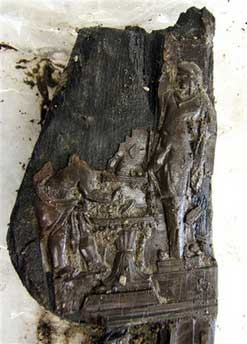
For the first time in history, pieces have been found of an ancient Roman throne – a throne that was buried in 79 AD, after the eruption of Vesuvius covered the city of Herculaneum with lava and ash, killing thousands of people. As one of the three cities that was destroyed in the eruption – the others being Pompeii and Stabiae – Herculaneum was closest to the volcano’s base and would have been the first to be destroyed.
The ancient wooden throne was decorated with bas-reliefs in ivory that depicted several ancient gods, which spanned across the entire chair. Two legs and a portion of the throne’s back makes up the most of the remains, and were located very near to the Villa dei Papyri, which is believed to have been the home of Julius Caesar’s father-in-law during the first century.
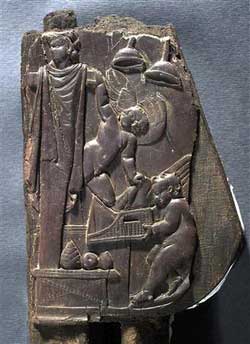
Prior to the discovery, Roman thrones were known only from artistic depictions – this throne is incredibly detailed in its own artwork, with images of Greek figures from myth shown in a Romanized style. The gods Attis and Dionysus are prominently featured, and other decorative features are made up of flowers, phalluses and pine cones – perhaps more than a little unusual for the modern eye.
The cult of Attis was prominent at Herculaneum during the 1st century AD, and since the god was associated with life, death, and rebirth, it is likely that the theme of the Roman throne was that of fertility – which explains the decorative features of choice.
While little is known as to how the throne would have been used – let alone whether the chair even belonged to the resident of the Villa dei Papyri – the cultic associations certainly point to it having belonged to someone who was prominently involved in Attis worship.
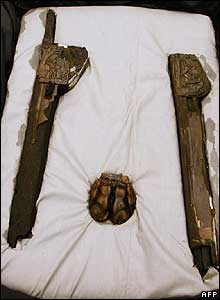
Either way, the survival of such a large portion of wooden furniture is rather astounding, though organic materials aren’t entirely unheard of in Pompeii or Herculaneum – the volcanic mud that came after the eruption did a very good job at preserving nearly everything, even food from the time of the eruption, in both cities.
Want to read more?


Tomorrow: Baby Cremation
By: The Scribe on November, 2007

The Tabula Peutingeriana, or “Peutinger Table” is an ancient Roman road map that actually shows the road network of the entire Roman Empire – all the way across Europe, Asia, and in parts of North Africa. The map was created in the 13th century by a monk from Colmar, and was drawn on a scroll of parchment.
The map itself was made up of eleven sections assembled together, and when laid out it measures approximately 6.75 meters long – and all evidence points to this map being a Medieval reproduction of an original that was created in the 3rd or 4th century AD. The art of the map is very schematic and stylized, with highly distorted landmasses that seem to suggest the map’s use was primarily for the information on distances between settlements – which is given right on the map – and recognition of major intersecting roads, rivers, mountains, and so forth.
Some of the Roman Empire’s most important cities – Antioch, Constantinople, and Rome – are denoted on the map with different symbols to indicate their importance, and the lack of the Iberian Peninsula in the western area of the map seems to suggest that the original copy of the map had a twelfth section that would have included this portion of the Empire.
The Tabula Peutingeriana seems to have been based on ‘itineraries’, or meaning the destination points along the Roman roads, since that would have allowed travelers to know how far they needed to travel – approximately – between each town. The roads are roughly parallel in their representation, and each city and its size/comparative scale is demarcated by one of several hundred place symbols – these can be anything from small building icons to elaborate portraits of the large cities.

An interesting feature of the roads along the map are little ‘hook’ marks that appear every so often – these hooks were actually representations of rest stops. The distance between each set of hooks indicated one day’s worth of travel, and sometimes this would include a little icon of a building that showed there was an inn or hotel at certain locations where a traveler could stay – more luxurious accommodations were shown by icons that had large courtyards in the picture.
The people who would have used this map were either travelers – typically those who were making a long journey or who traveled often – or couriers, who spent each and every day traversing the roads across the Roman Empire and beyond.
Want to read more?


Tomorrow: The REAL Argonauts
Previous page | Next page
