Archive for the ‘Ancient World’ Category
By: The Scribe on August, 2007

Though undoubtedly taken for granted today, the number (or lack thereof) known as “zero” was not always a part of the human mathematical mindset. Since zero is more of a concept than an actual number, the development of ‘true zero’ took quite some time to enter into human consciousness.
By the 2nd century BC, the ancient Babylonians had developed their own highly sophisticated mathematical theories – however, the way they expressed the lack of a positional value (ie. nothing, zero) was by leaving a space between numerals. By 300 BC, instead of leaving a space, two slanted wedges were used as ‘zero’ punctuation, while a tablet from the city of Kish shows that at least one scribe – in this case, a man named Bel-ban-aplu – wrote his zeros by making three hook marks instead of the slanted wedges.
And yet even at this early stage, the Babylonian nothingness-placeholder was not a real zero in the ‘true’ sense of the word, since it was neither used alone, nor was it ever placed at the end of a number. For example, in the Babylonian sexagesimal system of numerals, both the numbers for 2 and 120 (since it would be 2 x 60) looked the same, and could only be differentiated through context.
Elsewhere in the world, the ancient Greeks had their own notions of what constituted zero: they were unsure of its status as a number, since they didn’t see how nothing could be counted as something… naturally for the Greeks, this vein of thinking led toward philosophical and religious arguments about the nature of zero and whether ‘nothing’ could ever be thought of as ‘existing’. As a result, the thought of zero and nothingness was an immensely terrifying concept to Greek philosophers!
 Somewhere around the 5th to 2nd centuries BC, an Indian scholar named Pingala made use of the Sanskrit word “sunya” to refer to nothing or a void, which is actually the word that finally became the word “zero” after a series of translations over time. During the 4th century in India, scholars would often use a blank piece on a counting board to physically represent zero.
Separately from these other developments, the Mayans came up with their own system of representing zero – and although it became an integral part of the Mayan mathematical system, their isolation from other cultural groups did not result in any influence on Old World numeral systems.
The first documented use of zero as a number on its own came from ca. 130 BC, when the Greek mathematician and astronomer Ptolemy began writing a small ‘o’ with a long bar overtop as a symbol for nothing. However, this form of ‘zero’ still was not used for anything but fractions. It was not until sometime between the 6th and 8th century that a symbol for zero which could be used for representing an integral part of a number appeared on copper and stone tablets in India.
Although the history of ‘zero’ as a numerical concept is much lengthier than the small portion discussed above, it is worth noting that in 628 AD, the Indian mathematician and astronomer Brahmagupta wrote his definitive work Brahmasphuta-siddhanta (translated “The Opening of the Universe”), which attempted to definite the mathematical role of zero, thus ending the debate once and for all. Of course, the nature of zero was discussed and changed long afterward, but this work sparked a new direction and is still considered a piece of highly sophisticated mathematical theory for its time.
Want to read more?


Tomorrow: Astyages (Try saying that three times fast!)

By: The Scribe on June, 2007

As one of the deadliest projectile weapons known to man, the creators of the crossbow must have had some very intense warfare in mind as they developed this weapon. In fact, there is quite a bit of uncertainty over when and where the crossbow was first created and used, but evidence for its use first appears around the 4th century BC in China.
The earliest definitive evidence for Chinese crossbow use comes from manuscripts dating to the 4th and 3rd centuries BC in China, associated with the followers of Chinese philosophy Mohism, developed by a man named Mozi. This philosophy, although it asserted a belief in universal love, also called for the development of a political structure within which there was no central authority other than Mozi’s writings. The Mohists developed many ideas on fortification, statecraft, as well as agricultural theories, and were soon hired as advisors for the leaders of warring states.
Keeping this in mind, perhaps it isn’t so unusual that the first reference to crossbows appears in Chinese philosophical writings – the document discusses the use of a giant crossbow catapult during the 6th and 5th centuries BC. Since the use of the crossbow occurred before the manuscript was written, it cannot be said for sure whether use of the crossbow originated in China – though it is certainly possible. However, Sun Tzu’s book The Art of War also refers to the use of crossbows, and this book first appeared around 400 BC.

There are also reliable records that crossbows were used in 341 BC at the Battle of Ma-Ling, and by the end of the 3rd century BC, the crossbow had been very well developed and was a standard weapon used in Chinese warfare. In fact, Emperor Qin Shi Huang’s tomb from 210 BC contained several crossbow pieces, strewn about between the Terracotta Warrior statues.
In the Greek world, the earliest documented evidence for crossbow use was during the Siege of Motya in 397 BC, described by the scholar Heron of Alexandria in his book on war machines from the 1st century BC. Of course, since the gap between the event and the book’s composition is quite wide, there is speculation over the authenticity of the report. Regardless, Alexander the Great is known to have used crossbows for the siege of Tyre in 332 BC – and his crossbows were the first to have documented use of ballista construction, which used torsion spring bundle technology to increase projectile force. Ballistae could actually the shoot lighter projectiles, providing they had higher velocities, over a much longer distance.
As improvements to the crossbow continued, the Greek world soon saw the introduction of a smaller, sniper model called the Scorpio. By the time the Siege of Rhodes came around in 305 BC, siege towers were being constructed with multiple crossbows: a large ballistae at the bottom, designed to demolish the parapet and rid it of troops, while the top of the siege towers held armor-piercing Scorpios to snipe soldiers patrolling city walls.

It turned out that these types of crossbows were so effective in ancient warfare that the basic styles and functions saw very minimal change until well into the Middle Ages!
Want to read more?


Tomorrow: So much for gun laws…
By: The Scribe on June, 2007
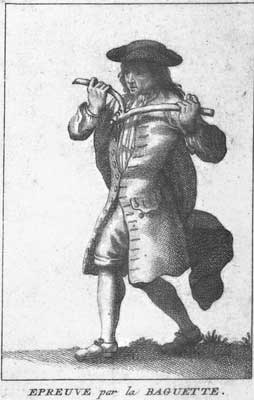 Dowsing, a practice wherein an individual divines the location of water and other objects, has been a part of human culture since early prehistory. Cave drawings and Egyptian hieroglyphs attest to this ancient practice; however there is still some significant skepticism over whether or not dowsing is a legitimate scientific practice. Generally purported to be a practice of superstitious spiritualists, some researchers do believe there is evidence to support the claims of some dowsers.
What was its original purpose? It is likely that dowsing was originally used to divine the will of the gods, most particularly in the areas of telling the future and determining guilt in legal trials. Apart from the ancient images of people holding ‘divining rods’, 15th century Germany is the most probable candidate for the more ‘modern’ aspects of dowsing.
Dowsing in 15th century Germany was mainly used to find underground sources of metal, and the technique was spread through Europe when German miners traveled to England to work in the country’s coal mines. As readily as the practice may have been accepted at first, it didn’t take long before the church caught wind of this ‘fortune-telling’, and in 1659, the Jesuits declared dowsing a satanic practice.
During the 16th century, practicing dowsers were labeled as ‘water witches’, and even being suspected of dowsing could be cause for arrest and trial as a heretic or for practicing witchcraft. In 1701, the Inquisition ceased using a dowsing rod during their guilt trials, though the practice never completely stopped among the general public. Practiced in secret, dowsers continued to keep their ‘abilities’ alive until the Victorian era, when dowsing became a popular practice among the high-born of society.

Victorian society had a fascination with spirituality and mysticism, and dowsing again grew more widespread – popping up everywhere from parlor games to mining companies.
In more recent years, several scientific studies have been carried out in an attempt to determine whether dowsing is simply the result of chance, or whether those claiming dowsing abilities can actually sense the changes in Earth’s magnetic field – thereby leading them to natural underground sources such as water and metal. Dowsers have used everything from wooden Y-shaped rods, to brass L rods, to bent coat hangers, to crystal pendulums for their practice. Often, dowsers will pose questions of their divining device, and depending on the sway of the pendulum or shift in magnetic fields, the dowser will interpret the answer.
Although most scientists still remain unconvinced at the authenticity of dowsing claims, the practice continues into modern day, mainly as a water-locating trend. Notably, this is a phenomenon that has survived in human culture for almost 10,000 years – and whether or not any dowsing claims are true, it is certainly worth consideration as an ancient practice that has been passed down with some level of sincerity throughout the millennia
Want to read more?



Tomorrow: The Assassin King!
By: The Scribe on May, 2007
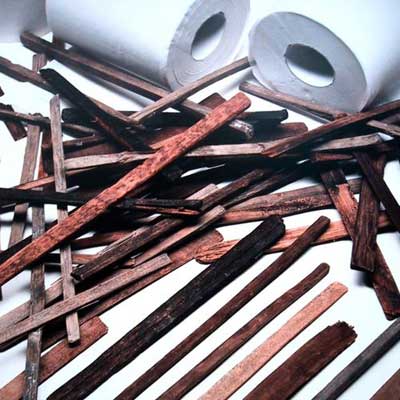
While the modern convenience of toilet paper is often taken for granted, the human history of toilet paper actually began relatively late. In the 6th century AD, wealthy individuals living in China often used paper for “sanitary” purposes – even though the standard paper making process had been perfected several centuries before. Regardless, there are several documents written by ancient scholars about the Chinese use of paper for toilet-related tasks. In 589 AD, the scholar Yan Zhitiu wrote that “paper on which there are quotations or commentaries from Five Classics or the names of sages, I dare not use for toilet purposes.”
During the Tang Dynasty, an Arab traveler to China in 851 AD recorded his thoughts on Chinese bathroom habits: “They are not careful about cleanliness, and they do not wash themselves with water after they have done their necessities, but they only wipe themselves with paper.” Notably, since ancient times in Middle Eastern cultures, the left hand has been traditionally considered unclean – because that was the hand people used to wipe themselves with after attending to their, ah, “natural faculties”.
It wasn’t until the late 14th century during the Song Dynasty that the Chinese emperor commissioned large 2ft x 3ft paper sheets to use after his toilet-related activities. However, even after the invention of the flush toilet in 1596, commercially produced toilet paper wouldn’t be available for another 300 years!
So, what did humankind do before they had soft tissues to clean their bottoms? The ancient Greeks made use of stones and clay, while the ancient Romans equipped their public toilets with a sponge on a stick, resting in a bucket of brine. If you were rich, you could use wool.
For those living in the cold, northern regions of the world, tundra moss was readily available during the summer, and snow would do the trick for the rest of the year. Colonial America had an interesting habit as well: they used cobs of corn, or pages from mail order catalogues that they would hang on a wall near their toilets. In fact, anything from leaves, to mussel shells, to pieces of fur were used by various cultures around the world, from the earliest of times until toilet paper became a readily available commodity.
In 1857, Joseph Gayetty sold the first factory-made toilet paper called “Gayetty’s Medicated Paper” in the United States, and these were single sheets of moistened paper that were medicated with aloe. Each sheet was printed with Gayetty’s name, and while it did take some time to catch on with the general public, it was apparently from that day forward that the world’s bottoms would never be the same.
Want to read more?
On a Roll: A Sheet-by-sheet History of Toilet Paper
Tomorrow: More ancient goodness!
Previous page | Next page
