Archive for the ‘Ancient World’ Category
By: The Scribe on January, 2011
The modern pillow is often the ultimate in luxury. It is thick, plush and filled with a variety of materials that are designed to help us get a great night’s sleep. Today, if someone wakes up with a sore neck or feeling tired, they often blame their pillow. When looking at some of the ancient floor cushions that archeologists have found, it is easy to assume that the pillows of today were very similar to the head pillows of ancient civilizations. That assumption is incorrect.
While some individuals in ancient cultures did use softer pillows filled with down or other materials, they were not always the norm. More often, head rests made of a variety of unusual materials were used by ancient cultures while they slept.
Japanese geisha thought nothing of resting their heads on curved wooden head rests. This was done so that the head would be supported but the elaborate hairstyles they wore would not be crushed or destroyed. A geisha had her hair molded into beautiful shapes with the use of hot wax and placing weight on it could cause a hairstyle to be destroyed. While the head rests kept the hair safe they were not overly comfortable.
 In ancient Egypt, there were examples of stuffed or upholstered pillows that were used. Egyptians also chose to use a curved or crescent shaped piece of wood as a place to rest their heads. The beds themselves were not overly plush as they were usually made up of a woven mat that was placed on a wooden frame. The curved wood rested on a short pedestal which raised the head. Other archeological ruins showed that some Egyptians placed their heads on curved pieces of stone rather than on wooden headrests. Pillows and beds were not overly plush because Egyptians were looking for ways to stay cool and a thick mattress or pillow would have been too warm for sleeping.
In China, pillows were used in some areas of life but for sleeping, a hard box made from stone, porcelain, wood or metal was more common than an upholstered cushion. They were often highly decorated and featured colorful patterns. Common patterns that were used included images of mountains or water, human figures, plants or animals. It is often possible to tell where and when a Chinese pillow was made just by the decorations that were used or the colors that were added to the porcelain.
In some cases, such as in Carolingian culture, cushions were not used however a portion of the bed was raised in order to elevate the head. There are some examples of metal bedsteads that had elevated heads and these were used until the 13th century when it was more common to use cushions to elevate the upper body.
Once pillows filled with soft material or padding became more common they were often seen as status symbols and were covered in very expensive and luxurious fabrics. Pillows were used not only on beds but also as a form of seating or furniture and were often used on the floor or on other pieces of furniture as well.

By: The Scribe on December, 2010
Many people think that the makeup that is being worn today is extreme. While it may be unusual and extreme in some ways it is much safer than the cosmetics that were worn throughout history by both men and women.
Today, people worry more about what they are putting on their skin and normally want a look that makes them seem healthy and natural. In the past, this was less of a concern. Part of this was due to the fact that people were unaware of the effects that some ingredients would have on their health. Part of it was due to the fact that very specific looks were desirable and that your appearance could have a huge impact on your social standing.
One practice that was common to many different cultures was the practice of making the skin lighter. Whether it was just a light coating to make a woman look paler or an extreme white face was immaterial. Many women in a variety of cultures would use powdered lead in order to lighten their skin. Women from Ancient Egypt straight through to the Elizabethan era would use cosmetics containing powdered lead to make their skin look whiter and brighter. Mercury was often used during this time period as well.
The Egyptians were among some of the most prolific users of makeup of any of the ancient cultures. The products they used included unguents that could hydrate the skin and various types of pigments and powders that would color their faces and change the appearance of Egyptian men and women. The oldest makeup on record was found in Egypt and dated from between 3100 and 2907 BCE. 
Egyptian women often made their eyes up using a variety of different cosmetic products, some of which were quite toxic. Kohl, for example, was a dark substance that was used to line the eyes. The kohl that was commonly used by Egyptian women was made from one of two main ingredients. It was either made from galena or lead sulfide. Soot was also used in some cases instead of kohl.
The use of makeup is often designed to make a woman look sexually alluring as well. One sign of attraction is a dilated pupil and women throughout history were known to use drops of Belladonna in their eyes since it caused the pupils to expand. This effect, coupled with darkly-lined eyes and red lips could cause a woman to look extremely attractive. This substance was also known as Atropine, a toxic substance made from the Henbane plant.
Henna has been used as a cosmetic and a skincare product for many years. A number of cultures use this as a way to celebrate important events for thousands of years. Henna paste stains the skin or hair and has become a popular form of temporary tattooing. It is also used as a way to celebrate weddings and other events and Middle Eastern and Indian weddings would not be the same without a bride, her hands and feet coated with intricate henna designs.
By: The Scribe on November, 2010
When we look at a picture of Cleopatra or a bust of any of the Roman emperors we tend to think that they were physically impressive or attractive. This is all well and good, but how realistic were these images? Archaeologists and historians are beginning to discover that in many cases the rulers that we think we know actually looked very different than their portraits.
Although scientists are doing their best to come up with realistic images of what ancient rulers looked like there is only so much that they can do to figure it out. Part of the problem is because many of the images and portraits that were made of ancient rulers have been lost. In other cases they may have been damaged or disfigured by natural disasters or by invading armies. However, in some cases digital imaging is allowing scientists to use remains and other sources of information to put together educated guesses about what some famous ancients may have actually looked like.
One of the best methods of telling what an ancient ruler looked like is to examine the coins that bore their likeness. Because they were minted during the time that the person was alive there is a better chance that they may look fairly accurate. For example, images of Cleopatra that have been found on the coins of the time actually suggested that she may not have been as beautiful as her legend would have us believe. They depicted her neck as being very large and her facial features as being very birdlike. 
It was believed that Alexander the Great may have suffered from scoliosis and that this was one reason why many of his images depict him looking off to the side. It may also have contributed to the peculiar gaze that Alexander was known to have. This comes from sculptures of Alexander that were made during his life and is supported by reports that his father and brother had the same congenital deformities. It is also believed that this may have contributed to his death as well.
The bust of Alexander (right) was carved by Lysippus and is commonly believed to be one of the most accurate. It shows him gazing off to the side.
Julius Caesar also may not have looked quite like the handsome and authoritative person that paintings, money and sculpture have shown him to be. In one sculpture that is believed to be quite accurate, Julius Caesar is depicted as having eyes that are closely set together and a pugilistic nose. He looks far different than the other sculptures that were made of him depicted.
The bust of Caesar shown below was found in France. It had been pulled from the bottom of the Rhone River. 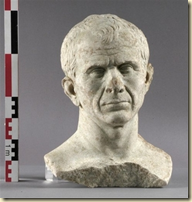
Other rulers have ordered stylized images of themselves as busts, works of art and on the coins that they minted. It was often not in an artist’s best interests to depict an ancient leader in a highly realistic fashion and portraits were often created that glossed over the physical shortcomings of ancient rulers. Ancient literature was also often written so that it painted rulers in a good light as well. It was not uncommon to find that unappealing information was either altered or left out so as to paint the conquerors in a good light or to gloss over details that were not to their credit.
By: The Scribe on January, 2008

While most of the modern world could likely not conceive of the possibility of not celebrating New Year’s Day on January 1st, the reality is that celebrating the New Year in January is a relatively recent idea.
The first New Year’s celebrations were held about 4000 years ago, when the Babylonians celebrated the first new moon that appeared after the Vernal Equinox. This fell around what is now known as late March, which made logical sense to the Babylonians – it was a time when spring was just beginning and the crops could be planted, giving it an agricultural significance. The Babylonians also had a longer holiday than the modern celebrant – the New Year’s festival lasted for 11 days.
In ancient Rome, New Year’s was celebrated on March 25 – the only problem was, each emperor kept tampering with the Roman calendar and causing the sun’s synchronization with the date to shift. To get everything back in order, in 153 BC the Roman Senate declared that January 1st be known as the start of the New Year… but it didn’t last for long. More emperors meant more tampering, until Julius Caesar set the record straight at January 1st again, but in order to get the dates back in sync with the sun, Caesar allowed the year 46 BC to drag on for 445 days.
This was all well and good, until the Catholic Church decided that New Year’s festivities were pagan and evil. In order to provide an acceptable alternative – instead of trying to shut down the popular celebrations – the Church started to have its own celebrations on January 1st. This was often referred to as the celebration of the ‘Feast of the Circumcision of Christ’, which corresponded to December 25th as the Christ child’s birth date. Jewish tradition dictates that newborn males are circumcised on the 8th day after their birth, which in this case falls on January 1st.

Similarly to today’s festivities, in 600 BC the ancient Greeks began using a baby to symbolize the New Year. The Greeks used the start of the new agricultural year to honor Dionysus, the god of wine and fertility, and parading a baby around was intended to symbolize the god’s rebirth. Although the early Church would see this practice as pagan, the popularity of the symbol resulted in the church conceding to using a baby in their own festivities – and explaining it as symbolic of the birth of baby Jesus.
With the arrival of the Middle Ages, the Church still abhorred New Year’s celebrations, and in some areas, the festivities were banned outright. It wasn’t until around 400 years ago that Western countries actually started celebrating January 1st as a holiday again.
Want to read more?


Tomorrow: More Ancient Standard
Previous page | Next page
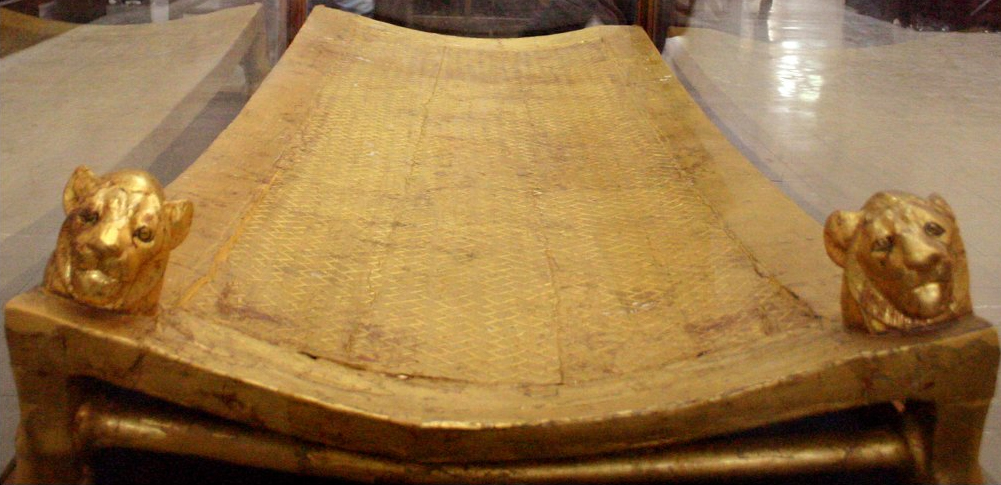 In ancient Egypt, there were examples of stuffed or upholstered pillows that were used. Egyptians also chose to use a curved or crescent shaped piece of wood as a place to rest their heads. The beds themselves were not overly plush as they were usually made up of a woven mat that was placed on a wooden frame. The curved wood rested on a short pedestal which raised the head. Other archeological ruins showed that some Egyptians placed their heads on curved pieces of stone rather than on wooden headrests. Pillows and beds were not overly plush because Egyptians were looking for ways to stay cool and a thick mattress or pillow would have been too warm for sleeping.