Archive for the ‘Ancient World’ Category
By: The Scribe on March, 2012
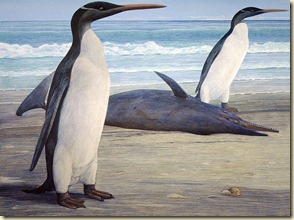 Long-time readers of The Ancient Standard may recall a post from 2007 that discussed the existence of giant penguins in Peru, but also lamented the unpublished data on even larger penguins that were thought to exist off the coast of New Zealand millions of years later.
Well, good news! Scientists have finally published their report on these giant “thinguins” that lived 25 million years ago (during the Oligocene period), based on a full skeletal reconstruction of the creature. The penguins are thought to have reached about 4.3 feet in height, which is just slightly taller than today’s tallest living emperor penguins (4 feet).
"It’s pretty exciting, we’ve got enough from three key specimens to get a pretty reliable construction of its body size," says University of Otago’s geology professor Ewan Fordyce. He and his team discovered the penguin bones 35 years ago, and recently teamed up with North Caroline State University research assistant professor Dan Ksepka to create the reconstruction.
While they used a king penguin to help build the ancient model, the main difference between ancient and modern penguins is in body composition—where today’s penguins tend to be a little more squat and round, these ancient flightless birds were much more streamlined. Their flippers were long and tapered, with narrow, spear-like beaks, and elongated midsections.
Based on the evidence, it appears that these giant New Zealand penguins lived alongside a number of other penguin species as well, some also giant and some with more familiar body types. Much like the species diversity seen today in the Falkland Islands, they were likely able to co-exist due to different food preferences (thus eliminating or reducing competition for resources).
 During the Prehistoric period in New Zealand, the vast majority of what we see today was submerged, leaving only small pieces of land above the water’s surface. Similar to many modern species, this ancient habitat of shallow waves, plenty of food, and defensive positioning from predators would have been ideal for these giant creatures.
The team who worked on the reconstruction and research project has given this newfound ancient species the Maori name Kairuku waitaki / Kairuku grebneffi, where kairuku roughly translates as “diver who returns with food.”
Why did the species become extinct? Likely for the same reasons it happens to other species—more aggressive predators, evolving competition for resources from other creatures, or environmental change.
The full study on this remarkable ancient species will be published in this month’s Journal of Vertebrate Paleontology (March 2012).

By: The Scribe on February, 2012
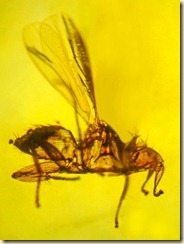 Don’t panic—Jurassic Park is not imminent! However, it’s not unheard of to find ancient things encased in amber. And recently, scientists uncovered the first 20-million-year-old bat fly fossil in the scientific record.
The bat fly is a rare, ancient, bloodsucking insect, and this particular bat fly is even more remarkable due to the parasite it contains: an ancient strain of bat malaria!
The fly was discovered in a mine in the Dominican Republic by George Poinar, Jr., an expert on amber-preserved insects from Oregon State University.
While this particular preserved variety of bat fly is now extinct, bat flies do still exist today, eating an exclusive diet of bat blood. In fact, some varieties of bat flies have adapted themselves to live only on the blood of specific species of bats.
Bat flies also very rarely leave their hosts. When they choose a particular bat to feed off of, they’ll cling to its body and feed at their leisure, though they will leave to find a mate and create more bloodsucking baby flies.
When Poinar looked at the amber-encased bat fly under a microscope, he discovered that it carried a new strain of bat malaria—a parasitic disease that’s so rare, only five or six scientific papers have discussed it to this day. (Scribe’s Note: How’d you like to contract a 20-million-year-old malaria virus?)
Before this discovery, Poinar worked on extracting DNA of other insects from amber, and was credited by the late author Michael Crichton as providing inspiration for his novel Jurassic Park. Does this mean we’ll see vampire parasites flying around on the back of cloned bats or bat flies anytime soon?
“As far as I’m concerned,” says Poinar, “this specimen is so rare that we wouldn’t want to attempt to try it.”
That’s probably a good thing for all of us.
Resources: Systemic Parasitology (February 2012); Parasites and Vectors (December 2011).
By: The Scribe on August, 2011
Scientists are now finding research that the gene responsible for red hair and freckles may have actually come from Neanderthal man. It is believed that the gene could be as much as 100,000 years old and was found in Neanderthals living in Europe. They believe that the gene was passed to our Homo sapiens ancestors about 40,000 years ago. That was when our ancestors migrated to the area from Africa.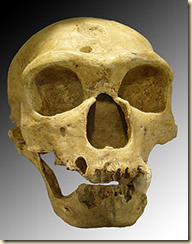
Neanderthals were taller than members of the Homo sapiens species and had much stockier builds. Their faces were larger than those of Homo sapiens ancestors and had large noses and chins and foreheads that receded.
Our ancestors, who belonged to the Cro-Magnon branch of Homo sapiens, were able to co-exist with Neanderthals for about 10,000 years. It is believed that the two species may have interbred in order for the gene to pass from one species to the next. It is the MC1R gene that is responsible for red hair and freckles. It is believed that Neanderthals that possessed the MC1R gene may actually have looked very similar to that of modern Europeans.
Having light skin was actually an evolutionary advantage for these Neanderthals. It meant that the individuals who had light skin and red hair were capable of absorbing more vitamin D from sunlight. In Europe, where there are clouds the majority of the time, this would have been a distinct advantage.
Other discoveries have been made that are changing scientists’ beliefs about Neanderthals. They were originally believed to have only rudimentary speech. Scientists and archaeologists have long thought that Neanderthals had a vocabulary of only about 70 words and that their speech was likely very guttural. New research is beginning to show that that may not have been the case. It is now theorized that Neanderthals may have had a much more sophisticated language than was originally thought.
 Archaeologists have also found painted shells in Spain that prove that Neanderthals created artwork, something that experts did not think they did. The painted shells were a form of body art or jewelry. Similar shells had been found in Africa and in the Near East and dated from 70,000 to 120,000 years ago. When they were found, they were attributed to our ancestors and not to members of the Neanderthal species. Scientists and archaeologists are now thinking that jewelry that was believed to have been created by Cro-Magnon man may have been created by Neanderthals instead.
The shells were painted with traces of mineral pigments. In some cases, tools used to paint the shells were found as well. There was no proof that the items had been painted at random as there were no traces of pigments found on other items such as food or other stone tools.
Not only was it obvious that the painting of the items was deliberate, some of the mineral pigments came from a distance away. This meant that they needed to be transported to the new area specifically for the purpose of creating artwork. Some shells were used as paint cups and others were decorated for use as body art or jewelry.
By: The Scribe on July, 2011
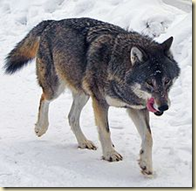 Scientists have begun to think that the relationship between dogs and humans may actually go back much further than they originally believed. Early humans domesticated dogs because they needed help herding animals as well as hunting them. They also provided an excellent alarm system and could be used as a food source in a pinch. Dogs enjoyed staying with humans because of the shelter and food that early man provided. Early dogs were still very much pack animals and enjoyed the companionship that early humans also provided.
In the past, scientists believed that humans and dogs paired up approximately 10,000 to 20,000 years ago. They used clues found in archaeological records in order to make this estimation. This was the time just before the practice of agriculture became a part of the lives of early humans. In the beginning, dogs were tamed wolves that were then interbred for specific characteristics. Some of the earliest dog fossils show this transition from wolf to dog. Examples of bones which show this change include those found at Chauvet Cave in France and Mezhirich in the Ukraine.
Now there is some proof that wolf bones that were found with human bones may have been dogs in their earliest stages. Because they were not bred for specific characteristics until much later it is possible that the wolf bones could have been those of domesticated dogs as the DNA would not have changed overly much in early days. Scientists now believe that dogs may have been domesticated in some form as far back as 100,000 years ago.
Scientists have been able to pinpoint what some of the earliest dog breeds are as well. The genetic structure of these dogs shows the least amount of change from wolf genes although some of the breeds are surprising. Fourteen ancient dog breeds have been identified. They are: the Basenji, the Shar Pei, the Shiba Inu, the Chow Chow, the Akita Inu, the Siberian Husky, the Alaskan Malamute, the Afghan Hound and the Saluki. The Saluki, in particular, is one of the oldest breeds. There are images of dogs which resemble salukis in Egyptian tombs dating as far back as 2134 BCE. They also appear on Sumerian carvings which hdate from between 7000 and 6000 BCE. Salukis are also connected to the Bible and to ancient China as well.
Scientists have also been able to determine that some dog breeds that were previously believed to be very old are actually more modern. These included the Pharaoh Hound, the Norwegian Elkhound and the Ibizan Hound. It is thought that these breeds were created in an attempt to recreate much older breeds that existed at one time.
It is believed that early dogs travelled to North America via the land bridge and likely  accompanied early humans as domesticated creatures. Some of these became wild dogs that have traits that are remarkably similar to dingos and other ancient canines. These traits include a medium build, a face that is vaguely foxlike, ears that are large and upright and a tail that is crooked.
Previous page | Next page
 Long-time readers of The Ancient Standard may recall a post from 2007 that discussed the existence of giant penguins in Peru, but also lamented the unpublished data on even larger penguins that were thought to exist off the coast of New Zealand millions of years later.
 During the Prehistoric period in New Zealand, the vast majority of what we see today was submerged, leaving only small pieces of land above the water’s surface. Similar to many modern species, this ancient habitat of shallow waves, plenty of food, and defensive positioning from predators would have been ideal for these giant creatures.


