By: The Scribe on Thursday, May 24, 2007
 Marie Louise Elizabeth of Orleans, better known as “La Duchesse du Berry”, was a young woman who spent the majority of her life indulging in court pleasures, hiding behind the façade of joie de vivre to conceal her true psychological and emotional trauma. Born to Philip II of Orleans and the Lady Francoise Marie, Marie Louise’s mother ignored her from birth, causing Marie to grow up much more quickly than any child should.
When she was six years old, Marie became so gravely ill that the royal doctors believed she was basically dead and refused to attend to her any longer. Instead, her father Philip II nursed Marie back to health with his own hands – and being grateful that she was still alive, he proceeded to spoil her in every way possible, even giving her a little court of ladies for her own when she was only 14 years old. Her mother, seeing a way to consolidate power, arranged a marriage for Marie to the 23-year-old Duke of Berry and forced her to spend a year losing weight to ensure she was ‘able to conceive when married’.
Even after the marriage, Marie Louise did not like her husband, Prince Charles, and often acted rudely toward guests at court. When she was 15, Marie had her first pregnancy, which caused her to become extremely irritable – and since her husband wasn’t able to be of any comfort, Marie’s father often spent several hours with her each day. This gave rise to rumors about a possible love affair between daughter and father, which would haunt the family for years to come.
In the later stages of her first pregnancy, Marie was involved in a boating accident that caused her to give birth early – the child died only hours later. In 1712, she experienced her second pregnancy, though she went into labor early for a second time: the baby died only two weeks later. Although her husband did everything he could to try and love her, Marie developed a violent temper and often spent hours alone with her father. On one occasion, her father put his painting talents to use by painting his daughter in the nude, which did nothing but increase the swirling rumors of incest.
During mealtimes – which were apparently quite frequent for Marie – one historian wrote that Marie Louise would often drink to excess and eat so much that she would promptly throw up in the middle of dinner. She engaged in numerous affairs, and made no effort to conceal them from her husband.
Eventually, Prince Charles gave up his attempts to care for his wife, and the two engaged in a battle of affairs to try and out-do each other. They began to fight in public, and on several occasions were reprimanded by the king; on one occasion, it was reported that Charles kicked his wife and threatened to send her off to a convent. In 1714, Charles unfortunately fell from his horse while hunting, leaving his wife to become a widow at the young age of 18 – and in addition, Marie had just announced her third pregnancy. Ordering her room to be decorated completely in black, she remained in bed for months before the baby was born.
Want to read more?
Unruly Daughters A Romance Of The House Of Orleans
Tomorrow: Would this child be the one to live, changing Marie for the better? Find out tomorrow…
By: The Scribe on Wednesday, May 23, 2007

In the 3rd century AD at Hierapolis in Western Turkey, it appears that the priests of Apollo were part of an elaborate deception that involved a real death chamber that is still off-limits to visitors today.
The Temple of Apollo was situated on top of a man-made platform attached to a monumental staircase, with an opening into the ground nearby that was known as the Plutonion. This 30-foot wide hole was often surrounded by a thick mist and possibly a fence, making it nearly impossible for curious visitors to the hole to see inside – however, this was for their own safety. Why is that?
It seems that the Temple of Apollo was built along a geological fault line, which elsewhere in the city produced its famed hot springs, a perfect natural feature for the Romans who loved their public baths. Unfortunately, another natural feature of this fault line was that it produced poisonous gases, which had to be released into the air somehow. In this case, the poisonous gases were mainly deadly amounts of carbon dioxide: enough to suffocate a living creature almost instantly. And guess where they were released into the air?

Indeed, the large hole in the ground near the temple was the release point for the gas. Any living creature that entered the hole – both in antiquity and even today – died immediately. Studies of the Plutonion and the Temple of Apollo have revealed a secret correlation between the two sites. It is known from ancient sources that the Plutonion was used for animal sacrifices, which were carried out by the Priests of Cybele – apparently the priests were the only living things that could enter the cavern without being affected by the gases.
These priests were from the nearby Temple of Cybele, a cult associated with the Mother-goddess figure Cybele. Her cult revolved around themes of death and rebirth, and she was often worshiped in caves which were thought to be associated with the Underworld. Thus, the priests of Cybele probably found the death pit to be quite appropriate for their worship, and chose it to carry out their sacrifices. What probably happened was that the priests put four cloth sacks over their heads, creating a pocket of clean air that would last several minutes – allowing them to enter the cave with the sacrifice, wait for the animal to die, and… then what?
Believe it or not, the Plutonion widens as it runs under the ground, leading directly to: the Temple of Apollo. A man-made section of this tunnel also leads to a room about 13 feet wide at the end, which would have given priests from the Temple of Apollo direct access to the death pit. What appears to have happened was that the Cybele priests brought the sacrifices far enough into the pit for the priests from the Temple of Apollo to enter the pit from the other side safely – where the fumes were already dispersed and couldn’t harm them – so that they could retrieve the sacrifices, prepare them in the underground room, and then display them in the upper rooms of the temple. This religious ritual would have seemed like an incredible miracle to visiting worshipers – although it was really just a creative bit of stage magic.
Want to read more?


Tomorrow: The duchess who loved her father…a little too much
By: The Scribe on Tuesday, May 22, 2007

Metals from lake mud in the central Peruvian Andes have revealed what appears to be the first evidence for metallurgy during the pre-Colonial period. Previously, bronze artifacts from the pre-Colonial period have only been found dating after the fall of the Huari civilization, predecessors of the Incas, around 1000 AD. However, archaeologists have been uncertain as to how or when metallurgy developed among these people, and were willing to consider that perhaps these artifacts were obtained by trade from coastal village sites.
By measuring the concentrations of copper, zinc, lead, silver, titanium and several other minerals in sediment samples from Laguna Pirhuacocha, scientists were struck at the extremely high levels of concentration that must have come from pollutants in furnace smoke. For example, a rise in zinc and copper levels as compared to the concentration of lead suggest an increase in copper smelting, while the rise of other minerals suggest silver smithing.
Chemical analysis can allow scientists to determine exactly when these pollutants were deposited in the lake bed, and the earliest evidence for metalworking in the region now falls between 1000 and 1200 AD – a significant amount of time before the Inca appeared in the area. It is also intriguing that this metalworking technology seemed to increase and develop just after the fall of the enormous Huari civilization.
However, history dictates that it was during a wide-spread drought around 1000 AD that the Huari civilization collapsed, as well as the neighboring Tiwanaku empire in the Peruvian Andes. Not only was water scarce and crops destroyed, but the water level in Lake Titicaca dropped at least 20 feet. Questions still remain about where the metallurgical technology came to get here in the first place, but it seems that after the collapse of the empires, the ideas and the information was quickly dispersed in the region.
After 1450 AD, the villages who practiced metallurgy shifted their production focus from copper to silver – indeed, this shift is traceable to a period of Incan control, when Inca rulers imposed a tax that was required to be paid in silver. After all, silver held a position of high honor in many Incan religious ceremonial practices.
Scientists have also gathered samples from a number of additional sites in the region, in hopes that they will be able to reconstruct a history of metallurgy in pre-Colonial Peru.
Want to read more?


Tomorrow: It’s a surprise 🙂
By: The Scribe on Monday, May 21, 2007
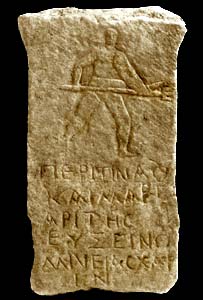 Among the ruins of the city of Ephesus in Turkey, archaeologists believe that they may have found an ancient gladiatorial burial ground – something never seen before, even in Rome itself. A major city in the Roman empire, this Ephesian graveyard contained graves with thousands of bones as well as three gravestones with carved images of gladiators.
For several years since the bones’ discovery, a team of pathologists at the University of Vienna have studied and catalogued the bones for age, injury, and cause of death. It appears that the graveyard contained bones of 67 individuals, almost exclusively between the ages of 20 and 30 years old. In addition, many of the individuals appear to have healed wounds – one body even showed evidence of surgical amputation, suggesting a high level of medical care that was rather unprecedented for the average Roman citizen.
A lack of multiple wounds on the bones also suggests that the individuals here were not involved in large, mass battles, but instead were participants in some form of controlled combat. Indeed, several bones showed evidence for mortal wounds, which would not be unreasonable in gladiatorial combat. Ancient written sources on Roman sports tell that in some cases, if the defeated gladiator had been a coward or unsportsmanlike in combat, the crowd would shout to have the losing party killed.
Relief depictions from Roman art show images of a kneeling man having a sword thrust down his throat, into the heart – evidently an efficient method of execution. Marks found on the vertebrae of several bodies from Ephesus show that this may have actually occurred to some of the individuals interred here. Some skulls were also found to have sets of three holes at irregular intervals, consistent with the possible damage done by a three-pronged weapon such as a trident. Other rectangular wounds may have come from a hammer.
If a gladiator survived three years of fighting in the arena, the ancient sources explain that he would win his freedom, and often these ‘retired’ gladiators became teachers in a local gladiator school. One of the skeletons from Ephesus was identified as the potential body of a retired gladiator, as he was middle-aged and appeared to have many healed wounds from previous fights.
Since gladiators had approximately a one in three chance of dying in each battle, the chances of survival for a gladiator was fairly bleak. It is therefore not unreasonable to consider the creation of cemeteries specifically for gladiators, though the graveyard at Ephesus is the first to be found.
Want to read more?
The Age of the Gladiators: Savagery & Spectacle in Ancient Rome
Tomorrow: Pre-Incan metal working
Previous page | Next page
