By: The Scribe on Monday, May 28, 2007
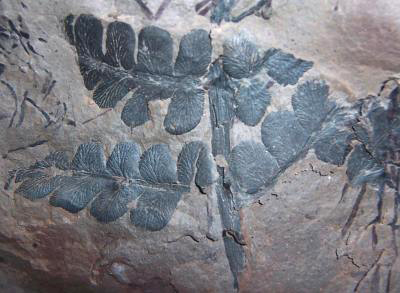
Inside of a coal mine near the town of Danville in eastern Illinois, it appears that there once existed a very large rainforest – 300-million years ago, that is. Spanning a thousand hectares and preserved by what must have been an incredible earthquake, the hundreds of fossilized plants found in the coal mine bear very little resemblance to today’s American forests.
Giant leaf impressions, large trunks of extinct trees, and tree-sized horsetail plant fossils were found 300 meters below the surface, and geologists have surmised that this ancient forest was once hot, wet, and very humid. The forest would have consisted of a very light upper canopy, with plenty of room for sunlight to enter and nourish the plants below. The trunks found were likely from 12-meter plants that formed a sub-canopy, though some club mosses were over 40 feet tall, judging by the fossilized remains.
Very few insect remains have been found, however it is thought that forest insect and animal life was significantly different – consisting of creatures like dragonflies as big as seagulls, and millipedes around three feet long.
The earthquake that buried this rainforest would have been significant enough to cause the entire section of land to drop below sea level, immediately encasing and preserving the entire ecosystem in mud – since a rapid burial is the only explanation for such extensive and widespread preservation. The fossils themselves look very much like leaf pressings in a scrapbook – just a whole lot bigger.
Not only will this enormous fossilized rainforest provide information about ancient ecosystems and extinct plant species, but it should also help scientists to learn about the formation of coal, which is actually formed by different plants in different settings. The way coal burns depends on its formation processes, so it is suspected that extensive testing will be conducted to see if the coal here has any different properties than coal found in other areas of the country – namely, where there aren’t giant fossilized rainforests overhead.
Want to read more?
The Eternal Frontier: An Ecological History of North America and Its Peoples
Tomorrow: The history of toilet paper!
By: The Scribe on Sunday, May 27, 2007
 From the slopes of Mount Carmel in Israel and the site of Oued Djebbana in Algeria, it appears that archaeologists have discovered the oldest examples of jewelry in the world. The three shell beads date to between 90,000 and 100,000 years old, predating other ancient jewelry finds by 25,000 years.
The shells are all very small, and come from a genus of marine mollusk similar to the Nassarius, and it is believed that they were selected because of their small size and thin fabric that can be easily pierced by a sharp tool. These three shells each have one hole, made by a sharp flint tool, which would have allowed them to be strung together as a bracelet or necklace.
Speculation is that these pieces of shell jewelry had some sort of social meaning, possibly representative of some symbolic behavior or assertion of status. It may be one of the earliest examples of modern behavior by humans of the ancient past, since previous evidences have not been identified as earlier than 50,000 years ago. Something like creating and wearing jewelry is an example of thoughtful creativity, and in the case of these shell pieces, there is no doubt that some forethought went into creating the items.
Namely, the sea isn’t anywhere near Mount Carmel – and in Algeria, the closest shoreline to Oued Djebbana is 200 kilometers away. The shells would have had to be located, gathered, and transported here by people either migrating into the area or perhaps simply brought as items gathered on a seasonal expedition. Either way, the minute size of the shells and the precision of the holes indicate a significant leap in human creativity for which scientists have had no previous evidence.
Want to read more?
A History of Ancient Israel and Judah
Tomorrow: A coal miner’s rain forest
By: The Scribe on Saturday, May 26, 2007

During excavations at the town of Argos in Greece, archaeologists discovered a 2,700-year-old copper urn inside of a burial. The burial was oddly reminiscent of the elaborate cremation rituals for soldiers as described in Homer’s Iliad, but it was what they found inside of the urn that was the most shocking: a yellow, brittle material which could be nothing other than a piece of ancient fabric.
In places like Egypt and the Near East, it is quite common to find fabric from thousands of years ago, due to the dry climate which prevents humidity from causing organic fibers to decompose. However, in places like Greece and along the Mediterranean coast, organic material decomposes very easily, due to the high levels of humidity. Very few organic artifacts have been found in the past in Greece, making this small piece of fabric of enormous historical value.
Conservation experts explained that because the fabric was placed inside a copper burial container, which began to corrode over time, copper oxides from the urn were able to kill the microbes that normally destroy fabric. In order to learn as much as possible from this find, the fabric is scheduled for testing that will determine the what kind of fabric it is, and what weaving techniques were used.
The fabric was not the only item inside the urn – there were also dried pomegranates, ashes, and charred human bones. The actual burial itself is also unique, because cremation was not a normal practice in Argos during this time. Of the six burials that
were closely grouped together on this same plot of land, the urn was the only cremation burial. One possible explanation for this is that the person in charge of this burial had a personal desire to imitate the ‘heroic’ funerary custom as described in the Iliad, for the purpose of making this burial stand out among the others.
Since Argos is one of the cities mentioned in the Iliad as the home of a the great Mycenaean warrior-king Agamemnon, it is possible that the individual buried here thought himself associated with the legendary ruler in some way.
Want to read more?
The Iliad of Homer
Tomorrow: Ancient Jewelry
By: The Scribe on Friday, May 25, 2007
 Perhaps not surprisingly, Marie’s third pregnancy also ended early, and the child died only 12 hours after the birth. This was the final link to whatever small remaining amounts of self-control and sanity she had, and from that point on, Marie became devoted to one thing only: indulging herself in excess.
Only a year later, the Sun King of France died, leaving Luxembourg Palace in the hands of Philip II. Marie asked her father for the palace, which he granted her, and she promptly kicked her mother and grandmother off the property. She began joining her father as he indulged in his excesses, and soon she developed a repertoire of her own vices. She gambled away family money, became a raging alcoholic, and often took meals with her father’s mistresses. On other occasions, she would attend her father’s private parties, featuring nude dancers who staged orgies to ‘recreate historic moments’ from the Classical era.
By the time she was 20 years old, Marie had earned herself the nickname “Princess Chubby” – she woke up at noon and would eat until three, rest for an hour, and then eat creams and salads again at four. In fact, the only exercise she ever did was hunt, and tended to simply lie around during the day. There is speculation from some historians that Marie suffered from bulimia, which may have been brought on by the excessive year of dieting before her marriage. She became morbidly large due to her binge-eating habits, however it was only a matter of time before she once again fell in love.
In 1716, Marie married her lieutenant, the Count of Riom. They were married in secret, and it didn’t take long before the obnoxious princess’ behavior took a drastic turn – the Count began to control his new wife’s behavior, even down to the clothes she wore. She became increasingly neurotic, experienced extreme mood swings, and by all outward appearances had returned to the church as a devoted follower – the truth was, she often returned to her previous indulgences, then became guilty and fasted, prayed, and visited nuns, only to once again return to the excesses in a vicious cycle.
Although the Count wished to make their marriage public, Philip II forbade it. In 1718, Marie became pregnant for the fourth time, and because she did not change her behavior even while pregnant, she became extremely ill in early 1719. The child was stillborn that spring, and her health never recovered. By July of that year, she died just before her 24th birthday – pregnant for a fifth time, and with what her physicians called a “deranged brain”. Though Marie’s mother hadn’t bothered to visit her while she was ill, her father, overcome with grief, died only four years later.
Want to read more?
Unruly Daughters A Romance Of The House Of Orleans
Tomorrow: Maybe Choose Dry Cleaning for 2,700-Year-Old Fabric?
Previous page | Next page
