By: The Scribe on Friday, June 1, 2007

As famous as the Mongol Empire was during the height of its power, if there was one thing the Mongol military knew how to do, it was killing. Everyone, that is. Founded in 1206 AD by Genghis Khan, the Mongol Empire would eventually encompass over 12 million square miles of territory, with a population of over 100 million people, making it the second largest land empire in history.
The key to Mongolian success was easy enough: if a population refused to surrender, they would simply wipe out the entire population, raze their cities, and take over the land. Naturally, word gets around quickly when entire cities get destroyed, so for those cities who were wise enough to choose self-preservation over heroics and submit to Mongol rule, they were spared and treated rather leniently.
The Mongol military was divided into ten-men squads called arban, while a regiment was ten thousand men, called a tumen. Although they weren’t exactly subtle about their art of war, the Mongols knew what to do when it came to a siege, and did it without mercy. They were very skilled in the construction of trebuchets from trees in the surrounding vicinity, and could build great numbers of them very quickly.
What the Mongols tended to do was to destroy a city’s advancing land army with horse archers, lancers, and smoke engineers. The engineers would be responsible for constructing siege engines before and during a battle, using them during the battle to distract enemy forces and provide cover through elements such as smoke and fire, and then repair them in case of a siege against the city. After all, once a city’s entire land army was destroyed, there was no way to defend themselves other than holing up behind their walls.
Unfortunately, for populations that attempt to outlast a siege, food becomes scarce and the close quarters of vast numbers of people becomes a prime breeding ground for plague. And once a plague begins, it generally isn’t wise to keep the bodies of deceased plague victims inside the city walls to rot and spread more disease. Typically, the corpses would either be burnt or thrown over the walls – so the Mongols, seeing this as an opportunity to make the most of their surroundings, had a great fondness for collecting the corpses of these plague victims, setting them inside their trebuchets, and hurling the bodies back into the city.
In some cases, if the siege had just begun but the Mongols had access to plagued corpses from a previous town or the surrounding area, they would launch the diseased bodies into the city to try and start a plague on their own. The city would become infested, and thus easily captured once the disease had spread. Macabre, yes, but highly effective!
Want to read more?

Tomorrow: Hanging coffins!
By: The Scribe on Thursday, May 31, 2007

The site of Cahokia is located near Collinsville, Illinois, and was home to an ancient Native American city between 650-1400 AD. It is made up of a series of earthen mounds, which were constructed by the city’s inhabitants around 1050 AD, when the city’s population suddenly exploded at the beginning of the Mississippian cultural period.
The most interesting aspect of this city is a giant hill called the Monk’s Mound, which was built with four levels of terraces and is the largest man-made earthen mound known in North America. On top of the mound, there seems to be some evidence for a large building, possibly a temple or ceremonial center for the city’s religious leader. It would have been visible to the entire city, and so it seems that the religion of these people was a focal point of their daily existence.
To the west of Monk’s Mound, archaeologists have identified a series of postholes forming what has affectionately been coined as “Woodhenge”, since it is likely that this area was used for astronomical observations such as seasonal equinoxes and solstices. During the 300-year occupation of the site, it seems that Woodhenge was rebuilt several times, and therefore must have played an integral role in the community.
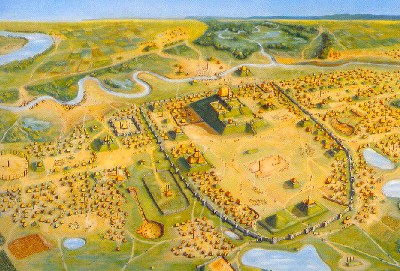
Although it was visible to the rest of the city, the Monk’s Mound was also surrounded by a wooden stockade and a series of watchtowers placed at regular intervals. This stockade seems to have separated the religious district or ceremonial center from the rest of the city itself, which was settled in a diamond-shape of about a mile long. There are about 120 additional mounds within the city area, and they are of varying shape, such as: conical pyramid, platform style, or ridge-top.
One intriguing find at Cahokia was the burial of a 40-year-old man who seems to have been an important community figure, possibly a religious leader or respected warrior. His grave-bed was an arrangement of more than twenty thousand seashell disc beads in the shape of a falcon – and the man’s body was placed on the falcon so that his head, arms, and legs aligned with those of the bird. This kind of burial must have held a very powerful significance for the inhabitants of the city. He was also found with a large cache of arrowheads from across North America, which demonstrates the extensive trade that must have been conducted at the site.
A number of other burials in the city were simply mass graves, and many of the skeletons here were missing hands and heads, which has led to the speculation of human sacrifice at the city.
Cahokia’s high point as a major urban center held a population of around 40,000 inhabitants, making it the largest prehistoric site in North America – a close rival to the great cities of Mesoamerica in Central Mexico. Its decline was likely caused by the depletion of natural resources as a result of climate change, and by 1400 AD the city was completely abandoned.
Want to read more?


Tomorrow: State of the art siege weaponry, diseased corpses?
By: The Scribe on Wednesday, May 30, 2007

The ancient Babylonians were very keen on learning about the sky above them, and in fact, many modern astrological traditions actually stem from early Babylonian observations about the night sky.
Although undoubtedly limited by the lack of technological advancement available to today’s astronomers, the Babylonians made some remarkable deductions using their own scientific knowledge, and they would pass this on to many other ancient civilizations as the centuries moved onward.
For the Babylonians, it should first be noted that astronomy and astrology were intricately intertwined, since science was primarily concerned with the religious revelations it would bring. The physical world was understood within the context of their religious knowledge, and unlike many people might suppose to be the case for modern science and religion, this did not seem to present any sort of barriers or contradictions in understanding.
To begin, the Babylonians were the first people to develop a theory of the ecliptic: that is, the path of the sun in relation to the stars and its planetary alignment throughout a calendar year. The Babylonians recognized that this area was divided into twelve sections at 30 degrees longitude – this is where the twelve signs of the zodiac originated, when the Babylonians gave names to the twelve sections. Notably, this ecliptic division was proven to be correct, and the ecliptic theory is still used in modern astronomical study.
The Babylonian calendar was actually divided up according to the lunar year, with twelve months, but because the months were somewhat shorter than the modern calendar – which is based on the solar year – on occasion, an extra month would be added into the year to ensure the agricultural seasons stayed on track. Weeks were divided into seven days.
In terms of astrological observations, the Babylonians were very interested in the possibility of knowing the future, and believed that the movements of the sun, moon, and the five planets they identified could be interpreted to know what the gods were planning to do. The planets they knew, though given different names than what they are currently called, were: Jupiter, Venus, Saturn, Mercury, and Mars. The planets were each associated with a particular Babylonian god, and specific priests were assigned to astrological divination – not only attempting to interpret the signs in the sky, but also constantly striving to perfect their understanding of the heavens.
Want to read more?


Tomorrow: City of the bird men
By: The Scribe on Tuesday, May 29, 2007

While the modern convenience of toilet paper is often taken for granted, the human history of toilet paper actually began relatively late. In the 6th century AD, wealthy individuals living in China often used paper for “sanitary” purposes – even though the standard paper making process had been perfected several centuries before. Regardless, there are several documents written by ancient scholars about the Chinese use of paper for toilet-related tasks. In 589 AD, the scholar Yan Zhitiu wrote that “paper on which there are quotations or commentaries from Five Classics or the names of sages, I dare not use for toilet purposes.”
During the Tang Dynasty, an Arab traveler to China in 851 AD recorded his thoughts on Chinese bathroom habits: “They are not careful about cleanliness, and they do not wash themselves with water after they have done their necessities, but they only wipe themselves with paper.” Notably, since ancient times in Middle Eastern cultures, the left hand has been traditionally considered unclean – because that was the hand people used to wipe themselves with after attending to their, ah, “natural faculties”.
It wasn’t until the late 14th century during the Song Dynasty that the Chinese emperor commissioned large 2ft x 3ft paper sheets to use after his toilet-related activities. However, even after the invention of the flush toilet in 1596, commercially produced toilet paper wouldn’t be available for another 300 years!
So, what did humankind do before they had soft tissues to clean their bottoms? The ancient Greeks made use of stones and clay, while the ancient Romans equipped their public toilets with a sponge on a stick, resting in a bucket of brine. If you were rich, you could use wool.
For those living in the cold, northern regions of the world, tundra moss was readily available during the summer, and snow would do the trick for the rest of the year. Colonial America had an interesting habit as well: they used cobs of corn, or pages from mail order catalogues that they would hang on a wall near their toilets. In fact, anything from leaves, to mussel shells, to pieces of fur were used by various cultures around the world, from the earliest of times until toilet paper became a readily available commodity.
In 1857, Joseph Gayetty sold the first factory-made toilet paper called “Gayetty’s Medicated Paper” in the United States, and these were single sheets of moistened paper that were medicated with aloe. Each sheet was printed with Gayetty’s name, and while it did take some time to catch on with the general public, it was apparently from that day forward that the world’s bottoms would never be the same.
Want to read more?
On a Roll: A Sheet-by-sheet History of Toilet Paper
Tomorrow: More ancient goodness!
Previous page | Next page
