By: The Scribe on Tuesday, June 5, 2007
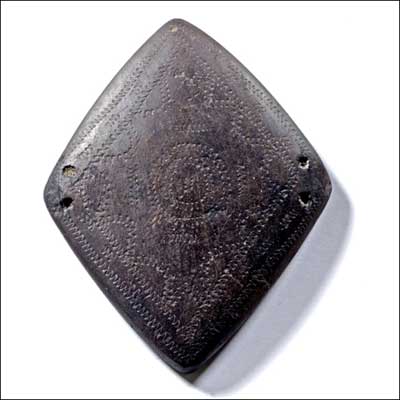
While excavating a site in Suffolk in 2007, archaeologist Clare Good stumbled across a diamond-shaped object made of mineral jet, incised with a geometric pattern. This 4000-year-old amulet bears a surprising resemblance to another gold geometric-style object from a site near Stonehenge in Wiltshire. Evidently, the two are strikingly similar, and experts have speculated that the black object is a ‘skeuomorph’ – a copy of the object in another material.
Located in the remains of a funeral pyre, Good suspects that someone placed a number of items, such as the jet object, some pottery, and a knife, inside the pit after the body on the pyre was burned. The object itself has several parallel lines drawn around the outside, with several semi-circles around the inside and double circle with center dot. What the meaning of this design was remains a mystery, though the type of material used to make this object is believed to have held significance for the ancient people who lived around Stonehenge.
Mineral jet has been used all over the world in ancient cultures to create religious artifacts such as amulets or beads, and thus it is believed that the item uncovered by Good was an amulet with ‘magical powers’ – possibly even commissioned by religious leaders or a wisdom healer in the area.
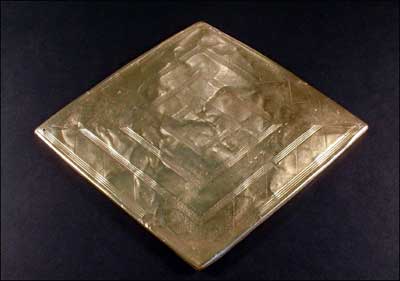
Traces of copper from several holes in the object indicate that the amulet was likely held onto a piece of clothing with copper pins – possibly leather clothing, due to the heavy-duty abilities of copper. Good believes that both the jet piece and the gold piece may have even been attached together onto someone’s leather garment, likely in a visible area to let others know of their supernatural protection.
Although it is not known to whom these amulets belonged, it is likely that they were wealthy elites, and more likely, elite religious leaders
Want to read more?


Tomorrow: The REAL Homer
By: The Scribe on Monday, June 4, 2007

While the notion of pay-toilets may seem rather off-putting and a little unfair – after all, why should someone be charged money to conduct a necessary bodily function? – it seems that the ancient Romans were all too familiar with this concept…
In the first century AD, the Roman emperor Nero levied what was known as the vectigal urinae, or simply put, “urine tax”. The tax was placed on the collection of urine, since the lower classes of society had to urinate into small pots that were then emptied into cesspools. Liquid could then be collected from these cesspools, as well as from the public toilets of the upper classes, and recycled for a number of chemical processes: animal skins could be soaked in urine to remove the hair fibers before tanning, and Roman launderers could use urine as a source of ammonia to bleach and clean wool garments.
 Although the tax was eventually removed, it was reenacted around 70 AD with the succession of emperor Vespasian. Known for his love of money and ruthless taxation – which, to his credit, eventually brought the Roman empire out of debt and left a surplus in the treasury for the next emperor – Vespasian re-applied the tax to urine collection, and extended it to the use of public toilets.
The Roman historians Dio Cassius and Suetonius wrote about Vespasian’s unpopular tax in their own history books, reporting that when Vespasian’s son Titus expressed his disgust over such a tax, the emperor simply showed his son several gold coins and asked: “See, my son, if these have any smell.” When Titus agreed that they had no odor, Vespasian replied: “…and yet, they come from urine!”
As undignified as Titus may have believed his father’s urine tax to be, in the long run Vespasian’s taxes actually benefited the Roman empire – perhaps the most evident example of this is in his most famous monument: the Roman Colosseum.
Want to read more?


Tomorrow: The magic amulets of Stonehenge
By: The Scribe on Sunday, June 3, 2007
 While it is well known that the Romans simply borrowed and renamed the Greek gods for their own religious purposes, it is often forgotten that the Romans tended to get creative with these divinities, and created various ‘epithets’ for them – versions of the gods based on certain aspects or characteristics.
So, naturally, the gods would have epithets concerning important buildings or aspects of Roman society that they were supposed to look after – and if there was something that the Romans were very proud of, it was their sewage system that helped to keep the city clean. Thus, why not appoint a goddess to take care of it?
Venus Cloacina, which translates as “Venus of the Sewer”, or more subtly “Venus the Purifier”, was the Roman answer to such an important issue. A fusion of the Roman Venus with the Etruscan water goddess Cloacina, the choice probably came from the placement of a well-known Venus statue near the entrance to the Cloaca Maxima, Rome’s major sewage system.

Since she was originally an Etruscan goddess combined with Venus, she kept some of the characteristics ascribed to these two, in combination with her role as the protector and controller of sewers. She was a protector of the marriage-bed – namely, sexual intercourse in marriage, and she was worshipped in her own small Shrine of Venus Cloacina in the Forum. The shrine was conveniently situated right above the Cloaca Maxima, and it was only a matter of time before the Romans began to mint coins with her image and images of her shrine on one side. Some evidence has also been found for a small poem or prayer that devotees could recite when making an offering at her shrine.

As odd as it may seem, one might consider that in a city the size of Rome, the last thing anyone would ever want was for the sewage system to break down, leak, or overflow. Having a goddess making sure the sewers stayed in proper working order was probably somewhat of a comfort, really…
Want to read more?

Tomorrow: More ancienty goodness!
By: The Scribe on Saturday, June 2, 2007
 For several centuries in China, a minority group called the Bo people had a very peculiar burial practice: hanging the coffins of the dead on the side of a cliff. Some can be found in cliff caves, others sit on projections in the rock, while the most perplexing coffins are suspended on stakes or boards that protrude from the rock face. Their height along the cliff faces vary anywhere from 10 to 130 meters high, leaving experts baffled as to how some of the coffins were lifted and placed that high!
Although there are at least five sites in China where the hanging coffins have been found, as well as one site in the Philippines, the majority of the coffins were placed around Matangba and Sumawan, where there are over 100 visible coffins.
While not much is known about the Bo people, their hanging coffins have certainly shed some light on their rather different way of doing things: the coffins are unpainted and undecorated except for a few studs, and in many cases the coffins were hewn from one single piece of wood. Inside several of the coffins, archaeologists found blue and white porcelain bowls from the Ming Dynasty, a simple iron knife, and several iron spear points. Some coffins contained small remnants of linen and silk, but nothing that could help historians to determine status, rank, or social organization of these people.

There are rumors that several cliff paintings have been identified near the coffins, however due to concerns over their preservation, they have not yet been discussed or published in reports for the general public. Presumably, these will eventually reveal some small details about the Bo people, perhaps shedding some light on why they felt the need to hang their dead in coffins along the faces of cliffs.
The practice of ‘burying’ the dead along cliffs disappeared at the same time as the mysterious Bo people, leaving many questions behind about why they did this, and why they disappeared seemingly without warning. Their entire culture seems to have disappeared, leaving only a slew of hanging coffins along the Chinese landscape
Want to read more?


Tomorrow: Roman goddess of…sewers?
Previous page | Next page
