By: The Scribe on Saturday, June 9, 2007
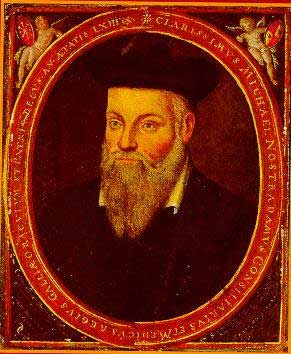
Nostradamus, born under the name Michel de Nostredame, was a French apothecary turned seer, whose book Les Propheties skyrocketed him to cult-like status after his death. Although often credited with predicting major events in the world, many of his “predictions” have been the result of misinterpretations or deliberate mistranslations of his extremely ambiguous quatrains.
As a child, Nostradamus grew up in Southern France’s Saint-Remy-de-Provence with at least eight other brothers and sisters. Although his family was originally Jewish, his father converted to Catholicism before Nostradamus was born. There is very little additional information known about his childhood, however when he was fifteen, Nostradamus attended the University of Avignon for studies. Only a year later, he was forced to leave the school when it was shut down from a plague outbreak, but he would eventually return to school at the University of Montpellier in 1529 to study medicine.
Unfortunately, Nostradamus was expelled from the school when they learned of his time spent as an apothecary before attending the University, which was a trade expressly forbidden by the school statutes. Undeterred, he continued to practice as an apothecary after the expulsion, and anyone wishing to read the expulsion document can actually still do so – it is still on file in the university library!
 In 1531, Nostradamus married, but it was only a few years later that his wife and both children died from plague. It was after their death that he began to travel more frequently, often spending time in various places in France and Italy. During one visit to Italy, his interest in medicine began to wane, and in 1550, Nostradamus wrote his own almanac – and, thrilled at its success, continued to write at least one per year for quite some time. With an estimated 6,338 prophesies contained inside the almanacs, high-born officials and nobles soon started seeking out Nostradamus for advice on personal and public matters.
It was after this success that he set out to write a book of a thousand quatrains, which he purposely constructed in an ambiguous manner so as to avoid criticism and attack from religious fanatics. When they were finally published in their final form as one book, Les Propheties, Nostradamus was labeled by many as insane or fake, though the elites of society still seemed to find inspiration in his words. This admiration may have led him to his claim of spiritually inspired writing, and while he did spend time in prison in 1561 for his writings, it was simply because he had neglected to seek the permission of a bishop before publishing his work, as was written in a royal decree for all publications.
Because he did not practice magic to support his prophesies, he could not be persecuted by the Inquisition, as some have suggested, and his relationship with the established church was actually quite jovial. In 1566, Nostradamus passed away after a long battle with gout: a skilled pharmacist, medical professional and self-professed prophet whose works would go on to become some of the most mistranslated writings in the entirety of history.
Want to read more?

Tomorrow: Ancient Egyptian Dentistry!
By: The Scribe on Friday, June 8, 2007
 Something North America seems to be famous for is revealing ancient flora… very, very ancient, in fact. In 2007, archaeobotanists working near Gilboa, Ohio, found what may be the world’s oldest known tree – a giant palm that lived around 380 million years ago.
Hearkening back 140 million years before the dinosaurs, and earlier than the Wollemia pine from Australia that may have lived with the dinosaurs, the Wattieza tree fern had a thin palm-like trunk with a top that resembled the fronds of a modern palm tree. It was likely only around 10 meters high during maturity, though this would have been high enough to reach sunlight through the dense forest canopy.
Archaeogeologists have identified this period of time as the Middle Devonian Period, between 397 and 385 million years ago, which is thought to have been an incubator period that saw the development of new reproductive strategies for land plants. Other life at the time included small insects, spiders, and oceanic crustaceans, as identified through fossil remains.
With the rise of land plants, the atmosphere and ecosystem of the entire Earth would have shifted, creating new micro-environments that could have sustained additional smaller plants and insects, eventually storing enough carbon to support an extensive amount of land life.
Previously, the oldest known tree was a plant called Archaeopteris, which had leafy twigs and long roots and branches, very unlike the small fern-leaves and reproductive spores from Wattieza. Archaeopteris was placed in the Late Devonian Period, around 359 million years ago.
The discovery of the world’s oldest tree has managed to shed significant insight into how the Earth’s landscape developed over the course of time, as well as helping to understand how much impact a forest’s growth can have on the rest of an area’s environment. So far, archaeobotanists have realized that it was the growth of these early forests and plant systems that must have paved the way for the sustainable development of early reptilian and mammalian life.
Want to read more?


Tomorrow: Nostradamus…OoOoOoooh
By: The Scribe on Thursday, June 7, 2007

Previously here at the Ancient Standard, we brought you a story about a gladiator graveyard recently discovered at the site of the ancient city of Ephesus in Turkey. Now, it appears that forensic analysis of 70 gladiator skeletons has revealed some startling news about gladiator lifestyles – or rather, what they ate during their lives as gladiators.
Instead of conforming to the modern media image of gladiators as muscle-bound Playboys, gladiators in ancient Rome were actually overweight vegetarians – strong and muscular, yes, but with more than a little extra pudge around the middle. Using a method known as elementary microanalysis, palaeoanthropologists were able to determine that ancient gladiators lived off a diet that consisted mainly of barley, beans, and dried fruit.
A simple diet such as this, while increasing bone density and actually allowing the gladiators to become much stronger than normal, would result in a zinc deficiency, causing an imbalance in the gladiator’s internal chemistry. There would be too much of a natural chemical called strontium built up in the body, which would result in the gladiator becoming – rather literally – fat.
Why was this beneficial? Primarily, these layers of fat would have helped to protect their vital organs against piercing blows from opponents. It may have also helped them to heal much more quickly after being injured. Considering that most gladiators only survived for an average of three years in the ring, it was likely the case that gladiators “beefed up” during the fighting seasons and training, and then lost the weight soon after retirement (if they survived that long).
So, as much as Hollywood would like everyone to believe that gladiators were poster boys for fitness, the truth of the matter is that even though they were incredibly strong and relatively attractive men – in fact, unattractive men weren’t even considered for gladiatorial training – they were actually relatively overweight, moreso resembling lightweight sumo wrestlers than Russell Crowe’s movie-gladiator Maximus.
Want to read more?


Tomorrow: 380 Million year old tree…
By: The Scribe on Wednesday, June 6, 2007
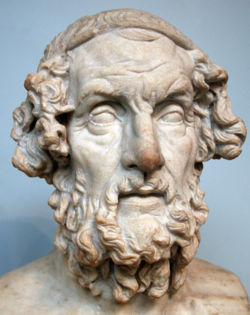 ‘Homer’ is the name of the ancient Greek poet traditionally attributed to the composition of the famous poems Iliad and the Odyssey: the Iliad tells the story of the Trojan War, while the Odyssey details the journey of the warrior Odysseus as he attempts to make his way home after the war has ended. Dated to around the 8th or 7th centuries BC, it is debated whether Homer actually composed the poems, or simply borrowed them from an already established oral tradition.
Almost nothing is known concretely about the life of Homer or who he even was, though tradition claims that he was blind – various Ionian cities also claimed themselves as his birthplace, confusing the matter further. Indeed, there is no definitive evidence to even say that he ever existed as a real person, however the ancient Greeks were highly familiar with these poems and seemed to accept that a poet named Homer did, at some point, live and compose tales of the Trojan war.
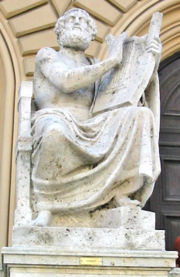 At the very least, it seems that Homer drew on the local ‘oral tradition’ of stories and tales about the Trojan War, known as the ‘Epic Cycle’, and re-wrote them as one large, coherent story. In fact, it is even possible that Homer did this without writing the poems down, and simply passed on his extensive repertoire of poetry through oral transmission – much like bards in Medieval Europe – and that they were not physically written down by a scribe until much later.
Scholars have also wondered about the level of truth in Homer’s poems – did he compose the Iliad and the Odyssey based on real events? Did a war against a city called Troy ever take place? It is possible that stories about a real war had been passed down and elaborated upon for generations, eventually reaching the point of legend – the events of which could then be composed as an entertaining, dramatic performance-driven piece of poetry.
The ancient Greeks revered Homer, and greatly admired his contribution to their culture and literature. Some Greek colonies, such as the city of Argos and the later Hellenistic city of Homerion, even developed ‘hero cults’ for Homer, and carried out ritual sacrifices in his name.
Want to read more?

Tomorrow: More interesting history!
Previous page | Next page
