By: The Scribe on Wednesday, June 13, 2007
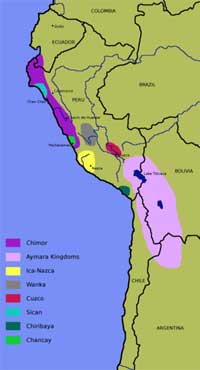 The Nazca culture of ancient Peru is perhaps best known for its legacy of mysterious, giant drawings left behind in the Peruvian deserts. However, before delving into the history and lore of these incredible creations, it’s worthwhile taking a look into who the Nazca people were in the first place, and what may have prompted them to create such fantastic artwork in the middle of the desert.
The Nazca people lived in the Nazca region, as shown in yellow on the map above, between 300 BC and 800 AD, and based their culture around a capital city known as Cahuachi. The population of the city was relatively small, however it was quite popular as a religious pilgrimage destination, visited primarily for ceremonial events and celebrations. It was occupied between 1-500 AD, and its situation in the landscape overlooked many of the Nazca desert lines.
Interestingly enough, Cahuachi also contains around 40 mounds with mudbrick or ‘adobe’ structures on top, which have been under excavation for the past few decades – with many more decades of work still to come. Some of the most interesting things learned about the Nazca culture through excavation was their skill at making clothing, as well as their impressive pottery vessels.
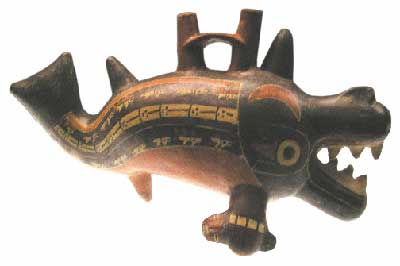
Consider this: one thousand years before any other Peruvian cultures on the north coast, the Nazca learned how to make clothes out of llama and alpaca wool. In fact, most of the designs found on Nazca pottery seem to have originated from textile patterns, suggesting that the Nazca were a highly creative people with vivid imaginations.
There were several distinct artistic phases to Nazca pottery, and the first began with simple designs of fruit, plants, animals and people, as well as some mythical scenes. As time passed, the drawings became more realistic, and the next phase saw an increase in background designs, humans, and bodyless demons. This was followed by phases of militaristic pottery, vessels with elite portraiture, and eventually images of disjointed figures, with the more familiar style of South American iconography that is still very difficult to interpret.
The disembodied heads sometimes shown on Nazca pottery were initially suspected to be renditions of ‘trophy’ heads, and this has since been archaeologically confirmed by several real caches of severed and ritually prepared heads in Cahuachi! Less gruesome animals commonly shown on Nazca pottery were whales, sharks, fish, snakes, hummingbirds, and plants like cacti and Peruvian flowers.
So, if they had such an established ritual culture already – as suggested through the severed heads from their capital city – why did the Nazca create giant drawings in the desert?
…to be continued…
Want to read more?


Tomorrow: More about the Nazca
By: The Scribe on Tuesday, June 12, 2007
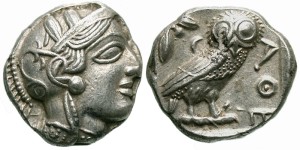 Looking at almost any modern coin, it’s rare to find one that contains anything other than this standard decoration: an important civic symbol on one side, and a bust of a ruler on the other. Believe it or not, this traditional coin setup actually began several thousand years ago in ancient Greece.
The first coins to be minted actually came from two places, where the idea of making small metal medallions that could be traded as currency seems to have developed simultaneously. At the end of the 7th century, both China and Lydia had begun to make plain, round coins for trade. The Greek historian Herodotus, in his work the Histories, briefly mentioned that the Lydians were minting coins around 600 BC. Either way, it wasn’t for another 150 years that coins became prominent around the Greek city-states.
Before the Greeks used minted coins, they made use of small iron rods for currency, called ‘obols’. Since around six obols could fit into the hand of an adult, six obols became equivalent of one drachma coin, once the system transferred over to coinage. In ancient Greek, the word drachma actually means “the graspable” – thus making it a logical choice of name.
The island of Aegina was the first place in Greece to mint coins, made out of silver with a very basic geometric shape on either side. Around 500 BC, the Attic drachma had become widely used in the cities, but hadn’t yet spread to the outlying areas. These early Greek coins had Athena’s owl stamped on one side, the head of Athena on the other, and were made of almost pure silver.
The Athenians produced huge quantities of coins during the Classical era, around 450 BC, in order to finance their enormous building projects on the Athenian acropolis. They also needed finances to pay for the Peloponnesian War, and it wasn’t long before Athens was demanding the required tribute payments from surrounding city-states in coinage.
Although the pictures on ancient Greek coins remained the same basically until the rise of Alexander the Great – when he would mint his own coins with his image on them – this means that the artistic history of the ancient Greeks can be traced with these coins, as artists’ techniques and tools developed over several centuries.
Want to read more?


Tomorrow: More great ancient history!
By: The Scribe on Monday, June 11, 2007
 Back In 2003, scientists stumbled across the fossilized remains of what has been dubbed the world’s oldest land-dwelling creature. Discovered in eastern Scotland, paleontologists have determined that the fossilized millipede is more than 420 million years old, beating out the previous record of a 400-million-year-old spider-like creature that was also found in Scotland.
The millipede has been dubbed “Pneumodesmus” by scientists, and it was actually discovered by an amateur scientist who found it near the fishing port of Stonehaven, along the coast.
The fossilized remains show a highly developed system of breathing for the creature, which has caused palaeontologists to wonder whether there were even earlier versions of millipedes with more primitive internal systems, suggesting that this one was the result of natural micro-evolutionary processes.
In 2004, a second fossil from around 438 million years ago was discovered in Scotland’s Rhynie, and was inside a piece of old, red sandstone. This fossil is considered the world’s oldest insect, and has been dubbed “Rhyniognatha hirsi”. Although its lack of wings may cause some to wonder whether it should be considered a land creature, the mandible structure is definitely that of an insect.
Since Scotland seems to be the haven for ancient fossilized bugs, scientists are beginning to understand why there is such a plethora of bug life on Earth today. If insects and crawling bugs had a ‘head start’ on over other living creatures millions of years ago, the amount of diversity of insect and bug life certainly begins to make logical sense!
Want to read more?


Tomorrow: A brief history of ancient Greek coins.
By: The Scribe on Sunday, June 10, 2007
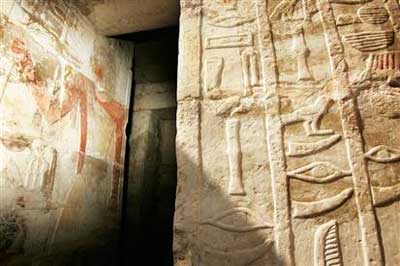
It appears that ancient Egypt did more than just worry about their hair and clothes… they also had a serious concern about their teeth! Archaeologists working at the site of ancient Saqqara discovered a tomb that was dedicated to three royal dentists over 4,200 years ago.
The dentists’ tombs are constructed out of limestone and mud brick, and each have a series of elaborately carved hieroglyphs and paintings. The tomb of the chief dentist has an inscription actually identifying his name – “Iy Mry” – as well as images depicting himself and his family carrying out ritual sacrifices, playing games together, and making offerings to the dead. A protective curse inscription above the tomb’s entrance reads: “Anyone who enters my tomb will be eaten by a crocodile and a snake.”
The tombs were identifiable as those of dentists’ due to the use of two hieroglyphs above the names of all three men, showing an eye above a tusk. The location of their burial next to the Step Pyramid would have been a place of honor for them, suggesting their practice was given a great deal of respect by the ancient Pharaohs.

The two other dentists, buried in separate tombs next to the chief dentist, also have their names spelled out in hieroglyphs: Kem Msw and Sekhem Ka. They must have all worked together during their lifetimes, which would explain why all three tombs were so close to one another.
According to ancient Egyptian medical papyri, there were actually two classes of dentists in ancient Egypt, the iryw-ibew – literally, “dentists” – which was the lower class of dentists, while the high-class dentists were known as the ir-iryw-ibew, which translates as “great of those who are concerned with teeth”. It is possible that the lower class dentists functioned much like dental hygienists in modern dentistry – there are even surviving descriptions of how to make ancient fillings and cure bad breath!
One ancient Egyptian ‘breath sweetener’ recipe reads as follows:
“Take frankincense, myrrh, cinnamon, bark and other fragrant plants, boil with honey and shape into pellets.”
…sounds like the ancient Egyptians had their own Tic-Tacs…
Want to read more?


Tomorrow: World’s oldest bugs (yes they are still icky)
Previous page | Next page
