By: The Scribe on Wednesday, March 21, 2007

The first Olympic Games were held in 776 BC in Olympia, Greece. Many events that are known from our modern Olympic games were first described in the famous Greek poem The Iliad. Held every four years in ancient Greece during July or August, a truce was called between anyone at war within the country for about a month before and after the games, to ensure the athletes and spectators could travel safely to the event.
Athletes were unpaid and trained year-round for the events in which they planned to compete. Notably, all athletes in the Greek world trained and competed in the nude! Although the Greek ideal was to gain honor through winning in the games, the victor would be crowned with an olive wreath immediately after his event, and his name recorded in stone – second and third place prizes did not exist. On the final day of the competition, victors from many events received a large amphora of olive oil, which could be valued up to five years’ worth of pay.
Much like modern Olympic victors who gain sponsorships and advertising stints after their events, ancient Greek athletes were often given financial compensation by their hometowns upon their victories; in some cases a statue of the athlete would be erected in the center of town, idolizing and making the athlete into a famous, hometown hero.
The ancient Olympics included many events which are still held in today’s modern games: discus, javelin, jumping events, footrace, wrestling, and boxing. Chariot races were also quite popular.
Want to read more?


Tomorrow: The Mayan Military
By: The Scribe on Tuesday, March 20, 2007
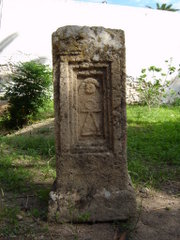 They were filled with superstitious dread, for they believed they had neglected the honors of the gods that had been established by their fathers. In their zeal to make amends for their omission, they selected 200 of the noblest children and sacrificed them publicly; and others who were under suspicion sacrificed themselves voluntarily, in a number not less than 300. (Diodorus 20.14.1-7 ff).
There is a child cemetery at the site of ancient Carthage named ‘Tophet’, which means “place of burning” or “roaster”, where around 20,000 burial urns have been excavated by archaeologists. These were buried between ca. 400 and 200 BC. Though some people have speculated that these were simply infants who died young, recent archaeological study has become more accepting of this religious ritual, since the bones found do not show any wear or evidence for disease.
The urns contain the burnt bones of children anywhere from newborn to two years old, and in some cases even fetuses. Many ancient societies in the Near East believed that there was a direct relation between sacrifice and the gods providing the people with a good harvest, which may provide an explanation for why these children were killed.
As early as 800 BC, ancient sources report that children were being sacrificed to the gods Ba’al and Tanit, and though the Carthaginians did not particularly enjoy this practice, they began to purchase children from slave traders or take the children of their own slaves for the purpose of being sacrificed. However, when times were bad, only the best would do – up to 200 children of the higher classes could be slaughtered and thrown onto the burning funeral pyre to ask the gods for help.
Various methods of sacrifice may have included: slitting the child’s throat; asphyxiating a child in its burial clothes; or for babies, simply throwing them into the fire.
Want to read more?


Tomorrow: Origins of the Olympics
By: The Scribe on Monday, March 19, 2007
 Although the ancient Romans are often remembered for their strong, competent leaders, the Roman emperor Caligula – commonly referred to as “Little Boots” – was described even by ancient writers as a ‘monster’ , and upon his death, he was so hated that the Senate destroyed all records of his rule!
Ancient sources detail the insanity of this emperor, which seemed to begin after a severe bout of illness several years into his reign. His depravities ranged from incest with three of his sisters – even going so far as to marry one of them – to multiple sexual relationships with men, as well as opening a brothel inside his own palace.
Caligula believed that he should be treated and like a god, and had a gold statue of himself set up inside a temple. This was dressed up each day in the same clothes that he would be wearing – which was typically royal purple, of course. This lust for power also caused him to elect his own horse to a position within the Senate!
Possibly one of the strangest things Caligula did during his reign was to attempt an ‘invasion of Britain’ – not an odd venture in itself, for Britain was a prized territory that not even the famous Julius Caesar had been able to conquer years before! So, Caligula gathered his army and set sail for the British shores… however, when they arrived there, Caligula had his soldiers disembark from the ships, and… ordered them to gather seashells. After a few hours, he told them to get back on the ships, and they returned to Rome, where Caligula presented the Senate with his prized ‘booty’ from conquering the British isles!
Caligula also had many, many people executed without reason during his reign, in many cases simply because he wanted to acquire their money and land. Not surprisingly, he was also extremely paranoid about potential conspiracies against him, and sometimes would hide when guests came to the palace and make strange noises, causing them to become flustered and leave. This paranoia did not save him, however, because after four years of his reign, he was assassinated outside of a theatre, along with his wife and baby daughter, whose head was smashed against a wall.
Want to Read More?


Tomorrow: Learn about child sacrifice in Ancient Carthage.
