By: The Scribe on Sunday, March 25, 2007
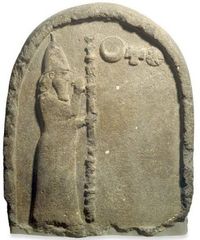 The last king of Babylon, Nabonidus was a monarch who truly wished that he had been born into another family – he simply was not interested in the job. Passionate about the ancient history of his own time, Nabonidus had a reign characterized by a lack of interest in the politics of his own kingdom, as well as the rejection of the traditional Neo-Babylonian religious practices.
A scholar and a recluse, Nabonidus decided that instead of worshiping Marduk, he would build a temple to the moon god Sin, and give his mother and daughter the jobs of temple priestesses… after which he went into self-imposed exile at the Oasis of Tema in the Arabian desert, making himself absent for about 10 years from the city he was supposed to be ruling!
According to writings in the Dead Sea scrolls, the accounts in the Hebrew scriptures which suggest that the previous king of Babylon, Nebuchadnezzar, was mentally unstable, may have in fact been referring to Nabonidus, whose reign followed that of Nebuchadnezzar. In the Hebrew scriptures, the tale talks of the king “imagining he was a goat” and that he “ate grass with the cattle”, after being cursed by God for not following Him. However, this may have been a reflection of Nabonidus’ refusal to conform to the traditional Babylonian religious practices, and perhaps somewhat reflective of his demeanor after his rather lengthy seclusion in the middle of the desert – alone… in the sun… – for so many years…
Indeed, upon hearing reports of the Persian army encroaching upon Babylon, Nabonidus returned to the city, but it was too late. Babylon was sacked and conquered in 539 BC by the Persians and their famed leader, Cyrus the Great.
Want to read more?

Tomorrow: All about Otzi
By: The Scribe on Saturday, March 24, 2007

Built in the 12th century for
King Suryavarman II of the
Khmer Empire, Angkor Wat was a Cambodian temple to the Hindu god Vishnu, and has been described as a rival to the splendor of the ancient temples in Greece and Rome. It was designed to reflect the home of the gods in Hindu mythology, containing a moat to represent the ‘cosmic ocean’, and an outer wall 3.6 km long that surrounds the temple complex.
In the middle of the temple, there is a ‘quincunx’ of towers – that is, five towers to represent the five mountains of the gods. There was extensive bas-relief decoration in three temple galleries and around the walls, though much of it has now been cut away and sold on the black antiquities market, making the interpretation of the scenes much more complex.The remaining panels we have depict various scenes from Hindu mythology, such as those from the Sanskrit epic poems Ramayana and the Mahabharata. Other panels show battle scenes, historical scenes of the king, as well as images of the 37 heavens and 32 hells of Hindu mythology. One of the most impressive features of the complex is also a causeway, leading to the enormous entrance, along which are balustrades in the shape of giant serpents. These were likely intended to be representations of the divine nature of fertility.
Want to read more?


Tomorrow: The Babylonian Goat King
By: The Scribe on Friday, March 23, 2007
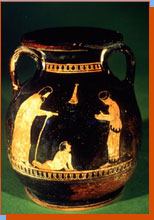 Hippocrates, a doctor in ancient Greece who has often been referred to as “the father of medicine”, after his death left a great deal of writings concerning women’s health, including the procedures and complications arising from an unwanted pregnancy.
Abortion in ancient Greece was not common, simply for the fact that it was highly unlikely that the mother would survive the abortive procedure – it is estimated that about one in ten women would live through an abortion. Indeed, speculation on the methods of abortion are numerous: pressure on the woman’s stomach, riding in a cart on bumpy roads, herbal supplements, or the most dangerous method – inserting a sharp knife or rod into the womb, killing the baby immediately.
Although infanticide was technically legal, a more acceptable recourse was to simply expose the baby at birth. Exposure was more common for female children; the child would generally be wrapped up and placed somewhere outside of the city, perhaps in a field or even in a back alley. Though this would typically result in the child’s death through exposure to the elements, anyone who found an exposed child was permitted to keep it and raise it as their own, though in many cases these children would be raised as slaves. Of course, there was always the option of making some money off the birth – even a noble-born child could be sold into slavery at any time.
Want to read more?


Tomorrow: All about Angkor Wat!
By: The Scribe on Thursday, March 22, 2007
 The Mayans were familiar with tactical warfare throughout their 2,000 year history, though unlike most ancient civilizations, the use of horses and chariots was not a part of Mayan military technique. Most Mayan weapons were items that could be used from a distance, that would allow soldiers to take advantage of the surrounding landscape’s natural forests for concealment.
Weapons used by the Mayans included: the bow and arrow, blowguns, spears, axes, knives with blades of volcanic glass , and spear-throwing slings called ‘atatls’.
Helmets were not common, and most armor was simply tight-woven cotton, with shields made of with animal skin, reed matting, or carved wood.
Barricades and trenches were popular devices in Mayan warfare, and armies had an elaborate signaling system using whistles and drums. Indeed, much of the Mayan system of warfare was based on the element of intimidation and surprise – the war chieftains are known from wall paintings to have dressed in elaborate animal-inspired robes and headdresses; painting one’s body with religious insignia was also common before battle.
Unfortunately for their enemies, the Mayans were keen on taking prisoners… for the express purpose of sacrificing them on a temple altar, in front of the entire tribe. The belief was that by eating the heart of an enemy warrior, you could gain a portion of that warrior’s strength.
Tomorrow: Abortion early in Greek history
Previous page | Next page
