By: The Scribe on Thursday, March 29, 2007

In the years following Otiz’s recovery from a glacier in the Otztal Alps, seven people connected in some way with the mummy’s discovery and research perished under allegedly “mysterious circumstances”. Although likely influenced by the media’s infatuation with the ‘Curse of the Pharaohs’, it is curious to note that four of these deaths were the result of violent accidents…
1.) Dr. Rainer Henn, 64: a forensic pathologist, Dr. Henn was the first victim of the ‘curse’. He was the head of the forensic team that examined Otzi’s body, and once picked up the cadaver with his bare hands to place it in a body bag. His death came as a result of a head-on collision with another vehicle in 1992… while he was driving to a conference where he was scheduled to present new research on Otzi.
2.) Kurt Fritz: shortly after Henn’s death, the second victim was an experienced mountain climber who had led Henn and his team to the iceman’s body. He was the only member of his party to be stuck by falling rocks during an avalanche in a region he was supposedly familiar with.
3.) Rainer Hoelzl, 47: the third victim, Hoelzl was an Austrian journalist who had filmed an exclusive documentary of the body’s removal from the ice, which was broadcast internationally. A few months later, he developed a mysterious illness – speculated to have been a brain tumor – and perished in extreme pain shortly thereafter.
4.) Helmut Simon, 67: a German tourist, it was Mr. Simon who had been hiking through the alps with his wife when he happened upon Otzi’s body in 1991. He returned to the region on an unaccompanied hike in 2004, and when he did not return as scheduled, rescue teams were dispatched… only to find that the weather had shifted suddenly to blizzard conditions, causing Simon to fall 100 metres into a deep ravine. His body was found eight days later, covered in ice much like the mummy.
5.) Dieter Warnecke, 45: head of the mountain rescue team that searched for Simon, Warnecke died of a heart attack – although according to his family, he was in perfect health. What is more, this occurred less than an hour after Simon’s burial.
6.) Konrad Spindler, 66: Spindler was the leading expert on Otzi before his death. Spindler suffered from a pre-existing chronic condition known as amyotrophic lateral sclerosis, and it was in 2005 that complications with the condition arose which claimed his life. Before his death, he was quoted as being dismissive of the ‘Otzi’s curse’ theory, saying: “I think it’s a load of rubbish. It is all a media hype. The next thing you will be saying I will be next.”
7.) Dr. Tom Loy, 63: Dr. Loy died just prior to completing a book about Otzi, and had also on several occasions been in close physical contact with the mummy. His death came as a surprise to his family, though there is a possibility that Loy may have suffered from a pre-existing medical condition.

While the concept of cursed mummies is indeed intriguing, it is also worth noting that these deaths only totaled seven, even though there were hundreds of other individuals involved with Otzi’s discovery and the subsequent research on the body and associated artifacts.
Want to read more?


Tomorrow: Girls gone wild…in ancient Egypt??
By: The Scribe on Wednesday, March 28, 2007
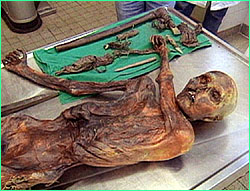 Although it was originally believed that Otzi the Iceman, Europe’s oldest known mummy, was ritually sacrificed by his people to appease the gods, further forensic analysis on the body has revealed that, in fact, ‘Frozen Fritz’ may have been the victim of an ancient murder!
A small tear on Otzi’s coat matched the shape of an arrowhead found lodged in his shoulder, suggesting that he may have bled to death after a confrontation with another individual, possibly from a competing tribe. However, Professor Annaluisa Pedrotti, from Trento University in Italy believes otherwise – according to her research, the type of arrowhead found in Otzi’s shoulder is known only from a very specific area in the southern part of the alps, suggesting that the attacker may have actually been one of his own people.
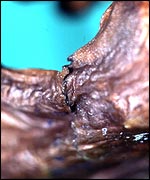 In addition, research done on the body in 2002 revealed a deep wound on Otzi’s right hand – cut down to the bone. Because his gear was found neatly arranged in the ice nearby, it appears that Otzi may have sat down to rest after the conflict and, weakened by blood loss, died shortly thereafter.
Unfortunately for Otzi, even if he had been able to avoid his fatal confrontation, he would have likely died in the near future regardless. At 46 years old, ‘Frozen Fritz’ already suffered from intestinal cancer as well as an intestinal parasite known as whipworm. It is thought that perhaps the 52 tattoos found all over his body – consisting of various lines and dots – were the results of a type of acupuncture, perhaps in an attempt to alleviate his suffering.
Tomorrow: Otzi’s Curse…?
By: The Scribe on Tuesday, March 27, 2007
 It seems that Europe’s oldest known mummy – Otzi the Iceman, or ‘Frozen Fritz’ – was so well preserved during his 5,300 year frozen stay inside an Alpine glacier, that scientists were able to analyze the contents of his stomach and determine exactly what Fritz ate for a final meal!
Evidence from his intestinal tract revealed that shortly before his death, Fritz probably ate venison and ibex meat, an unusually rich meal for a people who normally ate very small amounts of meat from rabbit, rat or squirrel. In fact, evidence shows that he ate two meals on his journey up the slopes: for his first meal, Fritz dined on the ibex meat as well as cereals and plants, and for his second – before his death at 3,200 metres above sea level – an unusual amount of deer.
Before the latest evidence, there were speculations that Otzi had been killed as a part of some ritual sacrifice, which may have explained why the diet of his final days was superior to that of the typical hominids of the time… however, it is now known that Otzi’s death was, perhaps, not of his own accord…
 Want to read more?

 Tomorrow: Frozen Fritz’s fatal confrontation…!
By: The Scribe on Monday, March 26, 2007

Although the ancient footwear you see here may look uncomfortable, the truth is that these shoes were designed to outlast a near infinite amount of stress and wear – in fact, the ancient Europeans used these shoes to hike up the treacherous pathways of the Austrian alps… even past elevations of 10,500 feet.Europe’s oldest known mummy, Otzi the Iceman (or more affectionately known as ‘
Frozen Fritz’), was discovered in a glacier of the Otztal Alps between the Austrian and Italian border, and was quite literally still wearing his shoes.
These wide, waterproof shoes seem to have been designed specifically for walking across snow, and though some have speculated that they may have been used as the tops of snowshoes, this remains under debate. The outer layer of the shoes was made of deer and bearskin, while inside was sewn a tree-bark netting. To keep the feet warm, grass was placed around the foot, forming a kind of ‘ancient sock’. In fact, these shoes were even recreated and tested by a Czech shoe expert named Petr Hlavacek, who hiked up to 8,200 feet – more than 25 miles in frigid, mountainous Alpine conditions – and only stopped due to personal reasons of recent surgery! In fact, the shoes functioned so well – and so much better than modern outdoor footwear – that these 5,300 year old pieces of footwear are now being studied for commercial production.
Want to read more?
Tomorrow: The Iceman’s intestines reveal his final meal!
