By: The Scribe on Friday, November 9, 2012
Okay, so maybe they weren’t technically naturopaths (in any sense of the word, really)… but a cave in northern Spain that some time ago yielded evidence that historians interpreted as suggesting some Neanderthals were brain-eating cannibals now shows evidence that, well, these early people used herbal remedies and ate all their greens.
 A new study done on the skeletal remains from the cave site of El Sidron in Asturias showed chemical and food traces left on the teeth of five individuals. Microscopic plant starch granules were found in tartar samples from the 50,000 year old teeth, and the cracks in the granules apparently indicated that the plants were roasted before consumption (and possibly that the Neanderthals really needed to floss after eating).
According to the dental investigation, starch and carbohydrates in the tooth tartar reveal that Neanderthals ate a considerable amount and wide variety of plants. The researchers were also surprised to find very few traces of meat-associated proteins.
And if it wasn’t enough to learn that our ancient ancestors would probably shop at Whole Foods instead of heading to a butcher shop, a team led by archaeologist Karen Hardy of Catalan Institution for Research and Advanced Studies in Barcelona found that these folks were also giving themselves doses of medicinal plants.
Things like yarrow and camomile were a part of their regular diet (the Neanderthals, not the research team), both plants with little nutritional value but well known for their natural medicinal properties.
“We know that Neanderthals would find these plants bitter, so it is likely these plants must have been selected for reasons other than taste. It fits in well with the behavioural pattern of self-medication by today’s primates, and indeed many other animals,” Hardy said. “Camomile is very well known as a herbal treatment for nerves and stress, and for digestive disorders, while yarrow is used to treat colds and fevers and works as an antiseptic.”
The findings add to a growing picture of Neanderthals as plant-loving hippies—er, people—and it’s unlikely that the Spanish population studied was an anomaly, according to researchers. Even more interesting, is that these findings question the established thought of Neanderthals as inflexible in their dietary preferences, a reason often cited for modern humans’ ability to dominate the competitive landscape for food resources.
By: The Scribe on Monday, October 29, 2012
How’d you like to be the person rooting through 2,000-year-old bags of poop? While it may sound distasteful and kind of disgusting, a research team from the University of Oxford begs to differ: “There’s absolutely no scent,” says Herculaneum Conservation Project director Andrew Wallace-Hadrill, “It’s exactly like earth compost.”
Around ten tons of ancient poop was unearthed and bagged from a cesspit in the ancient Roman town of Herculaneum, and dates back to about 79 AD. This is the same year that Mount Vesuvius erupted, burying both Herculaneum and its more famous neighbour Pompeii.
 What’s the point of poop? Studying the excrement from an ancient town can reveal a lot about the people, their diet, and their way of life—and it’s not just poop, for that matter. It wasn’t uncommon for Romans to toss other bits of garbage into their sewers too. Refuse like animal bones, shell fragments, and seeds or seed casings have led researchers to conclude that the residents of Herculaneum ate a well-rounded, diverse diet, including fish, mollusk, chicken, olive, fig, and fennel.
Wallace-Hadrill also added that “it’s a jolly good diet—any doctor would recommend it.”
The importance of understanding what the typical Roman ate can’t be overstated, because while much is known about the delicacies eaten by the Roman elite, we understand less about the “everyday” Roman.
What else did excavators find in the sewer? Things like coins, gemstones, jewelry, and more generic items like broken pottery and lamps.
But that’s not all—in the future, deeper analysis of the poop could show what kinds of diseases or parasites ancient Romans were susceptible to or were battling at this period in history. And since only 77 of the 774 bags of poop have been opened and examined so far, who knows what other secrets the waste might hold!
It certainly gives a new meaning to the phrase “pooping gold”…!
By: The Scribe on Friday, October 26, 2012
Archaeologists have recently uncovered the remains of a Mayan warrior queen in Guatemala, at the site of El Peru-Waka, an ancient city under excavation by Washington University. Excavations led by archaeologist David Freidel identified a tomb in the ruins of the city’s main pyramid temple, attributing it as likely belonging to military ruler Lady K’abel of the Wak—or “Centipede Kingdom”—between 672-692 A.D.
The body buried inside the tomb held a variety of numerous offerings, such as jade jewelry, stone figures, and ceramic vessels. Among those, the most important item found was a small alabaster jar carved to resemble a conch shell. The carving also includes a head and arms of an old woman, which appear to emerge from inside the shell.
The back of the alabaster jar holds distinct Mayan hieroglyphs that read “Lady Snake Lord” and “Lady Water Lily Hand,” both names which are thought to reference Lady K’abel. This military ruler governed with her husband, K’inich Bahlam, while her official title of “Kaloomte” translates as “supreme warrior”… showing that while she wasn’t the king, she actually had more power than he did in many affairs!
The skeleton itself, found within the tomb, wasn’t in the greatest condition, making it difficult for excavators to determine the gender and age of the individual. However, the features of the skull are distinct and resemble the well-recognized carved ancient portraits of the warrior queen, which is what led the team to name this as her tomb.
Queens of El Peru-Waka also wore very specific jewelry to denote their station—shells worn at girdle ornaments, for example—and this body’s torso held a red spiny oyster shell.
Unfortunately for the queen, the Wak kingdom eventually collapsed, but during its height there were numerous public plazas, temple pyramids, palaces, and many homes to house the large population.
Photo Credit: Photograph by El Peru Wake Regional Archaeological Project
By: The Scribe on Wednesday, June 13, 2012
Ramses II, more popularly known as Ramses the Great, was not one to rest on the laurels of such a gaudy title. As the man known to be the greatest pharaoh in Egyptian history, he earned not only a pretty nifty nickname, but also enjoyed the- ahem- “spoils” of such a position, having eight royal wives over his long life but as many as 200 concubines.
Somehow, even with all of those ladies in his life, Ramses the Great actually found time to rule over his kingdom. He did so for longer than any other Egyptian pharaoh, as he ascended to the throne in his early 20s and lived to be either 90 or 91 years old, depending on which scholar you ask. Ramses’ reign was so long that it was not his first son that would eventually take over for him, but his thirteenth, Mereneptah.
In fact, his long list of royal wives was not so much due to the fact that Ramses was a ladies’ man and more of a simple reality for a person who lived several decades longer than many people would back in ancient Egypt. Ramses the Great actually fathered over 110 children, not counting the “unofficial” children (to put it nicely) that he undoubtedly fathered with all of those concubines.
Aside from having enough children with different women to make an NBA All-Star blush, Ramses also was a part of many other historical events, possibly the most important of which was the second battle of Kadesh.
During a battle which Ramses was highly praised for (he embellished a bit on the outcome to his subjects), Ramses actually had to settle for a draw, which led to the historic agreement. Over 5,000 chariots and 10,000 soldiers fought in the huge battle in what is now Jordan, and though Ramses would prefer that we remember it as a dominant victory for his charges, Ramses still managed to set up the first recorded peace treaty in history, which is quite a groundbreaking accomplishment in its own right.
As much as Ramses wanted to be known as a great leader on the battlefield, his real passion seemed to be in architecture, as some of his works (most famously The Great Temples at Abu Simbel) astonish visitors to this day with their majesty and scope. Ramses’ signature was the large scale of his monuments and temples, as he was always concerned with ensuring that his legacy would be secure for thousands of years to come.
Unfortunately, when Ramses passed away after about 90 years of life, the riches and stature that he had helped Egypt gain could not last long without him. None of the pharaohs that followed him approached his greatness, and the Egyptian empire fell not even 150 years after the passing of Ramses the Great. Today, his mummy can be found in the Egyptian Museum in Cairo.
Previous page | Next page
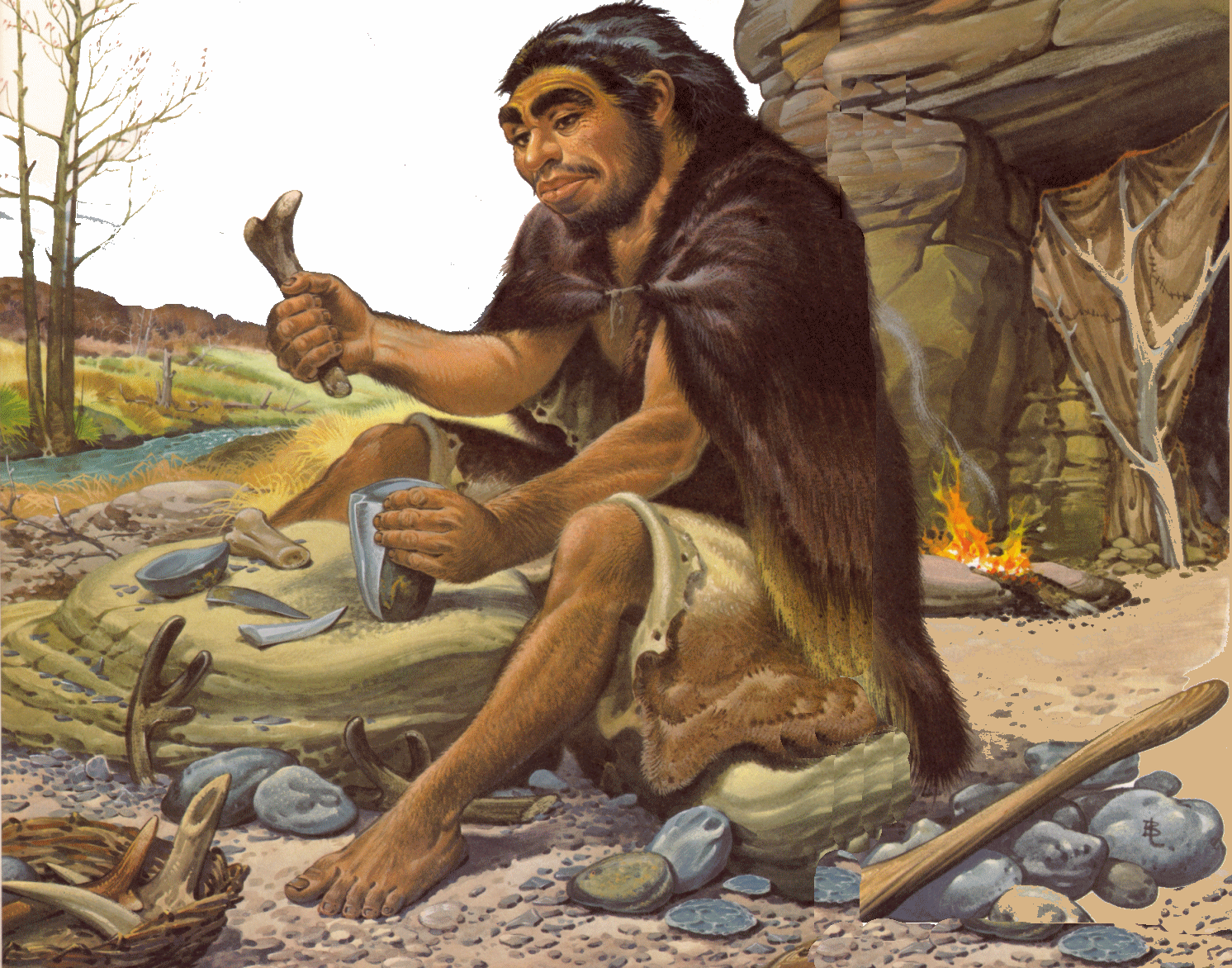 A new study done on the skeletal remains from the cave site of El Sidron in Asturias showed chemical and food traces left on the teeth of five individuals. Microscopic plant starch granules were found in tartar samples from the 50,000 year old teeth, and the cracks in the granules apparently indicated that the plants were roasted before consumption (and possibly that the Neanderthals really needed to floss after eating).

