By: The Scribe on Monday, June 11, 2012
Even by today’s standards, the love affair of Mark Antony and Cleopatra VII was pretty scandalous. Queen Cleopatra of Egypt had already had relations with Julius Caesar in a political power move that solidified her status as Egypt’s leader and gave her a son, cleverly named Caesarion.
However, when Caesar was assassinated years later, neither Cleopatra nor Roman triumvirate member Mark Antony were very pleased with the ascension of Caesar’s legal heir, Octavian. Further making family get-togethers awkward was Antony’s decision to abandon his wife, Octavia Minor, who was Octavian’s sister. He left Octavia Minor in favor of the infamous charms of Cleopatra, becoming something of a stepfather to Caesar’s son with the Egyptian beauty in the process.
This did not go over well in Rome, where not only did Octavian probably not like his sister being kicked to the curb, but politicians worried that Antony’s newfound unity with Cleopatra (and thereby, Egypt) would be a threat to the Roman Republic.
See, Antony may not have been heir to the throne, but he was a famous military leader and had the loyalty of many of Caesar’s veteran soldiers. In fact, leading up to the Battle of Actium, Antony’s military might equaled that of Octavian. The final slap in the face was when Antony unsuccessfully tried to lobby for Caesar and Cleopatra’s son, Caesarion, to take the throne instead of Octavian.
Things escalated, as they have a way of doing in these types of family dramas, and war was declared. The Battle of Actium was the decisive scrap between the two forces, as Antony’s large warships were outmaneuvered by Octavian’s smaller vessels. Also, Antony’s ships were undermanned due to a nasty outbreak of malaria preceding the battle. Finally, Quintus Dellius, one of Antony’s best generals, defected to Octavian’s side before the battle and gave away Antony’s strategies.
The sea battle turned out to be a disaster for Antony, and afterward many of his soldiers deserted him. Unfortunately, that wasn’t even the worst thing to happen to the famous loverboy, as he got some bad intel that claimed Cleopatra had been captured, and thus decided to end his own life in a Shakespearean twist. Even his suicide attempt (via stabbing himself with a knife) didn’t work out that well, and he had time to be taken to Cleopatra and die in her arms.
Cleopatra obviously did not take this development well, and she tried to work her charm one more time by attempting to arouse the pity of Octavian. She was not successful, and she ended up committing suicide as well, famously doing so by coaxing a poisonous asp to bite her. To add insult to injury, Cleopatra’s son with Caesar, Caesarion was killed under Octavian’s orders later on that year, allowing Octavian to know that he had vanquished all of his challengers in one fell swoop.
With these events, not only did the long line of Egyptian pharaohs end, but the Roman Republic became the Roman Empire. If there was any good to come out of it in terms of Marc Antony and Cleopatra’s doomed romance, it was that their three children together were spared from the vengeance of Octavian and raised by Antony’s spurned wife, Octavia Minor. Obviously, she did not carry a grudge as well as her brother.
By: The Scribe on Wednesday, May 2, 2012
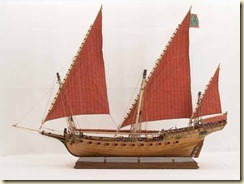 If you were a trader along the Mediterranean coast between the 16th and 19th centuries, your ship of choice just might have been a long sailing vessel commonly known as a xebec. Built specifically to navigate the waters and coastline of the Mediterranean Sea, xebecs were known for their ability to reach high speeds and their manoeuvrability. This was beneficial for two reasons: Faster merchandise transportation and, for the corsairs who favored the xebec design and speed, an ability to outpace victims or enemies.
Early xebec ships were outfitted with just two masts, but as the design progressed, xebecs became more easily recognized by their standard three-mast structure. The ships were long, designed for speed, with an overhanging, long bowsprit.
The types of sails used depended on the period of use. While traditionally the ships used lateen sails, later xebec designs included square sails on the foremast and lateen sails on the other, also known as a polacre-xebec.
As for the Mediterranean corsairs, they made their own adjustments to the ships, to better outfit them for plundering ships and seizing merchandise from other xebecs! Instead of relying simply on sails, these xebecs were outfitted with oars or sweeps, allowing the ships to come alongside other vessels in calm waters. The corsair xebecs, regardless of their narrow floor plan, would also carry 300-400 men, as well as nearly 30 guns in a range of sizes.
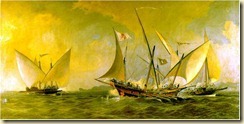
Though in early days they were referred to as a “throwback” to galley ships, xebecs could certainly hold their own, and lasted for several centuries as the ship of choice for traders and plundering corsairs alike!
By: The Scribe on Wednesday, April 25, 2012
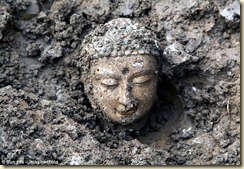 How’d you like to be the archaeologist responsible for finding over 3,000 Buddha heads & statues on your excavation? Or part of the team that has to put the thousands of broken ones back together?
As daunting as the task sounds, this discovery in Handan, China, is so exciting that doubtless the archaeological team from the Chinese Academy of Social Sciences doesn’t mind one bit. The discovery of the Buddha statues is thought to be the largest since 1949, when the People’s Republic of China was founded.
While many of the statues are broken, the majority are made from limestone and white marble, range from eight inches to several feet long, and are believed to be around 1,500 years old, dating back to 534-577 A.D. (Northern Qi / Eastern Wei Dynasties). They were found outside of the ancient capital city Ye, and one early theory is that the statues were buried after the fall of the Northern Qi dynasty, during a period where the rulers attempted to purge Buddhism from the country.
 But rough treatment of Buddhist art wasn’t completely typical of the period, as other sites appear to contain respectful statue burials. Katherine Tsiang, director of the Center for the Art of East Asia (University of Chicago), commented that “it may have been that some of the ruins and broken sculptures from the past were gathered from old temple sites and buried in a pit… in other sites, there are inscriptions that suggest that old damaged sculptures were not just dumped in a pit, but respectfully buried in an orderly way.”
By: The Scribe on Thursday, April 12, 2012
 That’s right—Kordax of DC Comics fame, while possessing a cool name and a backstory based on pseudo-Ancient-Greek history (er, he is Atlantean, after all), was not originally a comic book character.
Oh my, the shock!
No, in fact, the term kordax refers to something completely different… something which may make you look a little differently upon Aquaman’s ancestor the next time you pick up a copy of The Atlantis Chronicles.
The kordax, in Ancient Greek history, was a dance performed by men during comedic plays, such as those written by playwright Aristophanes.
The dance itself was… less of a piece of “choreographed movement” than other Greek dances performed by choruses. Those other dances were taught to young soldiers as part of their military training in formation and strategic movement. The kordax? Well, it was more like… drunken frat party carousing.
Scholars have referred to the kordax as “lascivious”, “vulgar”, “obscene”, and “lewd”. There is some debate over whether the dance had received this kind of connotation during the 6th-century when it was performed, or whether that’s a more recent development. Either way, the depictions of the dance on Ancient Greek vases show men with certain “enhancements” in “unique” poses (Scribe’s note: We’re trying to keep this family friendly, here…) that are believed to be artistic depictions of the men in costume and performing the kordax.
 There are also some who believe the kordax was a masked solo performance, which makes it very unlike the large-group chorus dances performed during tragedies and other plays. From what scholars can interpret based on artistic and written information, it was a vigorous, acrobatic dance that relied mostly on leg movements, with padding placed around the belly and buttocks (ie. the “enhancements” previously mentioned…).
It’s thought to have originated as a fertility dance, which makes an odd sort of sense, considering the ties of comedy to Dionysus, drinking, and grapes (which were all symbolic of fertility in one way or another).
And while we don’t have Ancient Greek YouTube videos to show us exactly how the dance was done, at least we have DC Comics, who likely didn’t expect anyone to put the originally meaning of “kordax” together with their character’s name… talk about an awkward moment, hmm?
Previous page | Next page