By: The Scribe on Tuesday, April 3, 2012
 Picture, if you will, a ship full of fierce, angry Vikings. They’ve spent countless days at sea, and they’re ready for some serious pillaging. They drop anchor, heave their axes, and burst upon the land with a wave of destruction that gains them a fearsome reputation for generations to come…
…and as the men sweep through villages and plunder women and livestock, another invader quietly slips down the ropes of the docked ship, or hides in sacks and crates until reaching the shore, where they creep off into dark corners or small holes, infiltrating the land in a way only they know how.
Ah, yes. Rodents. Mice, in particular. Perhaps the cleverest of invaders, or we might say in this case, colonizers. The mice didn’t just arrive with the Vikings to eat food and take over land, but rather, they looked around, thought the place seemed like a decent enough neighborhood to raise kids, and stuck around.
Between the late 8th and mid-10th centuries AD, Viking invaders took over land and settled their own people in many regions, including France, Scotland, England, Ireland, Iceland, Greenland, and Newfoundland. While house mice are known to have lived alongside humans from as early as 8,000 B.C. in the Ancient Near East, they evidently did more than that—they traveled and moved with humans at the same time.
To learn this, scientists compared the DNA of modern mice with that of mouse remains found on archaeological sites at these Viking-settled locations. It turns out that the mice hitched a ride on Viking ships from Norway or the northern British Isles (which were settled early by Vikings). DNA samples of ancient Viking house mice were found at nine sites in Iceland and several in Greenland, though surprisingly none seem to have made it over to Newfoundland.
It’s thought that the mice hid in hay bales and other crates of food supplies.
 The study’s leader, Dr. Eleanor Jones (University of York and Uppsala University), says that "human settlement history over the last 1,000 years is reflected in the genetic sequence of mouse mitochondrial DNA. We can match the pattern of human populations to that of the house mice." In other words? House mice did just as much raping and plundering of the land as the Vikings did, “mirroring” their invasions!
However, the Viking mice in Greenland were eventually ousted by a Danish mouse species (brought by other human colonisers), and are now extinct.
As for the strange lack of Viking house mice in Newfoundland? Cornell University’s Professor Jeremy Searle postulates that the “absence of traces of ancestral DNA in modern mice can be just as important. We found no evidence of house mice from the Viking period in Newfoundland. If mice did arrive in Newfoundland, then like the Vikings, their presence was fleeting and we found no genetic evidence of it."
Makes you think twice about setting down that mouse trap, hmm?
By: The Scribe on Wednesday, March 21, 2012
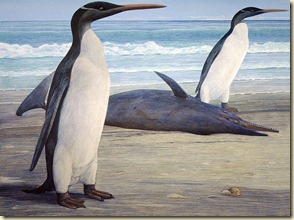 Long-time readers of The Ancient Standard may recall a post from 2007 that discussed the existence of giant penguins in Peru, but also lamented the unpublished data on even larger penguins that were thought to exist off the coast of New Zealand millions of years later.
Well, good news! Scientists have finally published their report on these giant “thinguins” that lived 25 million years ago (during the Oligocene period), based on a full skeletal reconstruction of the creature. The penguins are thought to have reached about 4.3 feet in height, which is just slightly taller than today’s tallest living emperor penguins (4 feet).
"It’s pretty exciting, we’ve got enough from three key specimens to get a pretty reliable construction of its body size," says University of Otago’s geology professor Ewan Fordyce. He and his team discovered the penguin bones 35 years ago, and recently teamed up with North Caroline State University research assistant professor Dan Ksepka to create the reconstruction.
While they used a king penguin to help build the ancient model, the main difference between ancient and modern penguins is in body composition—where today’s penguins tend to be a little more squat and round, these ancient flightless birds were much more streamlined. Their flippers were long and tapered, with narrow, spear-like beaks, and elongated midsections.
Based on the evidence, it appears that these giant New Zealand penguins lived alongside a number of other penguin species as well, some also giant and some with more familiar body types. Much like the species diversity seen today in the Falkland Islands, they were likely able to co-exist due to different food preferences (thus eliminating or reducing competition for resources).
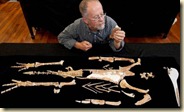 During the Prehistoric period in New Zealand, the vast majority of what we see today was submerged, leaving only small pieces of land above the water’s surface. Similar to many modern species, this ancient habitat of shallow waves, plenty of food, and defensive positioning from predators would have been ideal for these giant creatures.
The team who worked on the reconstruction and research project has given this newfound ancient species the Maori name Kairuku waitaki / Kairuku grebneffi, where kairuku roughly translates as “diver who returns with food.”
Why did the species become extinct? Likely for the same reasons it happens to other species—more aggressive predators, evolving competition for resources from other creatures, or environmental change.
The full study on this remarkable ancient species will be published in this month’s Journal of Vertebrate Paleontology (March 2012).
By: The Scribe on Wednesday, March 7, 2012
 In a cave in South Africa, archaeologists discovered the layered remains of ancient mattresses from around 77,000 years ago—and if that isn’t interesting enough, it turns out modern humans aren’t the only ones concerned about bugs between the sheets! The ancient sleeping mat’s top layer was made with insect-repelling leaves that scientists believe were used to ward off mosquitos, flies, while also killing off lice.
This discovery from the Sibudu Cave site means the bedding is 50,000 years older than anything previously found at sites around the world. The compacted layers of bedding—accumulated over time during the site’s occupation—show that it was periodically burned, likely to prevent other pests and contamination from garbage or human excretions.
It’s also entirely possible that the insect-repelling plant layer represents the first known use of plants for medicinal purposes by early humans. The leaves of the tree species in the bedding, Cryptocarya woodii, excrete a chemical that repels insects.
Lyn Wadley, study leader from Johannesburg’s University of Witwatersrand, has said that “the mattresses would’ve been a very comfortable [and] long-lasting form of bedding. Hunter-gatherers tend to live with each other in kinship groups,” so it’s likely that the beds accommodated a whole family.
 Although the ancient mattress layers only measured about 2 square meters (and 30cm high), it’s worth keeping in mind that ancient humans tended to be shorter and leaner than today’s average individual. Even if your family couldn’t fit on a space that small—and likely wouldn’t want to, considering the modern notion of “personal space” in Western society—that doesn’t mean humans who lived 77,000 years ago couldn’t sleep there or weren’t comfortable in such close quarters.
“The selection of these leaves for the construction of bedding suggests that the early inhabitants of Sibudu had an intimate knowledge of the plants surrounding the shelter, and were aware of their medicinal uses,” Wadley said. “Herbal medicines would have provided advantages for human health, and the use of insect-repelling plants adds a new dimension to our understanding of behavior 77,000 years ago.”
What were the rest of the mattress layers made of? Various collected grasses, sedges, and rushes… memory foam it wasn’t, but it sure beat sleeping on the cold ground!
By: The Scribe on Wednesday, February 29, 2012
What’s one thing all humans throughout the centuries have in common?
Well, besides that.
 How about the desire to save money? Or, to put it another way, to “get more stuff” for less cash?
In the 14th & 15th centuries, Medieval armies were looking for a way to supply weapons to their growing armies, but they needed a way to do it cheaply without compromising effectiveness in battle. The result? A new weapon commonly known as the halberd.
A halberd, also called a halbert or Swiss voulge, is a variety of “pole weapon” that requires two hands to wield. The blade of the weapon is mounted on a 5-6 foot shaft, with an additional long, pointed blade protruding from the top. The two-sided blade is axe-like on the front, and over time the design was refined in on order to better fend off approaching cavalry in battle.
On the opposite side of the axe-blade, a sharp hook was added that could be used to snare men on horseback and pull them to the ground. The top part of the weapon shaft was also reinforced with metal, to prevent the halberd from being easily sliced apart by swords.
As a result, the halberd became the weapon of choice for Swiss armies in the 14th & 15th centuries, and was quickly imitated by German armies as the weapon’s effectiveness became apparent. It was only when gunpowder warfare became more prominent in European armies—adding more musketeers and arquebuskiers to the front lines—that the halberd found use as a defensive weapon during reloads.
 Though the halberd fell into disuse over time, low-ranking European infantrymen carried halberds from the 16th to 18th centuries—and while these Medieval weapons are of course not used in modern warfare, they can be seen in one place specifically… they’re still used as ceremonial weapons by the Vatican’s Swiss Guard!
One more interesting halberd fact? They were a highly effective means of execution…
Previous page | Next page
 Picture, if you will, a ship full of fierce, angry Vikings. They’ve spent countless days at sea, and they’re ready for some serious pillaging. They drop anchor, heave their axes, and burst upon the land with a wave of destruction that gains them a fearsome reputation for generations to come…
 The study’s leader, Dr. Eleanor Jones (University of York and Uppsala University), says that "human settlement history over the last 1,000 years is reflected in the genetic sequence of mouse mitochondrial DNA. We can match the pattern of human populations to that of the house mice." In other words? House mice did just as much raping and plundering of the land as the Vikings did, “mirroring” their invasions!


