By: The Scribe on Wednesday, February 22, 2012
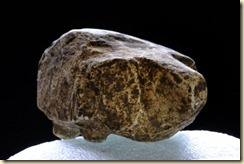 They just don’t make kids’ toys like they used to. Nowadays, head into any dollar store, and you can pick up an assortment of “Made in China” toys that’ll last for about 5 minutes at the hands of any active toddler. Want a toy that actually lasts? Turns out your kids were born in the wrong millennium!
In 2008, archaeologists working at the site of Stonehenge in Britain uncovered a child burial containing a variety of items, such as a pottery vessel (which may have contained food provisions for the child in the afterlife), and most remarkably, a carved chalk toy shaped like an animal.
The grave was tentatively dated between 800 B.C. and 20 B.C., and is considered a very important discovery in British pre-history. The discovery of any kind of representational artwork (human or animal) from this period is so rare that Joshua Pollard, the dig’s co-leader from the University of Bristol, commented it’s “almost to the extent where you get the impression there’s a bit of a taboo on making images of animals or people.”
There are two theories on what the toy represents, with one camp claiming it’s a hedgehog, and the other making their case for a pig. Mike Pitts, editor of British Archaeology magazine, expressed that “it’s without doubt a pig”, considering how common wild and domestic pigs were during the period in this region. “And once we get into historical times,” he said, “We know the pig is quite important in Celtic mythology, though not—to my knowledge—hedgehogs.”
 He also noted that once the Iron Age got underway in Britain, it wasn’t uncommon to come across figurines. However, it is more or less agreed that this little hedgehog/pig may be the earliest known toy in British history. It was likely made originally as a toy for the infant, or was crafted in memory of the child being stillborn or dying in infancy.
As for those who try to suggest that the child’s death was a result of human ritual sacrifice, Pollard reminds the curious that during this time in history, infant mortality was very high, “so there would have been a lot of natural death.” This seems to be substantiated by a second infant burial found nearby which, although it didn’t contain a toy, held the skeleton of a sheep or goat with stones piled over its head (indicating the animal had been ritually sacrificed).
Regardless of whether this ancient toy was played with or not, there’s no denying that current toy manufacturers could learn a thing or two from prehistoric toymakers about durability!
By: The Scribe on Wednesday, February 15, 2012
 Don’t panic—Jurassic Park is not imminent! However, it’s not unheard of to find ancient things encased in amber. And recently, scientists uncovered the first 20-million-year-old bat fly fossil in the scientific record.
The bat fly is a rare, ancient, bloodsucking insect, and this particular bat fly is even more remarkable due to the parasite it contains: an ancient strain of bat malaria!
The fly was discovered in a mine in the Dominican Republic by George Poinar, Jr., an expert on amber-preserved insects from Oregon State University.
While this particular preserved variety of bat fly is now extinct, bat flies do still exist today, eating an exclusive diet of bat blood. In fact, some varieties of bat flies have adapted themselves to live only on the blood of specific species of bats.
Bat flies also very rarely leave their hosts. When they choose a particular bat to feed off of, they’ll cling to its body and feed at their leisure, though they will leave to find a mate and create more bloodsucking baby flies.
When Poinar looked at the amber-encased bat fly under a microscope, he discovered that it carried a new strain of bat malaria—a parasitic disease that’s so rare, only five or six scientific papers have discussed it to this day. (Scribe’s Note: How’d you like to contract a 20-million-year-old malaria virus?)
Before this discovery, Poinar worked on extracting DNA of other insects from amber, and was credited by the late author Michael Crichton as providing inspiration for his novel Jurassic Park. Does this mean we’ll see vampire parasites flying around on the back of cloned bats or bat flies anytime soon?
“As far as I’m concerned,” says Poinar, “this specimen is so rare that we wouldn’t want to attempt to try it.”
That’s probably a good thing for all of us.
Resources: Systemic Parasitology (February 2012); Parasites and Vectors (December 2011).
By: The Scribe on Wednesday, February 8, 2012
Ah, guinea pigs. It’s thought that the Spanish Conquistadors brought the furry little rodents across the sea with them sometime during the 1500s, where they—according to previous common knowledge—frequently appeared on the plates of European aristocrats.
 However, a recent analysis of guinea pig bones found in 2007 at a home that was once part of the Spanish Empire suggests that these creatures may have actually been more companero than cena.
Analysis of the skeleton of the guinea pig, combined with chemical research on its bones and a look at Flemish paintings from this period which depict the animal, has led researchers to conclude that guinea pigs must have been domesticated at this time in Europe, and not necessarily only raised for food.
While it is still common today to raise guinea pigs for food in South America, and the pigs undoubtedly provided some occasional measure of sustenance for Europeans, there’s much more to suggest that they were cared for by both middle-class and upper-class Europeans as pets.
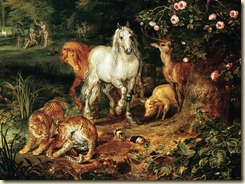 The skeleton of the guinea pig found in 2007 had no evidence of being processed as food, so researchers are quite confident that the creature was a part of the family—and therefore given its own little burial in the backyard.
Guinea pigs would have been considered “exotic” animals, due to their origins across the ocean. It’s actually rare to find guinea pig bones in the archaeological record, which is why their purpose in Europe during the 16th & 17th centuries has remained somewhat vague until this time.
It’s also worth noting that, because guinea pigs are rodents (which tend to have remarkable reproductive capabilities), it’s entirely possible that the whole situation of guinea pigs in Europe may have started with just two creatures being brought over as curiosities… and their presence, needless to say, “expanded” from there.
By: The Scribe on Wednesday, February 1, 2012
 Beaver Poison, Musquash Root, Poison Parsley… or maybe you know it by its scientific name, conium maculatum. No? How about this one: Poison Hemlock?
Ah, yes. Hemlock. The deadly plant that killed one of the world’s most famous philosophers. But how much do you really know about this ancient plant? And were you aware that it still exists today, and can be just as deadly?
Hemlock’s fame originates from one of the most famous trials in history—the trial and execution of ancient Greek philosopher Socrates in 399 BC. Accused and convicted of impiety, Socrates was sentenced to death by drinking a hemlock-based liquid. Accounts of the trial can be read in his student Plato’s dialogues and the historian Xenophon’s Apology of Socrates to the Jury. While some experts still debate how accurate these records are in terms of Socrates’ words as he died, it’s typically agreed that there’s no mistaking the accuracy of the description of how the poison acted once ingested.
Conium maculatum, or hemlock, is an herb that becomes toxic once ingested by humans or most domestic animals. The stems of the plant can grow up to two meters high, and are characterized by bunches of small, white flowers (known as umbels). The poison of the plant is a neurotoxin, which means it disrupts the function of the central nervous system, leading to respiratory failure and death. Muscular paralysis sets in at the feet & legs first, works its way up the body, and eventually paralyses the lungs & heart so that no blood or oxygen can circulate!
 The ancient Greeks knew a thing or two about this poison, because not only did they use it for execution, but some evidence has shown that they may have used it in small doses for other ailments such as arthritis, as a sedative, or to prevent or treat muscular spasms. Unfortunately, this may not always have been a successful venture, because the difference between a helpful dose and a fatal dose is very small.
Either way, when it came to executions, it certainly kept the mess down!
Previous page | Next page
 They just don’t make kids’ toys like they used to. Nowadays, head into any dollar store, and you can pick up an assortment of “Made in China” toys that’ll last for about 5 minutes at the hands of any active toddler. Want a toy that actually lasts? Turns out your kids were born in the wrong millennium!
 He also noted that once the Iron Age got underway in Britain, it wasn’t uncommon to come across figurines. However, it is more or less agreed that this little hedgehog/pig may be the earliest known toy in British history. It was likely made originally as a toy for the infant, or was crafted in memory of the child being stillborn or dying in infancy.


