By: The Scribe on Tuesday, January 24, 2012
It’s no secret that the Ancient Egyptians knew a thing or two about food—along with precious jewels, gold, and statues, they often left plenty of food behind when burying their dead. But it wasn’t all ritual offerings… in fact, the Egyptians had special concern for the animals they mummified along with people.
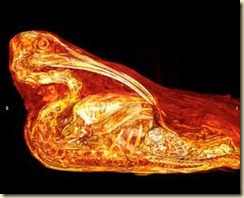 How so? Well, believing that the afterlife would require the same kinds of provisions as needed in life, they packed a delicious lunch for their animals. Or, specifically in this case, for sacrificed sacred ibis birds.
Millions of ibis mummies have been found at shrines across Egypt, where they were sacrificed to the god Thoth who represented wisdom and writing. It was only recently that PhD candidate Andrew Wade (University of Western Ontario) and colleagues used a CT scanner to look inside an ibis mummy to discover what’s inside.
It’s known that the Ancient Egyptians removed and preserved the organs not only of humans, but also of the creatures they buried—but what wasn’t previously known was that they were so concerned about the afterlife that they actually packed food into the stomachs of the sacrificed ibis birds, likely to ensure they’d thrive on “the other side.”
Wade has commented that “the ibis mummies suggest Egyptians believed that birds also travelled to the afterlife. It suggests the provision of an afterlife food source to the bird, and lends support to the idea that the viscera of ibises and humans alike were meant to continue their living function within the afterlife."
It must have been nice to know that even in death, you’d never go hungry!
Reference: Journal of Archaeological Science, DOI: 10.1016/j.jas.2012.01.003
By: The Scribe on Wednesday, January 18, 2012
There are few figures from Ancient Greek mythology that have become such a part of mainstream knowledge as the Cyclops. Stories of the one-eyed, man-eating giants have been used to scare children for thousands of years—but it’s entirely possible that the origins of this creature have more basis in reality than scientists could have ever imagined.
In 2003, archaeologists working on the island of Crete uncovered several bones, tusks, and teeth of an enormous prehistoric mammal. Previous to that, additional bones and skulls of the same creature were uncovered elsewhere on the island. The animal is believed to have been an ancestor to today’s modern elephant, but what makes this mammal so special is the single hole in the center of the skull.
 Today’s biologists have looked at the skulls and theorized that, in comparison our modern elephant, this ancient creature must have had a very pronounced trunk, much bigger than what we see today. However, to the Ancient Greeks, the skulls of these animals may have provided the foundation for their belief in ancient one-eyed monsters.
Remember, the people popularly referred to as “Ancient Greeks” (typically referencing to 5th-century Athens) had ancestors as well, and they were acutely aware of their heritage. Archaeologist Thomas Strasser from California State University has explained how the Ancient Greeks might have understood their own past: “The idea that mythology explains the natural world is an old idea, you’ll never be able to test the idea in a scientific fashion, but the ancient Greeks were farmers and would certainly come across fossil bones like this and try to explain them. With no concept of evolution, it makes sense that they would reconstruct them in their minds as giants, monsters, sphinxes, and so on.”
Scientists estimate that the Deinotherium giganteum, or “really huge, terrible beast”, stood around 15 feet tall, with 4.5 foot long tusks, making it one of the largest mammals who ever walked the Earth. They lived during the Miocene and Pliocene eras before their extinction, roaming Europe, Asia, and Africa. Much like today’s elephants, this creature was likely a strong swimmer, and would have reached Crete by swimming from Turkey during a period of lower sea levels.
As for the Ancient Greeks, they likely found the skulls and explained their existence as best they could. One of the best-known examples of Cyclops in mythology comes from Homer’s epic poem (The Odyssey) about the Trojan War hero Odysseus’ 10-year journey home after the war: When Odysseus and his men were trapped in a cave with a Cyclops—who started eating Odysseus’ men—they fooled the giant by getting him drunk, stabbing him in the eye, and sneaking out of the cave by tying themselves underneath the giant’s sheep as they were let out to pasture.
Image: Dwarf elephant skull, copyright D. Finnan/AMNH
By: The Scribe on Wednesday, January 4, 2012
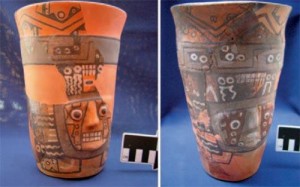
Peruvian Drinking Vessel (credit: Michael Moseley et al)
Binge drinking and arson—a crime of modern invention? Not entirely.
The Wari people of Cerro Baúl were drinking and burning things with enthusiasm in 1000 A.D., around the same time that they abandoned the town and other sites of cultural significance. Of course, the drinking and burning business isn’t as simple as it sounds—in fact, the Wari engaged in ritual binge drinking and ritual brewery burning.
It’s probably a good thing that today’s drunks don’t wander around towns burning down the breweries that produce their favorite grain-based beverages, but at Cerro Baúl, destroying their brewery was a necessary ceremonial component in the abandonment of the town.
According to the archeological evidence, there were 28 leaders who sat together in the brewery drinking pepper-spiced corn beer, a beverage very similar to chicha, a corn-based beer brewed by the Inca in modern-day Peru. After consuming copious amounts of alcohol, the Wari leaders—who were undoubtedly very much “in the bag” by this point, as it were—enthusiastically smashed their drinking vessels, preceded by setting fire to any and all surrounding flammable material. This had the consequence of leaving only the sections of stone wall standing, though these too collapsed over time.

Brewery at Cerro Baul field image (Photo by Patrick Ryan Williams, courtesy of The Field Museum)
While one might be tempted to protest that perhaps they merely had a sip or two before engaging in ritual vandalism, there is archaeological proof that indeed, the Wari leaders got rip-roaring drunk first. The remains of Cerro Baúl’s brewery revealed a capacity of around 1,800 litres per batch, with women doing the brewing. Fermentation followed, and finally the drink was spiced with pepper-tree seeds—a version of the drink reserved for nobles among the Wari.

Brewery at Cerro Baul
Based on the mug fragments, it has been determined that 12 of the participants were ‘lesser nobles’, because their drinking vessels held a smaller amount of liquid (355ml), and another four of the participants may have been senior officials or much higher on the social ladder, as their mugs contained much more elaborate iconography and held nearly 2L of beer.
And drinking wasn’t all they did—the spread was something worthy of a modern Super Bowl party, with the archaeological record showing remains of llama, deer, and a variety of fish.
Of course, the question remains: Why have a feast, get slobbering drunk, and then torch the place?
While the answer isn’t certain, it turns out that settling a town on top of a 600-meter mesa doesn’t make the best place to live. It takes a lot of time and effort to haul resources up the side of a mountain, which may have resulted in someone realizing the impracticality of building a city where no one could get to it. Good for defenses, bad for… everything else.
The ritual destruction, however, was likely a mechanism to preserve the purity of their historical living spaces—torching the brewery and subsequently other important buildings such as the temple and palace meant no one else could re-use the buildings for their own purposes or defile their sacred spaces.
And to finish the job? The Wari smashed their mugs in the fire. Of course the real question that follows is: With half the town on fire, where did they go to sleep it off?
By: The Scribe on Monday, August 8, 2011
Scientists are now finding research that the gene responsible for red hair and freckles may have actually come from Neanderthal man. It is believed that the gene could be as much as 100,000 years old and was found in Neanderthals living in Europe. They believe that the gene was passed to our Homo sapiens ancestors about 40,000 years ago. That was when our ancestors migrated to the area from Africa.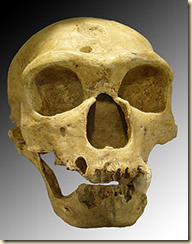
Neanderthals were taller than members of the Homo sapiens species and had much stockier builds. Their faces were larger than those of Homo sapiens ancestors and had large noses and chins and foreheads that receded.
Our ancestors, who belonged to the Cro-Magnon branch of Homo sapiens, were able to co-exist with Neanderthals for about 10,000 years. It is believed that the two species may have interbred in order for the gene to pass from one species to the next. It is the MC1R gene that is responsible for red hair and freckles. It is believed that Neanderthals that possessed the MC1R gene may actually have looked very similar to that of modern Europeans.
Having light skin was actually an evolutionary advantage for these Neanderthals. It meant that the individuals who had light skin and red hair were capable of absorbing more vitamin D from sunlight. In Europe, where there are clouds the majority of the time, this would have been a distinct advantage.
Other discoveries have been made that are changing scientists’ beliefs about Neanderthals. They were originally believed to have only rudimentary speech. Scientists and archaeologists have long thought that Neanderthals had a vocabulary of only about 70 words and that their speech was likely very guttural. New research is beginning to show that that may not have been the case. It is now theorized that Neanderthals may have had a much more sophisticated language than was originally thought.
 Archaeologists have also found painted shells in Spain that prove that Neanderthals created artwork, something that experts did not think they did. The painted shells were a form of body art or jewelry. Similar shells had been found in Africa and in the Near East and dated from 70,000 to 120,000 years ago. When they were found, they were attributed to our ancestors and not to members of the Neanderthal species. Scientists and archaeologists are now thinking that jewelry that was believed to have been created by Cro-Magnon man may have been created by Neanderthals instead.
The shells were painted with traces of mineral pigments. In some cases, tools used to paint the shells were found as well. There was no proof that the items had been painted at random as there were no traces of pigments found on other items such as food or other stone tools.
Not only was it obvious that the painting of the items was deliberate, some of the mineral pigments came from a distance away. This meant that they needed to be transported to the new area specifically for the purpose of creating artwork. Some shells were used as paint cups and others were decorated for use as body art or jewelry.
Previous page | Next page
 How so? Well, believing that the afterlife would require the same kinds of provisions as needed in life, they packed a delicious lunch for their animals. Or, specifically in this case, for sacrificed sacred ibis birds.


